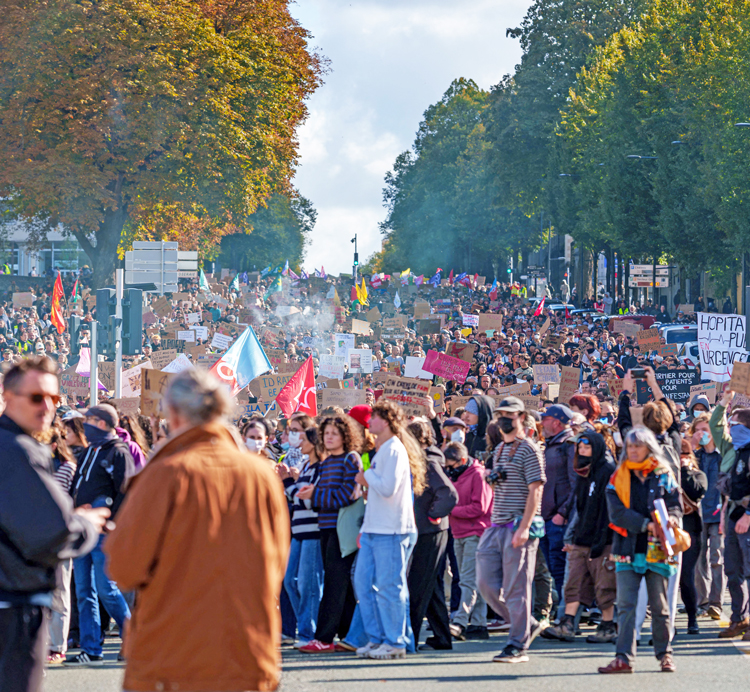
More than half a million working people in cities across France joined protests against the policies of the government of President Emmanuel Macron Oct. 17. A wave of protests by high school students against education cuts has won support from workers and farmers, who in turn have joined the students’ actions with their own demands against government assaults on their livelihoods, as the crisis of French capitalism deepens.
The big-business press played down the scope of the actions, focusing instead on rioting, looting and destruction orchestrated by middle-class radicals that took place alongside the demonstrations. Their rampage dealt blows to the fight to build solidarity with the massive union-backed protests.
The CGT, one of France’s main union federations, backed the Oct. 17 protests, calling for “higher wages and pensions, lower prices and the protection of public services that meet people’s needs.”
The police refused to authorize assemblies in Paris for the demonstration until a few hours before the start of the mass action. Then people were only allowed to gather at the Place de la Republique. Elsewhere, demonstrators were attacked by cops for holding “illegal” assemblies.
For weeks high school students held protests against government policies that have led to overcrowded classrooms, a lack of equipment and thousands of teachers’ jobs unfilled. Violent police attacks against the protests resulted in injuries to some students, spurring solidarity for their demonstrations among working people.
Veterans of the yellow vest movement joined the Oct. 17 actions in some towns. Yellow vest protests took place in 2018 and 2019, initially in rural areas protesting rising diesel taxes, before becoming a movement against the broader effects of the Macron government’s attempts to dump the capitalist crisis on workers’ backs.
“High schoolers have not been listened to for several weeks,” Arthur Leveque, a geography student told Le Monde at the Oct. 17 march in Angers in western France, just like “the yellow vests and others before them.”
French authorities said at least 550,000 participated in the Oct. 17 protests in 140 cities and towns across the country. One-fifth of the demonstrators were in Paris.
Thousands of hooded anarchists and other middle-class radicals, as well as jihadists from the suburbs, set fires, sacked stores and government offices and gave a handle to attacks by the cops and government restrictions on rights in wake of the actions. This thuggery took place in Marseille, Paris, Bordeaux, Lyon and Nice. The historic City Hall in Limoges, in central France, was gutted by fire.
The government seized on the violence to impose overnight curfews in parts of these cities and several towns in northern France. Authorities in Marseille banned demonstrations. Prime Minister Sebastien Lecornu refused to rule out declaring a state of emergency.
Unions, farmers join protests
In the industrial city of Ales in the south of France, the Oct. 17 march of 1,300 was led by a contingent of workers from the local hospital.
The Confederation Paysanne, a union of smaller farmers, denounced police violence against the high school students and organized contingents in some 20 different demonstrations. But the two largest farmers’ organizations in France, dominated by large capitalist farmers, did not support the student-initiated actions.
Farmers have also fought to defend their livelihoods in recent weeks, holding protests against fuel prices and intrusive European Union regulations. Hundreds of farmers driving tractors converged on the National Assembly in Paris Oct. 8 to protest EU budget proposals that would slash their income by 13% to 15%.
At least 2,400 people were arrested Oct. 17, one-third of them under 18 years of age. Macron said “radical far-left groups, joined by numerous criminals” had “sought to bring down the Republic.”
The actions come six months before a scheduled election to replace the president. His unpopular minority government faces growing resistance to its attempts to cut public services as it ensures government bondholders get paid. Wealthy capitalist investors are pressing the government to reduce its mushrooming debt, which is 115% of the country’s gross domestic product.
Different French political parties have sought to utilize the protests for their own electoral advantage. Marine Le Pen, leader of the right-wing National Rally, is the current front-runner in the presidential campaign. She attacked Macron, presenting herself as the only candidate who can restore order. She blamed an “alliance between politically motivated rioters and delinquents from the banlieues,” the poorer urban outskirts where much of France’s Muslim immigrant population lives, for the riots.
Jean-Luc Mélenchon — a leader of France Unbowed, a party on the left of capitalist politics — who marched in the Oct. 17 protest in Paris, has emerged as Le Pen’s main rival. Support for candidates across the traditional French bourgeois parties is waning.
Nat London in Paris contributed to this article