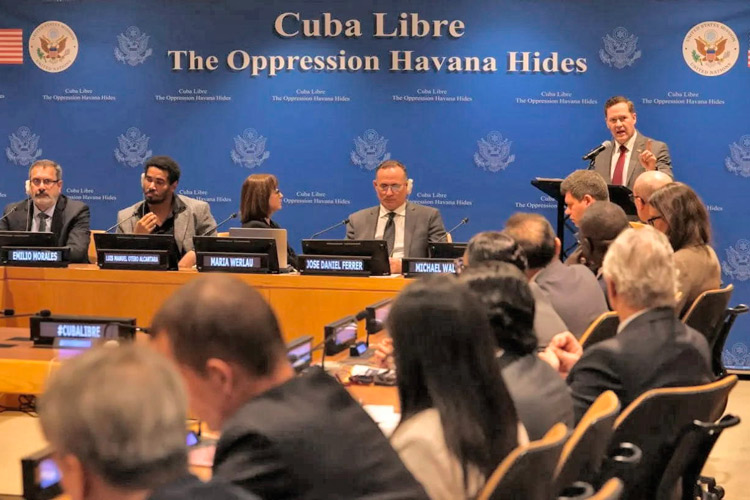
A striking report prepared by the government of Cuba detailing the U.S. government’s over six-decades-long record of attacks, sanctions and the recent oil blockade against its people will be presented and debated at a meeting of the United Nations General Assembly Oct. 27-28. It’s titled “Necessity of ending the economic, commercial and financial embargo imposed by the United States of America against Cuba.”
“During the past year, the U.S. government has stepped up its efforts to strangle and isolate the Cuban Revolution,” the report says. “Since early 2026, daily life has been marked by an almost total absence of fuel, long and distressing blackouts, widespread disruptions in the national power grid, recurring failures in water supply, severe obstacles to solid waste collection, and persistent shortages of food and medicine. At the heart of each of these hardships lies the blockade as the common cause.”
Washington — under every administration, Democratic and Republican alike — has carried out this course since the first months of the victory of the Cuban Revolution in 1959. “The majority of Cubans support Castro,” Lestor Mallory, then U.S. deputy assistant secretary of state for Inter-American affairs, wrote in a secret April 6, 1960, State Department memorandum. “It follows that every possible means should be undertaken promptly to weaken the economic life of Cuba.” To make “the greatest inroads in denying money and supplies to Cuba, to decrease monetary and real wages, to bring about hunger, desperation and overthrow of government.”
On page after page, Cuba’s report to the U.N. details the hardships Washington’s actions have imposed on the Cuban people from March 2025 to February 2026. Despite these attacks, they are determined to find ways to stand firm in defending their country’s sovereignty.
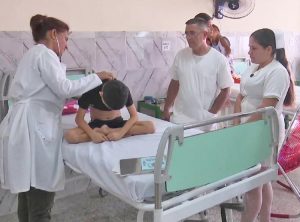
Cuba’s healthcare system, long a key gain of the socialist revolution, has been a central target of the U.S. rulers. The blockade of medical supplies, parts for medical equipment and crucially needed drugs, along with daily interruptions of electrical power, has led to a doubling of infant mortality and reduced the rate of survival from cancer for children and youth, from 85% to 65%. “Today, Cuba’s surgical waiting list stands at 100,000 patients, including 12,000 children,” the report says.
Food production and distribution has been severely affected. Cuba had 20,000 tons of food in national warehouses, but its distribution “has slowed to a crawl,” overwhelmingly due to lack of fuel for transportation. Crop yields have fallen as the daily average hours of irrigation have been reduced from 16 to two because of severe cuts in electrical power.
Yields in rice production fell to 1.9 tons per hectare in 2025, down from 4.21 tons in 2018, the report says. Cuba’s 2024-25 sugar harvest fell below 200,000 tons, the lowest production level in more than a century.
Thousands of containers filled with food, medicine and other goods bound for Cuba have been stranded across the Caribbean since two international shipping companies stopped all deliveries after Washington issued an executive order in May authorizing the freezing of assets and sanctions against companies that trade with Cuba.
Operations in hotels, banking, mining, airlines and more have been systematically cut back, as the U.S. rulers have wielded their sanctions and threats to foreign companies.
Cubans respond to attacks
After discussions organized in people’s assemblies all across the island, the Cuban government has adopted a series of sweeping measures affecting almost every aspect of the country’s economy, including property relations, economic planning and the state monopoly of foreign trade. Its goal is to revive agricultural and industrial production.
The Cuban people have responded by using their creativity to find ways to provide at least some essential services. These include initiatives by the thousands of members of the National Union of Energy and Mine Workers, who are waging a daily battle to keep the country’s electrical grid functioning. Efforts by Cuban workers organize the distribution of water to those in need and the collection of piles of accumulated trash.
Thousands of electric tricycles, many solar-powered, have sprung up to transport passengers and deliveries. Solar-powered charging stations are being set up in a growing number of cities, allowing residents to charge everything, from electric vehicles to key household devices.
Despite the damage from Washington’s punishing assault, more than 1.5 million students started the school year Sept. 1, with funding to assure children’s special needs will be met.
Ten thousand new medical students also began courses that day, determined to find a way to pursue care as widely as possible, in line with the historical record of Cuba’s socialist revolution — every person’s right to healthcare offered with human solidarity.
While transportation is still scarce, every morning 178 young students gather for classes at the National Ballet School in Havana, where rigorous dance instruction is organized, along with math, history and science classes. Over the decades, Cuba has produced dozens of internationally renowned dancers and choreographers. Classical ballet remains a celebrated part of the country’s culture. Tickets for performances there cost less than $1.
For years, the U.N. General Assembly has overwhelmingly adopted resolutions calling on Washington to end its decades-long economic war against Cuba. In 2025 the vote was 165 in favor, seven against and 12 abstentions.
In preparation for this year’s hearing, Washington has been using both offers of aid and threats to cut it off to place pressure on governments to vote “No.” But despite this pressure, Cuban Foreign Minister Bruno Rodríguez told the press in September, “Our people are confident in the overwhelming support of the world for the demand to end the blockade.”
Leading up to the vote, many groups across the country and around the world are planning actions demanding an end to Washington’s efforts to strangle the Cuban people.