
After working people in Cuba, led by Fidel Castro and the July 26 Movement, overthrew the U.S.-backed dictatorship of Fulgencio Batista on Jan. 1, 1959, the new revolutionary government that emerged took decisive measures to put the toiling majority in control of their own destiny.
For the first time landless peasants in the countryside could get land free of charge, eliminating capital’s monopoly over the land. It stopped the practice of foreclosing on working farmers for debts, and other practices of capitalist rule that had kept rural peasants trapped in economic dependency.
Along with sweeping agrarian reform, working people organized to carry out a deep social transformation. Workers and youth in city and countryside volunteered by the thousands to go into remote rural areas to teach people to read and write, eliminating illiteracy. Newly graduated doctors voluntarily deployed to mountainous areas that had never seen a physician before, drastically reducing infant mortality and the scourge of preventable diseases.
But today, the U.S. rulers are trying to strangle the Cuban people, imposing an oil blockade and escalating sanctions that severely affect farmers in planting, harvesting and the distribution of agricultural products.
The Cuban government estimates the damages caused by Washington’s systematic trade and financial embargo of the country’s agricultural sector exceeded $848 million in just one year between March 2025 and February 2026. And that’s before the oil blockade was imposed in January.
This tightening of economic sanctions comes on top of six decades of an embargo maintained by the U.S. rulers — under Democratic and Republican administrations alike — with the goal of overthrowing Cuba’s socialist revolution and the conquests working people there have made.
This includes the Cuban Revolution’s commitment to improve the standard of living of rural producers and working people as a whole. This was accomplished with conquering state power, the mightiest weapon working people can use to advance and defend their own class interests.
Working people in Cuba are currently in a titanic fight to defend the gains of the socialist revolution from the latest onslaught unleashed by the U.S. capitalist rulers, who are determined to bring capitalist exploitation back to the island.
Cuban farmers enter the fray
With the support of the government, Cuban farmers, led by the National Association of Small Farmers (ANAP), have been involved in a battle to break the country’s reliance on importing food, which drains billions in hard currency that is sorely needed for economic and social development.
Like other countries historically underdeveloped by imperialist exploitation, the price Cuba pays for imported goods far outpaces the country’s income from its exports. In Cuba’s case, this is compounded many times over by Washington’s systematic targeting of its primary sources of foreign revenue.
To combat shortages and soaring food prices, the country’s leadership has expanded incentives for farmers to grow more vegetables, grains, fruit and other crops and sell them directly on the market, without having to use state-run intermediaries. Production, however, has been hampered by the U.S. blockade, which cuts off supplies of fuel, fertilizers, pesticides and animal feed, as well as causing power outages and exorbitant diesel costs.
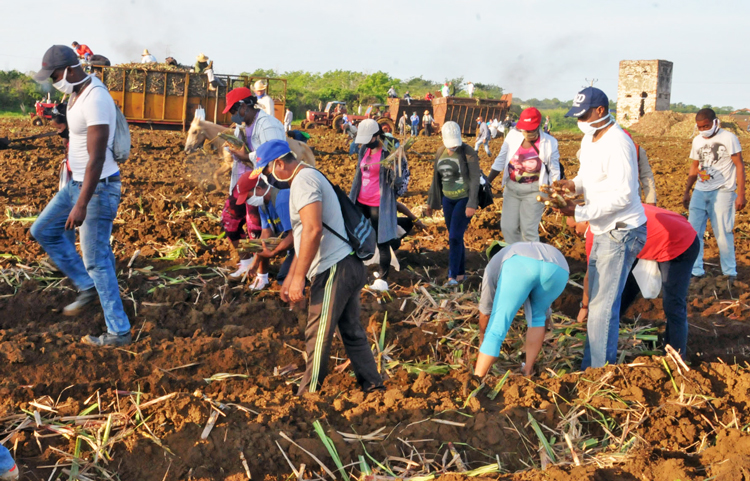
Earlier this year Cuba had to halt major portions of its sugar harvest due to the lack of fuel. The July 26 Agricultural Production Cooperative (CPA) in Abreus, in Cienfuegos province, was one of the many cooperatives affected. Its 150 members have shifted its efforts to raising cattle and producing milk to stay afloat and keep members working.
“We have had to explore several alternatives to avoid shutting down entirely,” Aliuska Moreira, a leader of the CPA, told Cuban TV last September.
A few years ago, the cooperative had set up a “mini-industry” — a small operation that processes surplus harvested food into tomato paste, canned and dried fruit and juices, providing employment for women in nearby communities. In the last two and a half years, however, production has declined due to the lack of electricity and worn-down equipment. The cooperative is now planning to build a small-scale slaughterhouse.
Many cooperatives are taking initiatives together with the local governments to meet broader social needs, drawing on farmers’ consciousness and commitment to the revolution’s conquests.
The July 26 cooperative runs a childcare center serving cooperative members and workers in the mini-industry. It also supplies the local home for the elderly with produce, as well as 15 families with special needs in a nearby settlement. “Our cooperative has always had the tradition to serve the community, it has been a principle” for us, Moreira, a leader of the CPA, told Canal Caribe on YouTube in June 2024.
“Thanks to the cooperative, I now live right next to the school,” said Yaniela Rodríguez, a teacher at the multigrade rural school there. “It was difficult for me to commute” from where I was living, “so they turned a classroom into a house for me.”
The July 26 cooperative stands out, but initiatives like theirs can be found among others of the more than 4,500 agricultural cooperatives in the country.
They are also applying for credit to invest in solar panels to power a charging station for the community.