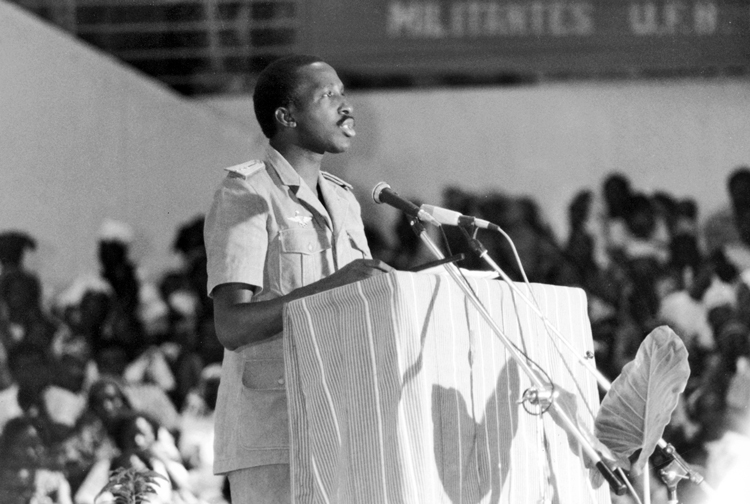
Women’s Liberation and the African Freedom Struggle by Thomas Sankara is one of Pathfinder’s Books of the Month for October. Sankara was the central leader of the popular, democratic revolution in Burkina Faso. He had been won to Marxism before leading an uprising in August 1983 in what had been the French colony of Upper Volta in West Africa. Inspired by the Cuban Revolution, he mobilized workers and peasants, women and youth to carry out deep-going social measures in one of the poorest countries in the world, as well as to extend international solidarity. He was assassinated in a counterrevolutionary coup on Oct. 15, 1987. The excerpt is from his speech to a rally of several thousand women on March 8 that year. Copyright © 2007 by Pathfinder Press. Reprinted by permission.
The revolution’s promises are already a reality for men. But for women, they are still merely a rumor. And yet the authenticity and the future of our revolution depend on women.
These are vital and essential questions, because nothing whole, nothing definitive or lasting can be accomplished in our country as long as a crucial part of ourselves is kept in this condition of subjugation — a condition imposed over the course of centuries by various systems of exploitation.
Starting now, the men and women of Burkina Faso should profoundly change their image of themselves. For they are part of a society that is not only establishing new social relations but is also provoking a cultural transformation, upsetting the relations of authority between men and women and forcing both to rethink the nature of each.
This task is formidable but necessary. It will determine our ability to bring our revolution to its full stature, unleash its full potential, and show its true meaning for the direct, natural, and necessary relations between men and women, the most natural of all relations between one human being and another. …
In other words, posing the question of women in Burkinabe? society today means posing the abolition of the system of slavery to which they have been subjected for millennia. The first step is to try to understand how this system functions, to grasp its real nature in all its subtlety, in order then to work out a line of action that can lead to women’s total emancipation.
In other words, in order to win this battle common to men and women, we must be familiar with all aspects of the woman question on a world as well as a national scale. We must understand how the struggle of Burkinabe? women today is part of the worldwide struggle of all women and, beyond that, part of the struggle for the full rehabilitation of our continent. The condition of women is therefore at the heart of the question of humanity itself, here, there, and everywhere. The question is thus universal in character. …
From the beginning of human history, man’s mastering of nature has never been accomplished with his bare hands alone. The hand with the opposable thumb is extended by the tool, which increases the hand’s power. It was thus not physical attributes alone — musculature or the capacity to give birth, for example — that determined the unequal status of men and women. Nor was technological progress as such that institutionalized this inequality. In certain cases, in certain parts of the globe, women were able to eliminate the physical difference that separated them from men.
“The revolution cannot triumph without the
genuine emancipation of women”
—Thomas Sankara
It was the transition from one form of society to another that served to institutionalize women’s inequality. …
For millennia, from the Paleolithic to the Bronze Age, relations between the sexes were, in the opinion of the most skilled paleontologists, positive and complementary in character. So it was for eight millennia. Relations were based on collaboration and interaction, in contrast to the patriarchy, where women’s exclusion is a generalized characteristic of the modern historical era.
Frederick Engels not only traced the evolution of technology but also of the historic enslavement of women, which was born with the arrival of private property, owing to the transition from one mode of production to another, and from one form of social organization to another. …
Humankind first knew slavery with the advent of private property. Man, master of his slaves and of the land, also became the owner of the woman. This was the great historic defeat of the female sex. It came about with the upheaval in the division of labor, a result of new modes of production and a revolution in the means of production.
In this way, paternal right replaced maternal right. Property was now handed down from father to son, rather than as before from the woman to her clan. The patriarchal family made its appearance, founded on the sole and personal property of the father, who had become head of the family. Within this family the woman was oppressed. …
[T]he struggle to liberate women is above all your struggle to deepen our democratic and popular revolution. … It now falls to you to act with the greatest sense of responsibility in breaking through all the chains and shackles that enslave women in backward societies like ours and to assume your share of the responsibilities in the political fight to build a new society at the service of Africa and at the service of all humanity.
In the very first hours of the democratic and popular revolution we said, “Emancipation, like freedom, is not granted, it is conquered. It is for women themselves to put forward their demands and mobilize to win them.” …
Together we must collectively take care that women retain access to work. It is work that emancipates and liberates women by assuring them economic independence and a greater social role, as well as a more complete and accurate understanding of the world. …
[T]he revolution cannot triumph without the genuine emancipation of women.