Under both the current Republican and former Democratic administration, the U.S. capitalist rulers have sharply stepped up their economic and military moves against Venezuela, and in Latin America more broadly, seeking to strengthen Washington’s alliances in the fierce competition they’re engaged in with the state capitalist rulers in China.
“This is a decisive decade and our actions or inactions regarding the PRC [People’s Republic of China] will have ramifications for decades to come,” Gen. Laura Richardson, commander of the army’s U.S. Southern Command, told the House Armed Services Committee in March 2023.
She was expressing a bipartisan view among U.S. military and civilian policy makers that action has to be taken to push back against Beijing’s growing influence in Latin America and the Caribbean. This is key, they say, for the U.S. rulers’ ability to compete in the Western Hemisphere, the Indo-Pacific region and globally.
“The PRC knows that economic power is a prerequisite for global military power,” Richardson told the congressional committee a year later. She noted that 22 of the 31 countries in U.S. Southern Command’s “area of responsibility” have signed on to Beijing’s Belt and Road Initiative, through which the Chinese rulers extend loans and initiate infrastructure projects with governments in Central and South America seeking to broaden Beijing’s foothold.
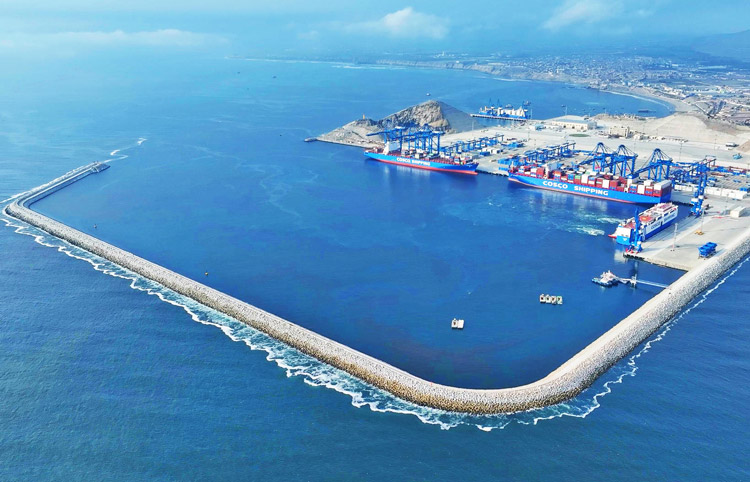
The U.S. commander noted Beijing is “playing the ‘long game’” with its development of sites and facilities that could have both a commercial and military use. Chief among them is a megaport in Chancay, Peru, which China’s state-owned Cosco Shipping Ports has built with majority-ownership and control.
Beijing’s goal with the Chancay port is to boost China’s share of trade, including importing minerals, agricultural goods and other products from Brazil and Bolivia. Currently ships carrying goods to China from much of Latin America and the Caribbean must travel through the Panama Canal. Using the new port and larger ships will reduce travel time from Peru to Shanghai from 35 to 23 days.
‘We’re taking back the canal’
During a visit to Panama in February, Secretary of State Marco Rubio pressed Panama President José Raúl Mulino to change the “status quo,” which gave significant control of the management of Panama Canal ports to the Hong Kong-based conglomerate CK Hutchison.
Speaking of the canal, President Donald Trump said in his January Inaugural Address, “We didn’t give it to China. We gave it to Panama. And we’re taking it back.”
The construction of the canal was completed in 1914, 11 years after the U.S. military intervened in Panama in 1903, imposing a treaty giving U.S. rulers the right to the canal “in perpetuity.”
Decades of struggles by Panamanians against U.S. domination of their resources and government and for an end to the occupation of the Canal Zone finally forced Washington to relinquish its control in 1999. The treaty included the dismantling of U.S. military bases — 16 of them — that had been used repeatedly for military interventions and to prop up dictatorial regimes aligned with U.S. imperialism.
The Trump administration is pressing the Panamanian government to allow a larger U.S. military presence in the canal area and free passage for its navy. “We had a hard time imposing the principle of Panamanian sovereignty over our territory,” President Mulino said April 10, after a visit by War Secretary Pete Hegseth.
While the deal reached between the two governments stops short of allowing the U.S. to reestablish permanent bases, the Pentagon will have broader sway to deploy its personnel there. Hegseth had pressed for more, but Mulino warned him, this “would set the country on fire,” explaining how unpopular such a move would be among Panamanian toilers.
Rubio’s first visit to Latin America as secretary of state included Panama. It led to Mulino’s announcement in February that Panama was dropping out of China’s Belt and Road Initiative. A month later, CK Hutchison agreed to sell its shares in two of its divisions that operate 43 ports in 23 countries, including two at either end of the Panama Canal, to U.S. investment company BlackRock.
Washington has also stepped up its use of tariffs and other threats to extract concessions from its southern neighbors, and to curb Beijing’s influence in the region. While China has surpassed the U.S. as South America’s top trading partner, U.S. imperialist interests still dominate the region, particularly in Central America and the Caribbean. And the U.S. rulers are determined to expand their position.
In his second trip to the region, in April, Rubio faced opposition from leaders of Caribbean governments when he called for port fees of up to $1.5 million to be levied on every port call made by ships built or flagged by China. They complained the move would deal blows to the region’s oil and gas industry, and significantly raise the cost of imported goods, particularly food.
Washington’s recent deployment of a navy armada off the coast of Venezuela and stationing jets on the U.S. colony of Puerto Rico is part of their buildup. In the last two years the U.S. Southern Command has coordinated joint military exercises with at least seven different countries in the region, including Guyana, which abuts Venezuela.