CHICAGO — In July, Union Pacific Railroad announced plans to take over Norfolk Southern. The $85 billion merger deal, if approved by government regulators, would form the first transcontinental railroad in the U.S., moving some 40% of the nation’s rail freight through 43 states from coast to coast.
Rail workers know from long experience that the bosses use mergers to push for job cuts and speedup that further erode safety, in the name of “efficiency” and “cost cutting.”
“I think they’re going to use the merger to put a ton of people out of work,” a member of the International Association of Machinists who works at the Union Pacific Proviso yard near Chicago told the Militant Sept. 22. He asked that his name not be used for fear of company reprisals. “They claim they’re broke when it comes to investing in anything, but they want to buy another railroad? They’re barely fixing the locomotives now. We’re working with skeleton crews. And they’d like to go to just one person on the train!”
The question facing railroad workers and our unions is how can we take this on. The fundamental nature of dog-eat-dog capitalist competition leads to monopoly, hand in hand with squeezing more profits out of their workers. The capitalist rulers’ government always stands behind the bosses, whichever party is in power. The record in the rail industry — including the bipartisan vote in Congress to uphold President Joseph Biden’s decision to bar my union, SMART-TD, from striking in 2022 — bears this out.
In 1980, the U.S. had 33 Class I railroads. That year a bipartisan Congress passed the Staggers Rail Act, removing many restraints on the rail bosses, facilitating an accelerated consolidation of the industry. As they merged or bought out their competitors, the biggest carriers ripped up tracks, closed yards and stopped serving less profitable routes to focus on the most lucrative. They spun off local delivery operations to smaller short- line railroads, many of them nonunion, with lower pay and even worse working conditions.
Today there are just six Class I railroads in North America, four headquartered in the U.S. and two in Canada. Meanwhile, the number of short lines has grown from 220 to over 600, carrying 29% of U.S. freight. And the percentage of union rail workers has fallen from 83% in 1983 to 54% today.
The rail barons deepened their offensive against rail workers and our unions. Freight rail crews went from four or five workers to today’s standard of two, an engineer and a conductor. Many carriers introduced the remote control switching operation in the rail yards, eliminating the engineer and leaving two, or all too often one, switchmen controlling the engine from a belt pack while doing all the work on the ground.
At the same time, UP’s average train length has grown from 8,000 feet five years ago to almost 9,500 today. Some are as long as 15,000 feet, nearly 3 miles.
The rail bosses have carried out similar cuts with worsened conditions for workers who maintain the tracks, inspect and repair cars and engines, and other crafts. In 1980 there were some 500,000 rail workers; by the early 2000s there were half that number. Over the last decade the rail bosses have cut nearly another one-third. They are pushing to get rid of the road conductor, and are testing no-crew-run trains.
Rail workers have resisted many of these attacks, but have repeatedly come up against government intervention. The century-old Railway Labor Act — which is also used against airline workers — is designed to tie the unions up in red tape. There can be years of mediation, “cooling-off” periods, presidential emergency boards and other hoops to jump through before workers can legally strike. And Congress, with large bipartisan majorities, has repeatedly stepped in to outlaw strikes, like they did in 2022.
What can we do about the merger?
Unions representing rail workers have taken various positions on the Union Pacific-Norfolk Southern deal. The rail conductors’ union, SMART-TD, changed its position completely Sept. 22 to support the merger after UP agreed to “job protection” for current union members.
Union Pacific’s promise that workers “will not face involuntary furloughs as a result of the merger” is “proof that when workers and management sit down in good faith, we can build an industry that serves everyone: employees, companies, and the American people,” union President Jeremy Ferguson said.
Tony Cardwell, president of the Brotherhood of Maintenance of Way Employees Division, said the union rejected a similar proposal because UP wouldn’t agree to protect workers if it leases out more tracks to short-line railroads.
Cardwell said that the Teamsters, which the BMWED is part of, have good relations with President Donald Trump, and he hopes they can get help from the White House in protecting union members’ interests.
Neither collaboration with the bosses, as they try move to undercut their competitors, nor looking to government officials and agencies that exist to protect capitalist interests offers a way forward for workers.
Workers have to organize to fight
We’re not going to stop the capitalist drive toward monopoly. It’s a fundamental part of the functioning of capital. The bosses are protected in this by the armed power of the state.
What we can do is fight for better conditions of work and for control of safety on the job, as we strengthen our unions and look to overturning capitalist rule in the future. That takes organizing ourselves independently of the bosses and their government, winning solidarity among all rail workers and our unions, and from the working class more broadly.
The government’s response every time freight rail workers consider striking shows the ruling class is scared of our potential power. Whether they’re able to stop us from using that power is a question of the relationship of forces, and our own confidence to act together in our interests.
A good example was the strike in August by flight attendants at Air Canada. They were fighting to be paid for all the hours they work. The Canadian government immediately used anti-labor laws to order an end to the strike, as it has done to workers in several other unions. But this time the flight attendants kept their picket lines up, won widespread labor support and got a better contract.
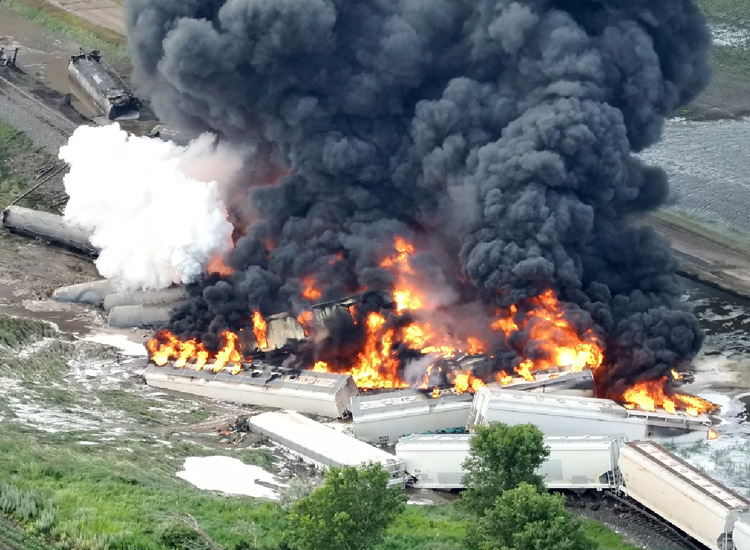
Fights by rail workers for safer conditions, larger crews instead of more cutbacks, and shorter trains would win support from many workers. The residents of East Palestine, Ohio, won broad support, from rail workers and others, after a Norfolk Southern train derailed there in 2023. Norfolk Southern bosses decided to burn off five carloads of toxic vinyl chloride in order to reopen the main track as fast as possible. This compounded the damage to working people in the area. Their fight for accountability from the company and the government gives a glimpse of what’s possible.
Naomi Craine is a freight rail conductor and member of SMART-TD.