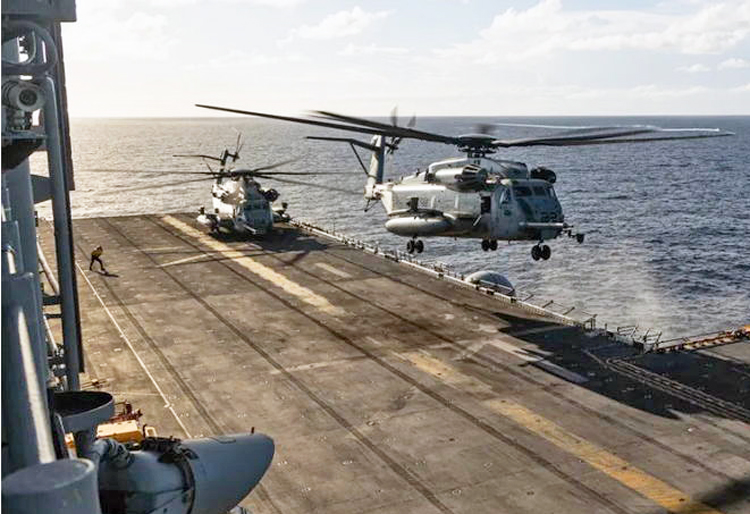
The Donald Trump administration is sharply escalating its threats against the government of Nicolás Maduro in Venezuela. The combined military, political and economic pressure is also aimed at sending a message to other governments in Latin America and the Caribbean that the U.S. rulers intend to deepen their domination of the region, as well as curbing Beijing’s efforts to extend its influence there.
Despite criticisms of the current U.S. naval deployment off the coast of Venezuela, initially justified as combatting “narcoterrorism,” Washington has continued to blow up boats it claims — without presenting concrete evidence — were trafficking drugs to the United States.
According to Washington, 32 people have been killed in the seven attacks on boats since September.
U.S. government officials, however, are speaking more openly about the military deployment in the Caribbean as being part of Washington’s “maximum pressure” policy to oust the Maduro government.
The Financial Times and other media have reported President Donald Trump rejected offers made by the Maduro government in negotiations, including greater U.S. access to the country’s oil and mineral resources in exchange for defusing tensions. In the meantime, Washington keeps beefing up its military presence in the region.
Washington sent three B-52 bombers over the Maiquetía Flight Information Region, a designated airspace area used by Venezuela to manage civilian and military traffic near its capital, Oct. 15. In recent weeks, F-35 fighters and other aircraft launched from the former Roosevelt Roads Naval Station in Puerto Rico have reportedly flown in the same area.
The Trump administration has also asked Grenada’s prime minister, Dickon Mitchell, if the U.S. military could set up a radar base at the Maurice Bishop International Airport. Presumably it would monitor operations in Venezuela, just 100 miles south.
The request came a month after U.S. authorities announced in September that Grenada will be banned from exporting fish to U.S. markets starting in January 2026. This would deprive the small Caribbean island nation of millions in foreign exchange.
The airport was a flagship project of the popular revolutionary government led by Bishop, and it is currently an important part of the country’s tourist industry. Its facilities recently underwent a $67 million systems upgrade and expansion of its runways, funded through Beijing’s Belt and Road Initiative.
Ironically, after Bishop was overthrown in a Stalinist-led counterrevolution in 1983, one of pretexts for the subsequent U.S. invasion was that the airport — under construction at the time with the help of Cuba’s socialist government — posed a military threat to U.S. interests.
Attacks also aimed at Cuba
For over two decades, the imperialist rulers in Washington have tried to overthrow the Venezuelan government, impose one more subservient to their interests, and take back control over the country’s vast oil resources.
The Oct. 15 New York Times reports President Trump has authorized the CIA to carry out covert operations inside Venezuela. It would allow the CIA to target Maduro either unilaterally or in conjunction with a larger military operation inside Venezuela.
The Times also noted the CIA’s long history in Latin America and the Caribbean — from plotting coups in Guatemala in 1954 and Chile in 1973 to a number of assassination attempts against Fidel Castro. It also organized the Bay of Pigs invasion of Cuba in 1961 that was defeated by the armed mobilization of the Cuban people.
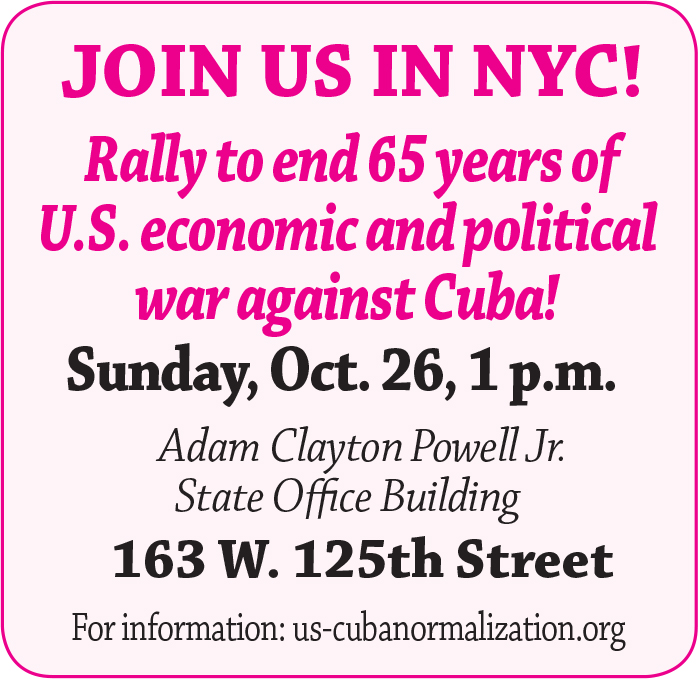 With the removal of the Maduro government, Washington also seeks to deal blows to Cuba’s socialist revolution and people. While diminished in the last few years, Cuba still relies on oil shipments from Venezuela and other trade.
To deepen pressure on the Venezuelan and Cuban governments the U.S. rulers have pressed for their exclusion, as well as the government of Nicaragua, from the December Summit of the Americas in the Dominican Republic.
Meanwhile, the award of the Nobel Peace Prize to Venezuelan opposition leader María Corina Machado has been celebrated by bourgeois liberals in the U.S. who gloat at Trump not receiving it.
Many in Venezuela, however, are well aware of Corina Machado’s long record calling for U.S. military intervention to topple Maduro and Washington’s devastating economic sanctions on Venezuela. She supports the recent U.S. military strikes in the Caribbean.