The French edition of Labor, Nature, and the Evolution of Humanity: The Long View of History by Frederick Engels, Karl Marx, George Novack and Mary-Alice Waters is one of Pathfinder’s Books of the Month for October. Its collection of writings covers the sweep of human history, from the evolution of our earliest ancestors, through the emergence of class society, up to the crisis of capitalism today. Workers in the front lines resisting the imperialist rulers’ march to fascism and another world war will find this book, with its long view of history, invaluable. The excerpt is from the first chapter, “Without materialist dialectics, there can be no working-class revolution,” by Waters, a leader of the Socialist Workers Party. Copyright © 2021 by Pathfinder Press. Reprinted by permission.
[W]ithout an understanding of the dawn of humanity and our subsequent evolution — with its contradictions and ensuing dialectical leaps, its unanticipated combinations and inevitable unevennesses — working people the world over are doomed to remain prisoners of the moment in which we live. Prisoners of the capitalist epoch, unable to see beyond the relations of class exploitation that warp every aspect of our lives, ideas, social relations, and even personal values.
The dog-eat-dog world of capitalism, however, is not eternal. Nor is it the product of “human nature,” as we are often told.
Class-divided societies, of which capitalism is but the most recent stage, arose only a few thousand years ago. That’s not even a blink of the eye in the history of humanity. Those class divisions emerged along with the increasingly productive social labor of our ancestors, which enabled them to produce more than needed for mere survival. Along with that surplus, however, arose private property, priesthoods, and states, together with their armies and other repressive institutions used to defend the property, power, and privileges of the ruling few.
For its part, the social and political dictatorship of capital is barely a few hundred years old. Based on work for wages by the great majority of us who have no property to live off and must sell our ability to labor to an employer, capitalism too had a beginning under particular historical conditions. It will have an end under others.
Armed with this long view of history, a working-class vanguard of all nationalities, religions, skin colors, and both sexes — engaged in struggles together with millions of other working people — can develop the experience, political confidence, and fighting capacities to chart a revolutionary course. A course that can take state power out of the hands of the propertied rulers and build governing institutions created by the working class. Only then will a society worth living in for the great majority, one free of class exploitation and oppression, become possible.
All this is contrary to everything we are taught — and not taught — whether in school or factory, prison or place of worship.
For the owners of capital, this is dangerous knowledge.
For the working class, to whom this dangerous knowledge belongs, it opens a window on the road forward to a different and better world. …
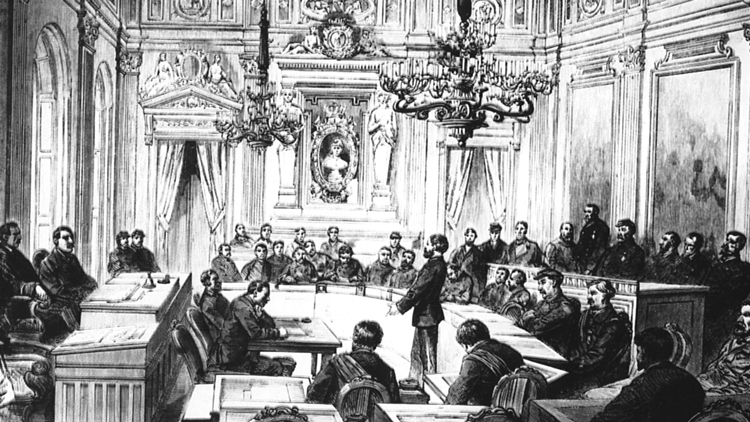
As workers’ experience over a century and a half has taught, however, such emancipation can only be won using a political instrument, the dictatorship of the proletariat. In their preface to an 1872 edition of the Communist Manifesto, Marx and Engels pointed to the lessons of the Paris Commune a year earlier, where “the proletariat for the first time held political power for two whole months,” they wrote. …
That lesson was confirmed in practice by the greatest pupil of Marx and Engels, V.I. Lenin, who in October 1917 led the Bolshevik party in bringing to power the workers, allied with the peasantry, of Russia’s overturned tsarist empire.
And again in the 1950s and 1960s, as Fidel Castro and the Rebel Army leadership mobilized the Cuban masses in establishing a workers state just ninety miles off the shores of the world’s mightiest and most brutal imperialist power. It was the state, the revolutionary government, not of any particular movement or organization, as Fidel put it in a March 1964 speech, but of millions wearing “the work shirts of workers and farmers and other men and women of the people.” …
“Just as Darwin discovered the law of development of organic nature, so Marx discovered the law of development of human history,” said Engels in March 1883, speaking at the graveside of his lifelong friend and comrade.
Marx explained that “the degree of economic development attained by a given people or during a given epoch forms the foundation upon which the state institutions, the legal conceptions, art, and even the ideas on religion, of the people concerned have been evolved, and in the light of which they must, therefore, be explained, instead of vice versa, as had hitherto been the case.”
After pointing to Marx’s irreplaceable contribution to understanding the laws of human history, however, Engels concluded: “Such was the man of science. But this was not even half the man.”
“For Marx was before all else a revolutionist,” Engels said. “His real mission in life was to contribute, in one way or another, to the overthrow of capitalist society and of the state institutions which it had brought into being, to contribute to the liberation of the modern proletariat, which he was the first to make conscious of its own position and its needs, conscious of the conditions of its emancipation.
“Fighting was his element. And he fought with a passion, a tenacity, and a success such as few could rival.”
It is the revolutionary conquest of state power by the working class —“conscious of its own position and its needs, conscious of the conditions of its emancipation”— that will open the door to the final battles to build a world based not on exploitation, the degradation of nature, subjugation of women, racism, and war. A world built instead on human solidarity. A socialist world.
That is what a long view of history teaches us.