Russian President Vladimir Putin’s invasion to try to conquer Ukraine and its people, the bloodiest war in Europe since World War II, has ground on for almost four years. Despite his escalating bombardments of civilians and the county’s power networks, Ukrainian working people, in uniform and out, are determined to fight to the end to defend their country’s sovereignty.
As the Kremlin’s war targets working people in Ukraine, it also shows utter contempt for Russian workers in uniform, sacrificing them by the thousands as cannon fodder. There is growing disaffection and desertions, as well as protests at home.
After a phone call with Putin, President Donald Trump met with Ukrainian President Volodymyr Zelensky at the White House Oct. 17, and then called for both sides to “stop right now at the battle lines” and make a peace deal. Both Zelensky and his backers among the European imperialist powers agreed to a temporary ceasefire. The Kremlin rejected the idea, and plans for a new meeting between Putin and Trump were put on hold.
The front line stretches 800 miles through southeastern Ukraine, from the Kharkiv to Kherson regions. Putin’s goal has always been to capture the rich mining and industrial area of the Donbas, but after 11 years of trying, Moscow’s forces only occupy three-quarters of the region. The line has been largely frozen for months. Still, Putin demands that in any ceasefire Ukraine hand over land Moscow hasn’t been capable of conquering.
Massive Russian casualties
As more and more Russian forces are committed to try to capture Pokrovsk, a key supply hub in the east, their casualties continue to mount. A leaked Moscow document says between the beginning of the year and Sept. 1 there were 35,000 dead, maimed and missing in action each month, far more than the Kremlin has recruited as replacements.
At least 50,000 Russian soldiers have deserted since the war was started, knowing they face being used as “cannon fodder,” Yevgeny Kochegin, head of the Volgograd-based watchdog group Dozor, said. They can see “how this ends, and they don’t want to be part of it.”
For the Kremlin’s high command, the Russian troops are “garbage. They’re meat, nothing more,” Ivan Chuvilyaev, a rights advocate for Get Lost, an organization assisting Russian deserters, said. “Why doesn’t someone want to fight in a war? Because he doesn’t want to kill or die. It’s that simple.”
Anti-war concerts in St. Petersburg
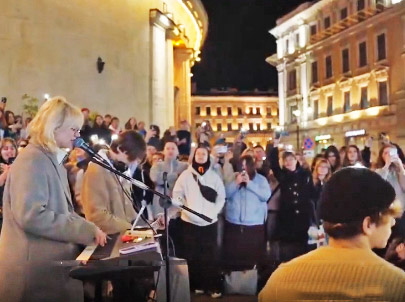
A St. Petersburg court Oct. 16 sentenced Diana Loginova, an 18-year-old singer; guitarist Vladislav Leontyev; and drummer Alexandr Orlov, all members of popular street band Stoptime, to nearly two weeks in jail for blocking pedestrian access to a metro station. Their public performances of anti-war and anti-Kremlin songs in Russia’s second-largest city have attracted hundreds of young people singing and dancing along, and thousands of online fans.
For weeks Stoptime, one of many bands performing nightly along Nevsky Prospect, St. Petersburg’s main thoroughfare, had gone unnoticed by authorities. But as the band’s popularity grew, so did hostile attention from Russia’s pro-war bloggers. They demanded Moscow arrest them.
Loginova, whose stage name is Naoko, faces charges of “discrediting the Russian army,” the Kremlin’s euphemism for opposing the war, which can carry a serious jail term.
Stoptime’s repertoire includes songs by popular anti-war musicians now in exile for publicly opposing the Kremlin. One, composed by exiled songwriter Monetochka, says: “You’re a soldier, and I wanted to patch up your stitches. To mend your broken heart and sew it back together. But the metal is stuck fast. You’ve probably seen too much.”
“They are doing a dangerous thing,” Innokentiy Molchanov, 17, a regular concertgoer, told the New York Times. The band is “important because at least someone should say the truth.”