

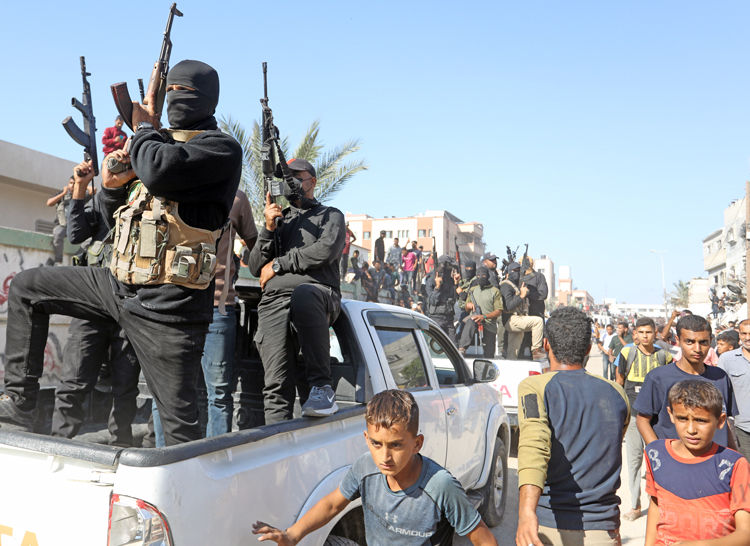
Taking advantage of the ceasefire with Israel brokered by the U.S. government that began Oct. 10, Hamas death squads have reappeared and began executing their political opponents in the roughly 50% of Gaza not under the control of the Israeli army. Hamas’ goal is to terrorize Palestinians in Gaza and reassert its dictatorial rule.
Hamas leaders tell their squads to take videos of the killings and maimings, to use to intimidate Palestinians and to recruit like-minded thugs. One video shows a pickup truck loaded with Hamas goons and the bodies of those they killed driving through Gaza City — just like they did during their Oct. 7, 2023, pogrom. Only this time it wasn’t Jews, but the bodies of Palestinians they claim were “Israeli collaborators.”
Hamas has clashed with several opponent capitalist families. Along with owning businesses and farms, many of these clans are involved in smuggling. Some have collaborated in the past with Hamas, their largest rival; Fatah; or other armed anti-Israel groups.
Hamas thugs attacked a Doghmush family compound in Gaza City, one of the largest clans, including with mortars and RPGs. In the ensuing battle dozens of Doghmush fighters or family members were killed, as well as 12 Hamas operatives.
On Oct. 18, Hamas ambushed and killed Mahmoud Marwan Barbakh in Khan Younis by calling him to come pick up a food package. Hamas later said it was a case of “mistaken identification.”
The same day a large force from Hamas’ Al-Qassam Brigades attacked and killed Hisham Muhammad al-Safatawi in the Nuseirat area. He had previously been imprisoned in Israel, his family said, for “national activity.” That was of no interest to Hamas, who considered him a competitor.
The Hamas thugs violated “the sanctity of the home” and “women and children were assaulted in a manner that bears no relation to the morals of our people,” the family said.
In addition to executions, one of Hamas’ favorite methods to deal with opponents is using metal pipes to shatter the bones in their arms, legs and feet.
While greatly weakened by the IDF over two years of war and much of its heavy weaponry destroyed, Hamas is still the most powerful organized force in Gaza, with thousands of operatives armed with semiautomatic weapons, grenade launchers and other weaponry. While Israel destroyed many of the tunnels Hamas built underneath hospitals, schools, mosques, U.N. offices and apartment buildings, a large number remain intact.
They’re repairing damaged tunnels and collecting unexploded munitions in preparation for renewed attacks on Jews and Israel.
“We haven’t seen anything that helps us recover,” Mahmoud Abu Amra, a teacher from Deir al-Balah, told The Media Line news agency. “Instead, Hamas forces have reemerged, heavily armed, seeking revenge against armed groups and also against activists who criticized them online.”
Two realities in Gaza
The ceasefire “has split Gaza into two alternate realities on either side of the ‘yellow line’ behind which the Israel Defense Forces have withdrawn,” wrote Moumen Al-Natour in the Washington Post Oct. 21. He is a lawyer who played a central role in organizing demonstrations of thousands against Hamas in Gaza City earlier this year and a longtime opponent of its rule.
“My Gaza, where I wish to live, exists between Israel and the yellow line,” he wrote. “There the war is over and change buzzes in the air. People have access to food, medicine and electricity. And other signs of normality are beginning to return, such as some children going back to school.”

“Few there speak of Hamas with any warmth or positivity. For once they no longer have to.”
Hamas claims that it speaks for the “entire Palestinian people” in “defense of Arab land.” In fact, it is the biggest obstacle working people in Gaza and the West Bank face in being able to defend their national rights and aspirations.
After narrowly winning elections in Gaza in 2006, it crushed its political opponents in bloody fighting and has maintained dictatorial rule ever since. Hamas broke strikes by trade unions and restricts women’s rights. It violently attacked protests of thousands in Gaza in 2007, 2017 and 2019.
U.S. gov’t keeps pressure on Israel
Israel retaliated after two Israeli soldiers were killed and others wounded in attacks by Hamas in violation of the accord. Hamas denied it was responsible and President Donald Trump backed them up, claiming “rebel” units were involved.
While Trump continues to warn that Hamas must disarm or “we will disarm them,” Washington has done nothing to prepare to do so. The Israeli army is the only force today capable of disarming and dismantling Hamas. But Washington opposes Israel doing that.
The White House dispatched the trio of Trump’s son-in-law, Jared Kushner; special Mideast envoy Steven Witkoff; and Vice President JD Vance to Israel to turn up the pressure on Israeli Prime Minister Benjamin Netanyahu and his government. Secretary of State Marco Rubio is expected to join them Oct. 23.
Vance insists that Israel needs to maintain “a little bit of patience,” despite Hamas’ moves to reimpose its reign of terror over Gaza.
“It’s fair to say that with Vance, Witkoff, and Kushner all in Israel, the United States is indeed ‘staying on top of everyone’ — at least on top of Jerusalem” to prevent Netanyahu “from resuming an all-out war on Hamas,” the Jerusalem Post reported Oct. 21.