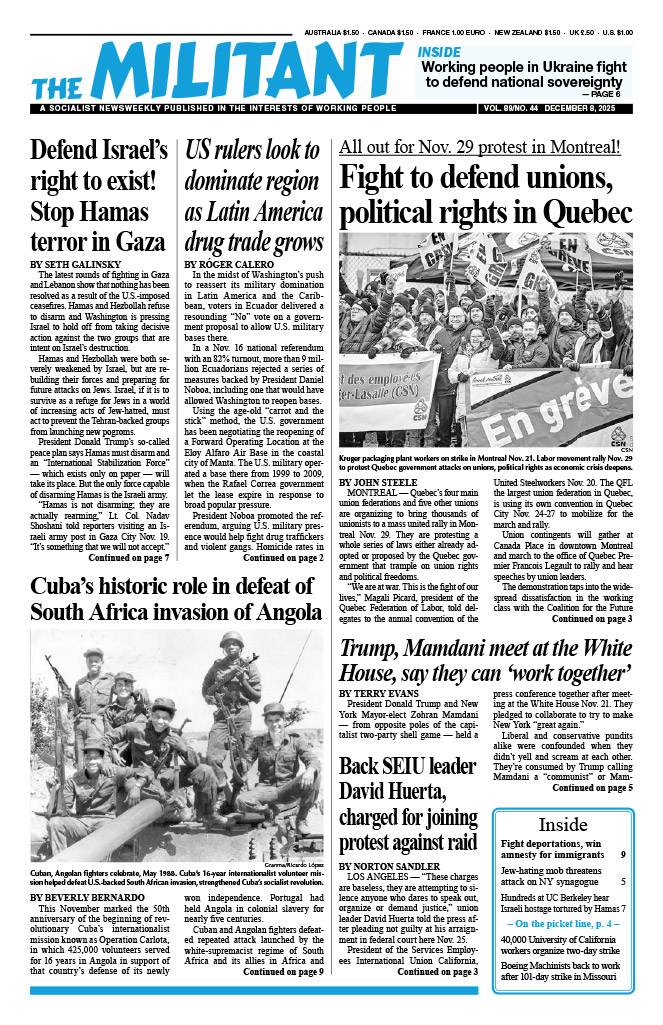
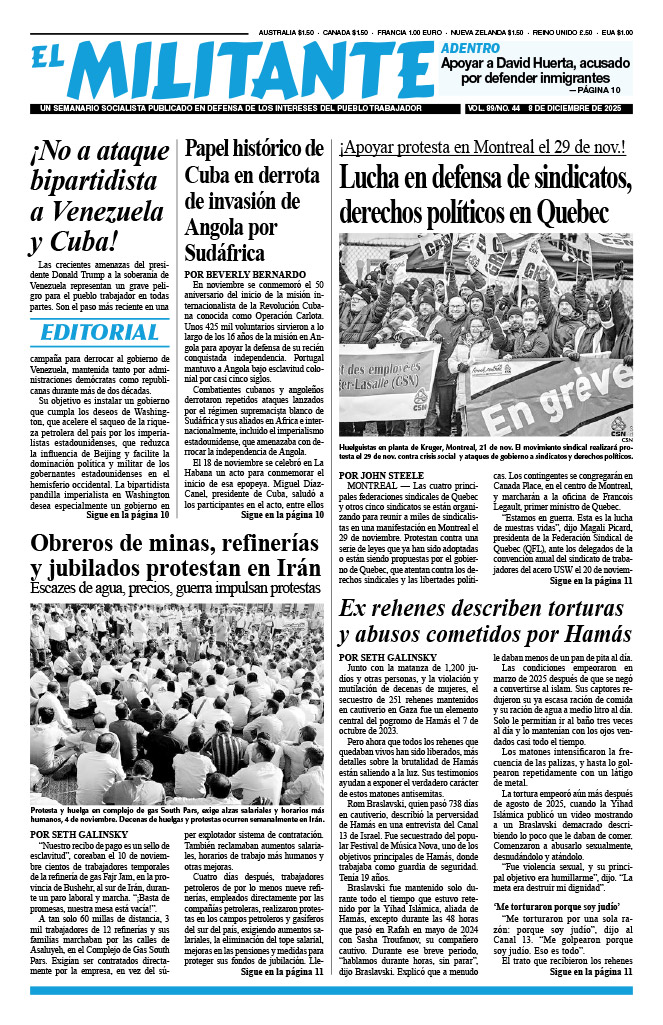

This November marked the 50th anniversary of the beginning of revolutionary Cuba’s internationalist mission known as Operation Carlota, in which 425,000 volunteers served for 16 years in Angola in support of that country’s defense of its newly won independence. Portugal had held Angola in colonial slavery for nearly five centuries.
Cuban and Angolan fighters defeated repeated attack launched by the white-supremacist regime of South Africa and its allies in Africa and internationally, including U.S. imperialism, that threatened to overturn Angola’s independence.
A commemoration was held in Havana Nov. 18 to celebrate the anniversary of the onset of that struggle. Cuban President Miguel Díaz-Canel greeted everyone, including members of the diplomatic corps from Angola, Djibouti, Congo, Guinea-Bissau, Cape Verde, South Africa, Namibia and Guinea. He brought greetings and an embrace from Raúl Castro, a leader of the Cuban Revolution.
Angola’s ambassador to Cuba, Carlos Cruz de Lemos Sardinha, recalled how the Cubans had crossed the Atlantic to fight for Angola. He said new generations need to know about the support the revolutionary island nation brought to Angola at a difficult time, and in spite of the fact that Cuba was suffering the consequences of the brutal effects of the U.S. rulers’ economic and political war. He thanked Cuba for its example of solidarity and assured all those present that Cuba’s strength and sacrifice in support of Angola had not been in vain.
Operation Carlota was named after a slave called Black Carlota. On Nov. 5, 1843, while working on the Triunvirato plantation in the Matanzas region, she took up her machete at the head of a slave rebellion in which she lost her life.
“At the moment of the birth of a sovereign and free Angola, Cuban internationalist combatants, under Fidel’s guidance, responded to the call of the president of the MPLA [Popular Movement for the Liberation of Angola], Dr. Agostinho Neto, to support the struggle against the invading forces that sought to stifle the cry for independence,” Álvaro López Miera, minister of Cuba’s Revolutionary Armed Forces, told the gathering.
“This epic act of solidarity” was “initiated by 480 Cuban military instructors in the summer of 1975,” he said. The combatants and people of Cuba responded to the fraternal call because as Fidel said, “to be internationalists is to pay our own debt to humanity.”
“Operation Carlota did not end; it was transformed,” he said, pointing to how Cuba still sends aid to Angolan hospitals, classrooms and more.
Enormous victory for African freedom
In late 1987, South African apartheid troops launched a second major offensive, hoping to inflict a crushing defeat on Angola. But the Cuban and Angolan leaderships came to an agreement to decisively defeat South Africa and assure Angola’s independence. The March 1988 victory they won at Cuito Cuanavale, routing the apartheid army, echoed around the world — and across South Africa above all. In the words of Nelson Mandela, that victory “broke the myth of the invincibility of the white oppressors.”
Less than two years later, Mandela, who was imprisoned for more than 27 years by the apartheid state, walked free. “By 1994 the racist regime was no more, and Mandela was president of South Africa,” SWP leader Mary-Alice Waters explains in her introduction to Cuba and Angola: The War for Freedom by Harry Villegas, a Cuban general who served three tours of duty in Angola.
The decadeslong battle greatly strengthened Cuba’s socialist revolution. Combatants who served in Angola brought back with them renewed pride in Cuba’s internationalism and determination to defend it arms in hand.