In the midst of Washington’s push to reassert its military domination in Latin America and the Caribbean, voters in Ecuador delivered a resounding “No” vote on a government proposal to allow U.S. military bases there.
In a Nov. 16 national referendum with an 82% turnout, more than 9 million Ecuadorians rejected a series of measures backed by President Daniel Noboa, including one that would have allowed Washington to reopen bases.
Using the age-old “carrot and the stick” method, the U.S. government has been negotiating the reopening of a Forward Operating Location at the Eloy Alfaro Air Base in the coastal city of Manta. The U.S. military operated a base there from 1999 to 2009, when the Rafael Correa government let the lease expire in response to broad popular pressure.
President Noboa promoted the referendum, arguing U.S. military presence would help fight drug traffickers and violent gangs. Homicide rates in Ecuador are among the highest in the world. Mexican, Albanian and Colombian mafias are fighting for control of multimillion dollar drug operations there.
But the memory of abuses carried out by the U.S. military during its 10 years in Manta was too strong for many Ecuadorians. They rejected Noboa’s appeal, seeing the return of the U.S. military as an affront to the country’s sovereignty.
Despite the setback in Ecuador, Washington continues to expand its military deployment in the region, as it threatens to either tame or topple Venezuelan President Nicolás Maduro. The U.S. government says its military buildup is an “anti-narcoterrorism” operation, accusing Maduro of heading a cartel that sends drugs to the U.S. and threatens national security.
Washington continues to use this justification for its military buildup and for blowing up boats off Venezuela’s coast and in the Pacific it claims are moving drugs, despite the widely known fact that Venezuela is not a source of cocaine. The vast majority of global cocaine production is concentrated in Colombia, Peru and Bolivia.
For years the capitalist rulers in the U.S. have had Maduro’s government in its crosshairs. With a change in government in Venezuela, Washington also aims to deal a big blow to Cuba, which receives political support and oil from Caracas. Since 1959, the overthrow of Cuba’s socialist revolution has been a central goal of all U.S. administrations — Democrat and Republican alike.
Ecuador is a major hub for cocaine shipments to Europe, Asia and the Pacific. These are more profitable destinations for drug traffickers than the U.S. A kilo of cocaine reportedly sells in Colombia for $2,000, in the United States the average price is $28,000, whereas the same kilo (2.2 pounds) goes for $40,000 in Europe.
Ecuador’s ‘narcobananas’
Tons of cocaine are transported inside millions of banana crates shipped every day from Ecuador’s port of Guayaquil. The practice is so widespread, it’s commonly known as “narcobananas.” The drug trafficking reached President Noboa’s family business in March, when a report emerged alleging that 700 kilos of cocaine were found in containers belonging to the Noboa Trading company between 2020 and 2022. According to European Commission reports, 57% of the banana containers from Guayaquil arrive in Antwerp loaded with cocaine.
An estimated 90% of U.S.-bound cocaine passes across the U.S.-Mexico border after being conveyed through a corridor from Central America to Mexico. To get to the Caribbean, Colombian drug traffickers transit through Venezuelan territory.
US deployment threatens region
Working people in the U.S. and throughout the hemisphere are watching the massive U.S. build-up of military assets in the region with growing concern. And they question Washington’s military strikes.
As of Nov. 24, the U.S. military has destroyed at least 21 vessels, killing 83 people, who they claim are involved in drug trafficking. The U.S. government has produced no evidence these boats carried drugs, nor did they provide the people aboard them due process. The White House has defended the actions, saying regular interdiction operations are ineffective.
There are now about 15,000 U.S. military personnel in the region, including thousands of Marines and the USS Gerald Ford carrier battle group on Venezuela’s doorsteps, as well as F-35 fighter jets based in newly reopened U.S. bases in Puerto Rico.
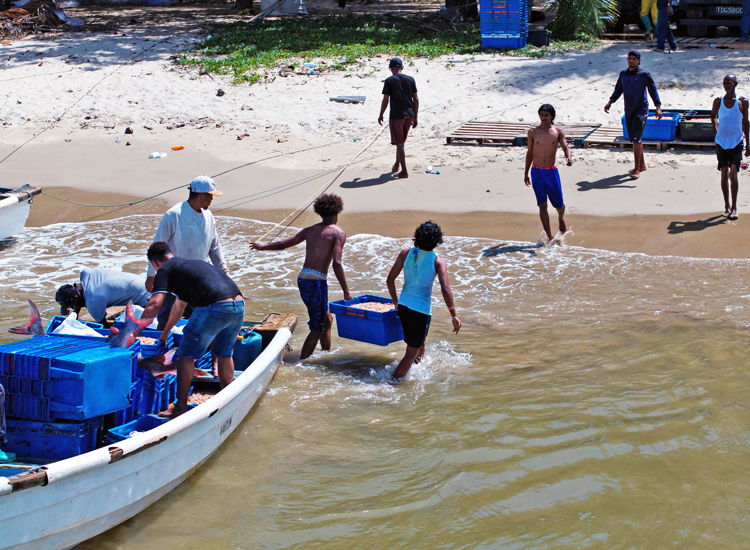
The government of Trinidad and Tobago has enthusiastically backed Washington’s deployment. The 22nd Marine Expeditionary Unit and helicopters carried out joint exercises with the military there Nov. 16-21. Trinidad and Venezuela are separated by a small bay just 7 miles wide at its narrowest point. The U.S. airstrikes against alleged drug boats has stoked fears in fishing communities there. Many are staying closer to shore, afraid they might get targeted.
During the nine years the U.S. base operated in Manta, military and coast guard personnel were accused of mistreating locals and sinking or damaging 14 fishing boats allegedly involved with drug trafficking.
One fisherman was killed along with his crew of 18 when U.S. forces sank his boat in 2002. A relative of his told France 24, “It wasn’t animals who went out fishing. It was parents, sons, husbands, uncles, who went to seek bread for their children.”