
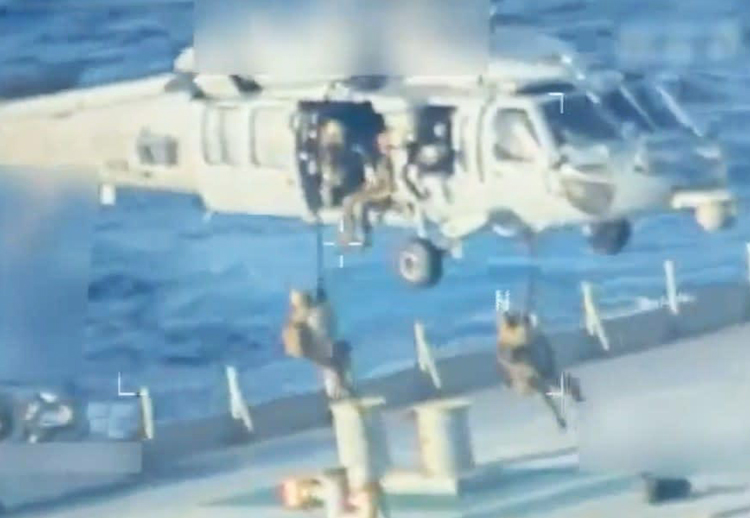
The U.S. government escalated its military attacks against Venezuela Dec. 16, announcing it had put in place “a total and complete blockade of all sanctioned oil tankers” entering and leaving the country. Since then U.S. naval forces have seized two tankers loaded with crude as they sailed from Venezuela, and tried to intercept another on its way to pick up oil.
“Venezuela is completely surrounded by the largest armada ever assembled in the history of South America,” wrote President Donald Trump, announcing the new assault on the country’s sovereignty aimed at ousting Venezuelan President Nicolás Maduro.
These attacks are having a chilling effect on vessel owners who are afraid their tankers will be seized by Washington. In the meantime, Venezuela’s oil customers, including Chinese refiners, are demanding steeper discounts, robbing the country of much-needed revenue.
At the moment, the U.S. military has at least 12 warships, including an aircraft carrier, and some 15,000 troops deployed in the region. The Pentagon moved additional special-operations aircraft and troops to Puerto Rico Dec. 22. Trump claimed Dec. 29 the CIA had carried out drone strikes on a port, saying it was used by a narcotics gang. If confirmed, that would represent a further escalation in Washington’s military campaign.
Blockades, even partial ones, are an act of war. In October 1962, during what is known as the Cuban Missile Crisis, President John F. Kennedy ordered a naval blockade against Cuba and placed U.S. armed forces on nuclear alert as it assembled an invasion force of 90,000 troops primed for an assault against Cuba. Washington’s invasion plans were stayed by the mobilization of millions of armed Cuban workers and farmers ready to face the invaders, and to defend conquests they made through their socialist revolution.
For over six decades the U.S. rulers have maintained a relentless economic and political war against Cuba aimed at overturning its revolutionary government. The current escalation against Venezuela is aimed both at removing the Maduro government and cutting off Cuba’s main supply of oil, dealing devastating blows to its energy supplies and revenue sources.
Rights of oppressed nations
Trump said Dec. 16 the blockade will continue until the Venezuelan government returns “all the oil, land, and other assets that they previously stole from us.”
The U.S. rulers’ claim to ownership of Venezuela’s oil and other resources tramples on the right of sovereign states and peoples to dispose freely of their natural resources, a principle central to the struggles for self-determination of colonial peoples during the 1900s and to the unresolved battles for economic and political independence from imperialist domination today.
Venezuela holds the world’s largest known oil reserves. Since oil was discovered there in the 1920s it was developed and controlled by U.S. firms that syphoned the country’s oil wealth into their own coffers, leaving only a fraction of the revenue for Venezuela. In 1976 Caracas nationalized the oil industry, taking control of the assets of Exxon, Shell and Chevron. That, however, did not mean the U.S. companies ceased plundering the country’s wealth and enjoying immense preferential treatment from subservient Venezuelan governments.
With the election of Hugo Chávez as president in 1998, the Venezuelan government sought to gain greater control over the industry and the state-owned Petróleos de Venezuela, S.A. — PDVSA — whose management remained deeply tied to the former U.S. owners.
When oil bosses tried to bring down the Chávez government by organizing a lockout at the country’s refineries in late 2002, workers responded by restarting production and joining together to defend the plants from bosses’ sabotage. The lockout failed.
A series of restructuring measures in 2007 eventually led to the renationalization of assets of foreign firms, with Caracas offering to pay them book value compensation, which they rejected, demanding billions more. Chevron is currently the only major U.S. company that profits dearly from its operations in Venezuela through a special license from the U.S. Treasury Department. Others have withdrawn due to punitive sanctions by Washington.
“We don’t owe anything to anybody,” Maduro said Dec. 23, “to the contrary, they’re the ones who owe us.”
Through a confrontation with the Maduro government the U.S. capitalist rulers are reasserting their dominance in the Western Hemisphere. Their course, as outlined in the Trump administration’s National Security Strategy released early in December, is aimed at denying other powers, especially Beijing, control over the region’s vast wealth.
Over decades China’s state capitalist rulers have been advancing their influence in the region. Economic and political relations with Venezuela have occupied a central place in that strategy. By seizing China-bound oil tankers off of Venezuela’s coast, Washington is sending a warning toward Beijing in the longer-term global power struggle for control of resources, maritime routes and influence.