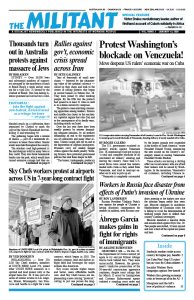

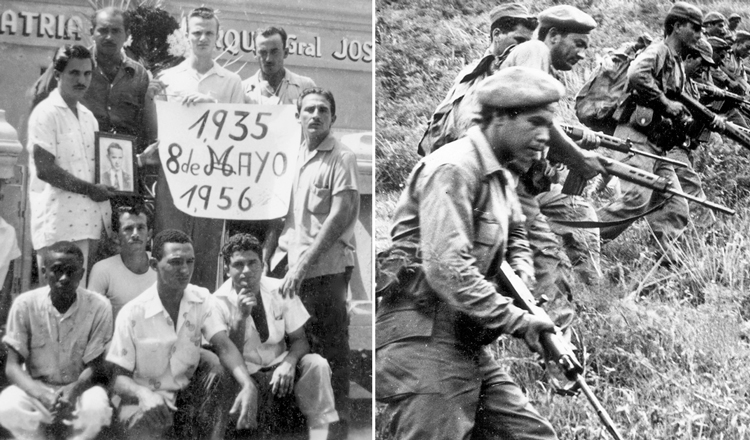
“Our participation in the liberation struggles in Africa and other parts of the world made the Cuban people stronger,” says revolutionary leader Víctor Dreke in his newly published firsthand account, Cuba and the Independence War in Guinea-Bissau and Cape Verde: The Fall of the Last Colonial Empire in Africa.
The Dec. 15 issue of the Militant featured the introduction by Mary-Alice Waters to Cuba and the Independence War in Guinea-Bissau and Cape Verde: The Fall of the Last Colonial Empire in Africa, released by Pathfinder Press Jan. 1. We asked Martín Koppel, co-editor of the book along with Waters, to prepare this article so our readers can learn more about the book’s author, Cuban revolutionary leader Víctor Dreke.
Dreke tells the story of a little-known but decisive chapter in the struggles of working people and the oppressed. Published by Pathfinder Press, the book was released Jan. 1, the 67th anniversary of the triumph of the Cuban revolutionary war led by Fidel Castro, which overthrew the Fulgencio Batista dictatorship and opened the door to the first socialist revolution in the Americas.
Cuba’s internationalist actions “reinforced the values of our socialist revolution that we continue to defend today,” Dreke explains. “Those not willing to fight for the freedom of others will never be able to fight for their own,” he says, citing Castro’s words in 1976 saluting the Cuban volunteers who had just helped their Angolan brothers and sisters defeat an invasion by the South African apartheid regime.
Dreke — Commander Moja, as he is known in Africa — brings to life the popular struggle that in 1974-75 not only won independence for the West African nations of Guinea-Bissau and Cape Verde, but hastened the liberation of Angola and Mozambique, bringing down the entire Portuguese colonial empire — the final one to stain the African continent.
That victory also led to the downfall of a decadeslong dictatorship in Portugal itself, triggering a mass revolutionary upsurge of workers and peasants there.
Dreke tells us in vivid detail how, between 1966 and 1974, hundreds of Cuban volunteers — including himself — contributed to these history-changing events. The interview with him is followed by a chapter with reflections by several other Cubans who fought for Guinea-Bissau’s independence or helped lead that internationalist mission.
Two decades in the making
This new book has been two decades in the making. It came out of work on an earlier interview with Dreke published by Pathfinder, From the Escambray to the Congo: In the Whirlwind of the Cuban Revolution. There he recounts his decadeslong involvement in Cuba’s revolutionary movement — how he and thousands like him were transformed from courageous but inexperienced rebel youth into seasoned working-class revolutionists.
In that book, a couple of pages are devoted to his participation in Cuba’s support to the independence war in Guinea-Bissau. But interest by readers in learning more about that story prompted further rounds of interviews.
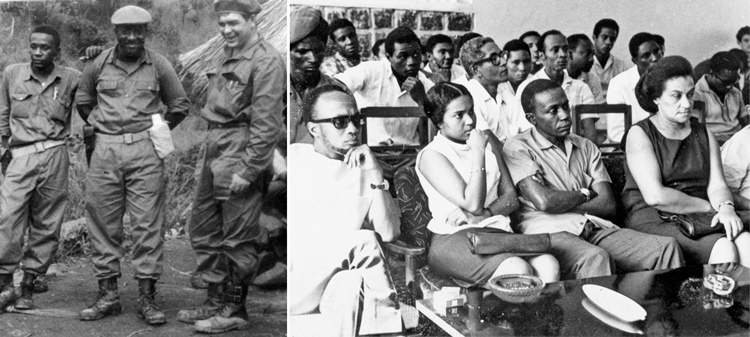
In late 1966, Castro asked Dreke to head the Cuban combat mission in Guinea-Bissau. In the final chapter to the new book, another leading participant in that mission, Alfonso Pérez Morales, known by his nom de guerre Pina, poses the question, “Why Dreke?”
His answer is: “Fidel chose Dreke because he needed an experienced military commander, someone who had led troops in combat and demonstrated his ability to make decisions in a complex guerrilla war being fought on three fronts.
“Second, he wanted someone who was familiar with the thinking of our country’s top leadership and was able to transmit that to, and work with, Guinean leaders like Amílcar Cabral,” the central leader of the African Party for the Independence of Guinea and Cape Verde (PAIGC), which led the liberation war.
“And third, Fidel wanted someone who had been through the mission in the Congo.” In that country, 130 Cuban internationalists led by Ernesto Che Guevara had fought in 1965 alongside followers of Patrice Lumumba, the first prime minister of an independent Congo, who had been assassinated in 1961 by a brutal U.S.-backed regime. Dreke was second-in-command of the Cuban column there.
Pina explained that Castro told Dreke to take with him to Guinea-Bissau “the best compañeros who had fought with him in the Congo.”
As Dreke noted in From the Escambray to the Congo, Che’s assessment was that the Congo mission “was a failure” — a bitter outcome with a potentially lasting demoralizing impact on Cuba’s internationalist volunteers. Dreke said he believed that if Guevara had lived to see subsequent victories in Africa, he would have altered his initial balance sheet. Some who went through the Congo experience, including Dreke himself, “later went on to participate in the liberation struggle in Guinea-Bissau,” Angola, and other countries.
Joins revolutionary movement
Víctor Dreke was born in 1937 into a working-class family in Sagua la Grande, in the central province of Las Villas (today Villa Clara). He began his political activity at age 15, joining protests against the March 1952 military coup by Fulgencio Batista. As a high school student he was involved in support to a historic 1955 strike by 200,000 sugar workers in Las Villas.
That year Fidel Castro and other revolutionaries founded the July 26 Movement to lead a mass struggle to overthrow the Batista dictatorship. Dreke joined it, heading an underground cell in Sagua that carried out sabotage actions against the tyranny.
By early 1958, sought by Batista’s police, Dreke left town and joined a guerrilla front in the Escambray Mountains led by the March 13 Revolutionary Directorate. He took part in several battles against Batista’s army and was wounded in combat. When the Rebel Army, headed by Fidel Castro, sent a reinforcement column led by Che Guevara to Las Villas province, the Directorate placed its forces under Guevara’s command.
In the final days of December 1958, the Rebel Army captured the key city of Santa Clara. In From the Escambray to the Congo, Dreke describes how “the entire people came out in the streets and joined us, acting as the incipient militias” that after the January 1959 victory were organized to defend the revolution. That experience deepened Dreke’s confidence in the capacity of working people to transform society and themselves — as millions in Cuba did over the following years.
In the culminating hours of the battle of Santa Clara, Dreke was second-in-command of a Rebel Army unit that forced the surrender of the heavily armed Squadron 31 of the dictatorship’s Rural Guard.
Early years of revolution
After Batista and his leading henchmen fled the country on Jan. 1, 1959, the movement led by Castro mobilized workers and farmers to defend their new government against Cuban capitalists and big landowners, backed by U.S. imperialism. As those battles unfolded, they overturned capitalist rule and carried through the first socialist revolution in the Americas.
Millions joined the efforts that wiped out illiteracy, implemented a land reform in the interests of plantation workers and small farmers, enforced new laws barring racist discrimination, integrated women into political and economic life, and built housing, schools and child care centers through volunteer work brigades.
During these years, Cuba’s revolutionary leadership entrusted Dreke with important responsibilities. In early 1959 he served as a prosecutor in the revolutionary tribunals that brought to trial the torturers and murderers of the former Batista regime.
As a Rebel Army officer he also helped carry out the Cuban Revolution’s commitment to uproot racial discrimination, not only with laws but above all by leading working people of all skin colors to fight together, breaking down prejudices.
As Mary-Alice Waters notes in her introduction to From the Escambray to the Congo, Dreke describes in those pages how easy it became after Cuba’s socialist revolution to “take down the rope” that had long segregated blacks from whites at dances in the town squares. At the same time he explains “how enormous was the battle to transform the social relations underlying this and all the other ‘ropes’ — inherited from colonialism, capitalism, and Yankee domination.”
Dreke led two militia companies in the 1961 battle at the Bay of Pigs, where a U.S.-organized mercenary invasion of Cuba was defeated. The following year he was promoted to the rank of commander of the recently founded Revolutionary Armed Forces.
In the early 1960s Dreke was deputy commander of the special military units, known as Lucha Contra Bandidos (LCB, Fight Against Bandits), organized to defeat counterrevolutionary bands armed and financed by Washington. Dreke headed the LCB in the Escambray, the principal base of the bandits who were terrorizing peasants to try to reimpose a government beholden to U.S. and Cuban capitalists. By mid-1965 the LCB units and peasants had crushed most of these gangs.
Congo and Guinea-Bissau
From April to November 1965, Dreke took part in the Congo mission. It was there that Guevara gave him the nom de guerre Moja, which means “One” in Swahili. Che wrote in his Congo diary that Dreke had been “one of the pillars on which I relied.”
As his new book recounts, in 1967-68 Dreke led the Cuban combatants and doctors who served in Guinea-Bissau at the request of PAIGC leader Amílcar Cabral. He simultaneously directed the Cuban volunteers training militias in neighboring Guinea-Conakry, a former French colony, to help defend it from French and Portuguese imperialist threats. That country, whose president was Ahmed Sékou Touré, was the rear base for the PAIGC’s guerrilla war against Lisbon’s colonial rule.
In 1986-89 Dreke returned to a now independent Guinea-Bissau to serve as adviser to its armed forces.
Over the decades, Dreke has held numerous other leadership responsibilities. From the founding of the Cuban Communist Party in 1965 to 1975, he served as a member of its Central Committee.
U.S. speaking tour
Members of the Socialist Workers Party in the U.S. were first introduced to Dreke in 1999 by Iraida Aguirrechu, chief editor of the Communist Party’s publishing house, Editora Política. At that time he was a leader of the Association of Combatants of the Cuban Revolution. He readily agreed to an interview, and it led to the book From the Escambray to the Congo. It was launched in February 2002 during the Havana International Book Fair at an overflow meeting of more than 200.
Dreke spoke at the event along with Mary-Alice Waters, president of Pathfinder Press. Also on the platform were generals and Heroes of the Revolution José Ramón Fernández, Rafael Moracén and Harry Villegas. They were joined by Commander Faure Chomón, who had led the Revolutionary Directorate forces in the Escambray during the revolutionary war; Jorge Risquet, head of the Cuban internationalists who went to Congo-Brazzaville while Guevara was leading the column in neighboring Congo-Kinshasa; and Armando Entralgo, a former revolutionary combatant and Cuba’s first ambassador in Ghana.
Alexandre Nunes Correia, a leading PAIGC cadre during the liberation struggle, was also welcomed onto the platform. He told the audience he had fought alongside “my commander Moja” during the independence war, and joked that he “seemed like a Guinean who just happened to be born in Cuba.”
After the Havana fair, Dreke and Waters took part in a five-day speaking tour across central Cuba. They spoke to hundreds of people, from veteran revolutionary combatants to high school students. The meetings were held in Santa Clara, Sancti Spíritu, Trinidad and Sagua la Grande, as well as in the towns of Placetas and Manicaragua — in the heart of the Escambray Mountains — that had been the sites of important battles in the revolutionary war. The book presentations were hosted by the Combatants Association, the Communist Party of Cuba and two provincial governments.
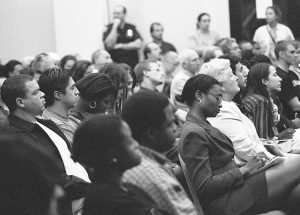
In late 2002, Dreke was invited by a broad range of student, faculty and other groups to do a monthlong speaking tour in the United States on “Cuba and Africa: From 1959 to Today.” Sharing the platform with him was Ana Morales, who had helped found the medical school in Guinea-Bissau, the first one in sub-Saharan Africa. They spoke in seven cities to a total of 3,000 people — university students, rail workers in Washington, D.C., Black farmers in southern Georgia and Alabama, civil rights leaders in Atlanta and Birmingham, and more.
A high point of the tour was a meeting of 250 at Florida International University in Miami. It was co-sponsored by academic departments and student organizations, as well as Haitian, Cuban American and civil rights groups in the Miami area. Because of the breadth of forces supporting and attending the event, as well as the disciplined conduct of students acting as security monitors, efforts by right-wing opponents of the Cuban Revolution to cancel or disrupt the meeting were a resounding failure. This victory for free speech was repeated the same week at a campus meeting of 125 in Tampa.
At the conclusion of the tour, in an interview with Militant reporter and SWP leader Sam Manuel, Dreke said how much he had appreciated the seriousness of the exchanges with workers, farmers, and young people he had met — their widely varying questions and opinions.
“Sometimes people thought we were angry at them,” Dreke told the Militant. “Sometimes they were angry at us because they didn’t like the answer we gave. But we told everyone we are here to answer any question and they should not be afraid to ask anything.”
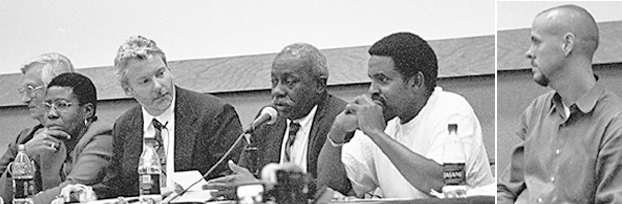
At the Miami meeting, in face of hostility by a small minority who wanted to prevent an exchange and at one point unsuccessfully tried to storm the platform, Dreke’s clear answers, calm demeanor, and sense of humor riveted the audience and won respect for the Cuban Revolution, as he and Morales had done at other events.
Since 1959, no Cuban revolutionary leader of Dreke’s stature had had the opportunity to speak so widely in the U.S.
Dreke was also invited to speak at broadly sponsored events in London and Dublin in 2011, as well as in five Italian cities in 2017.
Equatorial Guinea’s first book fair
Dreke served from 2003 to 2008 as Cuban ambassador to Equatorial Guinea. In 2005 he invited a team of socialists from the United States and the United Kingdom to participate in the first-ever book fair in that central African country, a former Spanish colony. They brought a shipment of Dreke’s book and a range of other Pathfinder titles to make available at the book fair.
During the event, held at the National University of Equatorial Guinea in Malabo, the capital city, Dreke and Waters presented From the Escambray to the Congo to a responsive audience of 200 university and high school students. Many were eager to read Dreke’s account of his experiences in the Cuban Revolution and internationalist missions in the Congo and Guinea-Bissau.
In 2008 Dreke accompanied a team of Militant reporters from the U.S. and United Kingdom on a fact-finding trip to 10 cities and towns in Equatorial Guinea. Government officials arranged for them to visit hospitals and clinics across the country, meeting members of Cuba’s volunteer medical brigades as well as youth who had studied medicine in Cuba.
Out of those two trips came the Pathfinder book Capitalism and the Transformation of Africa: Reports from Equatorial Guinea. It includes Dreke’s speech at the 2005 book fair, “Cuba’s experience is at your disposal.”
On returning to Cuba from his responsibilities as ambassador in Equatorial Guinea, Dreke served for many years as a national leader of the Association of Combatants of the Cuban Revolution and head of its work in Havana.
Dreke has also shouldered many other responsibilities as a representative of the Cuban Revolution in Africa. Today he is president of the Cuba-Africa Friendship Association.
Earlier this year, Dreke was given an award by the Amílcar Cabral Student Health Brigade, a group of youth from Guinea-Bissau, Burkina Faso and other African countries who are studying medicine in Cuba. The students inscribed the following dedication on the plaque:
“To Commander Víctor Dreke. Thank you for your support to the unification and liberation of Africa from imperialism and colonialism. The struggle continues!”