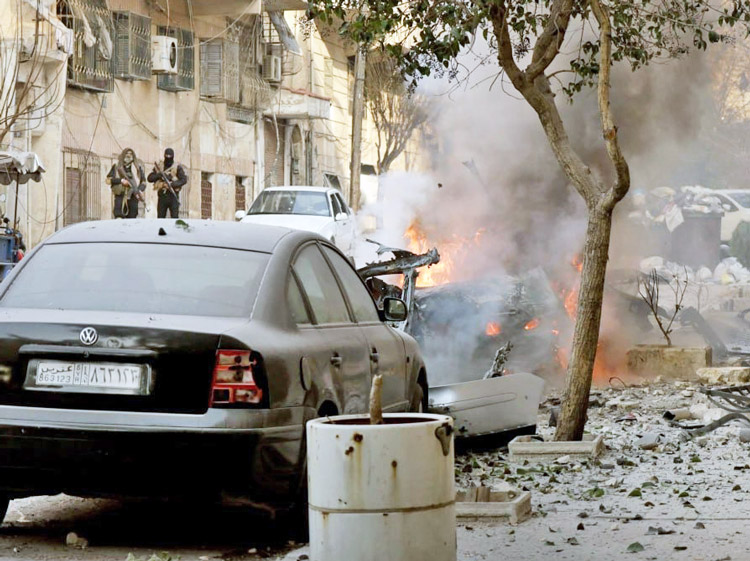
At least seven people were killed and 52 injured as of Jan. 7 in the Kurdish-majority neighborhoods of Ashrafiyeh and Sheikh Maqsood in Aleppo, the largest city in northern Syria, during attacks by Turkey-backed militias affiliated with the new Syrian government over the last month.
The factions, the al-Amshat (Suleiman Shah Division) and the al-Hamzat (Hamza Division), have also targeted the densely populated town of Deir Hafer, east of Aleppo, using mortar shelling, heavy weapons and suicide drones.
The Syrian National Army has taken advantage of the attacks on the neighborhoods, striking sites where it says the Kurdish-led Syrian Democratic Forces has launched drones in its defense.
In a major escalation Jan. 7, the army declared that “all military outposts” it claims belong to the SDF are “legitimate military targets.” Eighty tanks and military vehicles have been deployed.
The Kurdish Internal Security Forces in Aleppo told the media that the shelling had “caused significant material damage,” and “heightened tension among civilians.” It released a photo of 41-year-old Fatima Hamadeh “who was martyred as a result of the heavy shelling” there.
It is allied with the SDF, which controls most of northeast Syria. The SDF stated that the two neighborhoods are “under full siege,” with the entry of food, medical supplies and other essential goods blocked.
The Turkish factions have resisted integration into Syria’s new military structure formed after the overthrow of dictator Bashar al-Assad by the Syrian people in 2024.
The Kurdish Internal Security Forces said it had “responded firmly” to al-Amshat and al-Hamzat. “Our responses will remain within the framework of the law and the legitimate defense of civilian lives and property,” it said.
On Jan. 3 Rudaw news wrote that the siege of the Aleppo neighborhoods has “severely disrupted daily life,” including a power blackout, the closing of schools and “mistreatment by security forces.” Nouri Sheikho, co-chair of the civilian council in the neighborhoods affected, said that Syrian authorities have so far refused to repair the power grid brought down by the shelling.
“This is a political objective to force the people to retreat further,” Sheikho said. “They do not allow fuel to pass through and say that the [Kurdish] military forces use it for themselves. These are all pretexts so that gas and fuel do not reach the neighborhoods and pressure is put on the people.”
Kurds, an oppressed nationality, make up some 10% of Syria’s population. Thirty million Kurds, in Iraq, Syria, Iran and Turkey, comprise the world’s largest nation without their own country.
Last March an agreement was signed between SDF Commander-in-Chief Mazloum Abdi and the new Syrian regime, headed by President Ahmed al-Sharaa, to integrate SDF into state institutions. The SDF wants to join the Syrian army as a block, with its command structure in place for its 50,000 troops. Damascus is pressing SDF fighters to join the army as individuals.
The Turkish government, long a bitter opponent of the Kurdish struggle for self-determination, is threatening to intervene if the SDF doesn’t dissolve itself completely into Syria’s state military. Ankara views the SDF as totally intertwined with the Kurdistan Workers Party inside Turkey, which it has long attempted to suppress and dismantle.