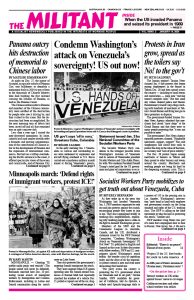
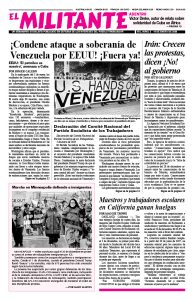
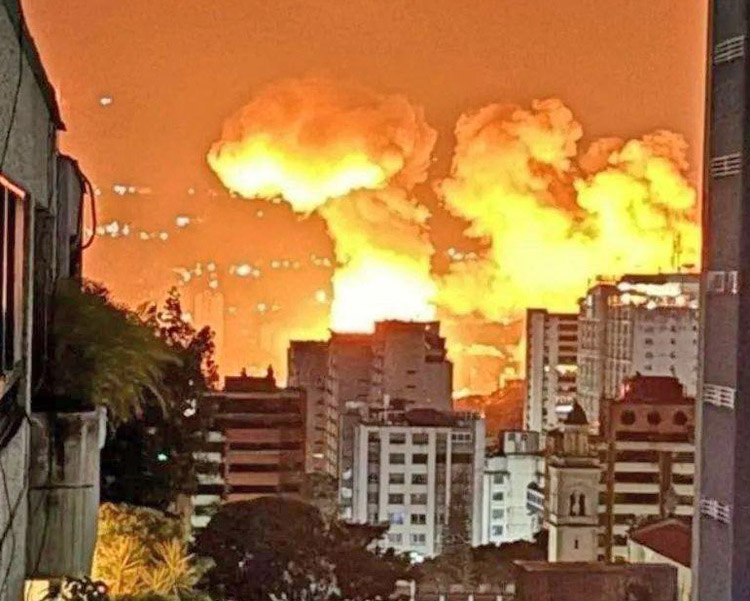
In the early morning Jan. 3 Venezuelans in Caracas and surrounding areas were awakened by explosions and aircraft flying overhead as U.S. forces carried out a murderous military assault aimed at forcing Venezuela’s government to submit to Washington’s imperialist dictates. The assault left 80 people dead; a trail of destruction; President Nicolás Maduro and his wife, Cilia Flores, taken captive; and the country’s sovereignty violated.
In the operation, dubbed “Absolute Resolve,” some 150 aircraft — bombers, fighter jets, helicopters, drones and reconnaissance planes — paved the way for special operations units to break into the compound where Maduro and his wife lived. They transported them to the assault ship USS Iwo Jima and then flew them to New York. Both pled not guilty to narco-trafficking and other charges in a Manhattan federal courthouse Jan. 5.
Washington claims the Venezuelan president is the head of a drug cartel that smuggles massive amounts of cocaine into the U.S. For weeks the White House had threatened to carry out land strikes inside Venezuela. U.S. forces have destroyed dozens of boats U.S. authorities say are carrying drugs, killed some 115 crew members, and imposed a naval blockade on oil shipments from Venezuela.
Circling vultures
“We are ready to stage a second and much larger attack if we need to do so,” President Donald Trump told a press conference hours after the invasion. Washington is now going to “run” Venezuela, he said, including taking control of the country’s oil industry and vast resources. They “stole it from us,” Trump insisted.
The naval blockade and the massive U.S. armada will remain, he said. “All political and military figures in Venezuela should understand what happened to Maduro can happen to them,” he added.
These moves announced the U.S. rulers’ intention to step up their domination of the Western Hemisphere. “Our adversaries remain on notice,” said Secretary of War Pete Hegseth at the Jan. 3 press conference. “America can project our will anywhere, anytime,” he said. “This is America first.”
One of their key goals is cutting off Venezuela’s supply of oil to Cuba in hopes that it will bring the country’s economy to a halt. The U.S. rulers have been determined to bring down Cuba’s socialist revolution, ever since Cuban workers and farmers overthrew capitalist exploitation and oppression over six decades ago, taking their destiny into their own hands. “If I lived in Havana and I was in the government, I’d be concerned,” Secretary of State Marco Rubio said.
At a meeting of Venezuela’s national defense council, Vice President Delcy Rodríguez condemned Washington’s violation of the country’s sovereignty and pledged to defend its territory and resources.
Rodríguez was sworn in as president Jan. 5, and is now the point person in negotiations going forward, the White House says. They expect her to be accommodating to U.S. interests.
In a message to the Venezuelan people and the world, she “invited the U.S. government to collaborate with us on an agenda of cooperation oriented toward shared development.”
Writing in the Miami Herald, Antonio María Delgado summed up what Rodríguez faces: “private talks, public defiance, incremental compliance, and constant recalibration.”
Time will tell what will transpire.
Prior to the Jan. 3 invasion, Maduro and Trump had held talks in which Caracas reportedly made offers to grant increasing access by U.S. oil bosses to the country’s oil wells, refineries and vast reserves. Washington rejected the offers and kidnapped Maduro instead, to be in a stronger position to coerce Caracas into meeting the U.S. rulers’ demands and to send a broader message.
“It’s clear that they seek to impose themselves through threats, intimidation and force,” President Maduro said in a Jan. 1 interview on state TV.
“What’s their goal? They’ve said. To grab Venezuela’s oil, gold, and rare earths,” he said. “All the cocaine moving in this region is produced in Colombia, we’ve been victims of the drug trafficking in Colombia, for decades! Everything else is a narrative that no one believes, even in the United States.”
Cubans die fighting in Venezuela
Among the dead in the Jan. 3 armed assault were 32 members of Cuba’s Revolutionary Armed Forces and the Ministry of the Interior. They died in the bombardment or in fighting alongside Maduro’s security detail in an effort to prevent the U.S. forces from kidnapping him.
They were publicly honored by the Cuban government. “Victims of a new criminal act of aggression and state terrorism, the combatants knew how to uphold through their heroic actions, the solidarity of millions of compatriots,” said a statement Jan. 5.
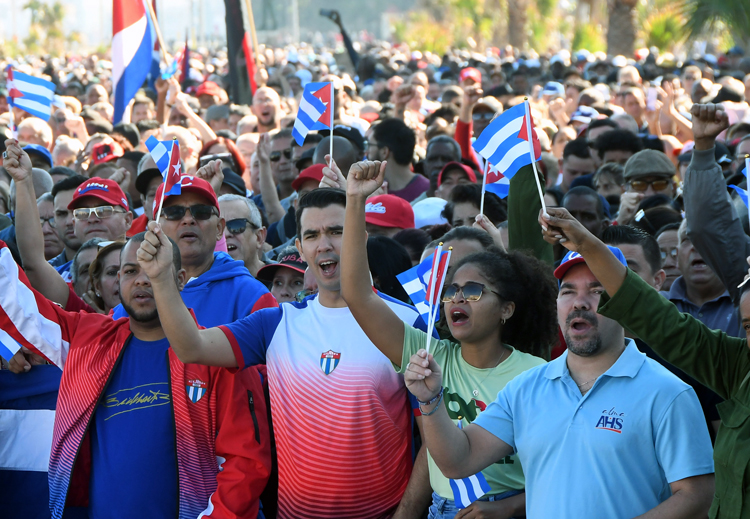
Tens of thousands of Cubans demonstrated in Havana Jan. 3, calling on working people around the world to mobilize to stop Washington’s war drive. The action showed what the U.S. rulers would face if they tried to invade Cuba.
Thousands of Cubans have been part of internationalist missions in Venezuela, working as doctors, teachers and other technical personnel for decades, earning the respect and admiration of millions of Venezuelans. These Cuban workers “feel as their own the attacks committed” against the Venezuelan people, the Central Organization of Cuban Workers (CTC), Cuba’s main trade union federation, said in a Jan. 3 statement. “We express our solidarity with that noble people and we will not stop denouncing before the international community this new military escalation and interference by the U.S. government.”
Governments in Mexico, Colombia and elsewhere in Latin America condemned Washington’s aggression against Venezuela. Demonstrations against the invasion were held in cities across the U.S. calling for “U.S. Hands Off Venezuela!”
Major labor federations, including the International Trade Union Confederation, the Trade Union Confederation of the Americas, and the ITUC’s U.S. affiliate, the AFL-CIO, have condemned the U.S. attack.
“We, the trade union movement of the Americas, condemn the military aggression and kidnapping of President Maduro and his partner Cilia Flores, a violation of the sovereignty and integrity of the Venezuelan people and of all Latin America and the Caribbean,” the ITUC and TUCA said in a Jan. 3 joint statement.
The AFL-CIO posted the statement, saying, “We join the international labor community in condemning President Trump’s unconstitutional actions in Venezuela.”