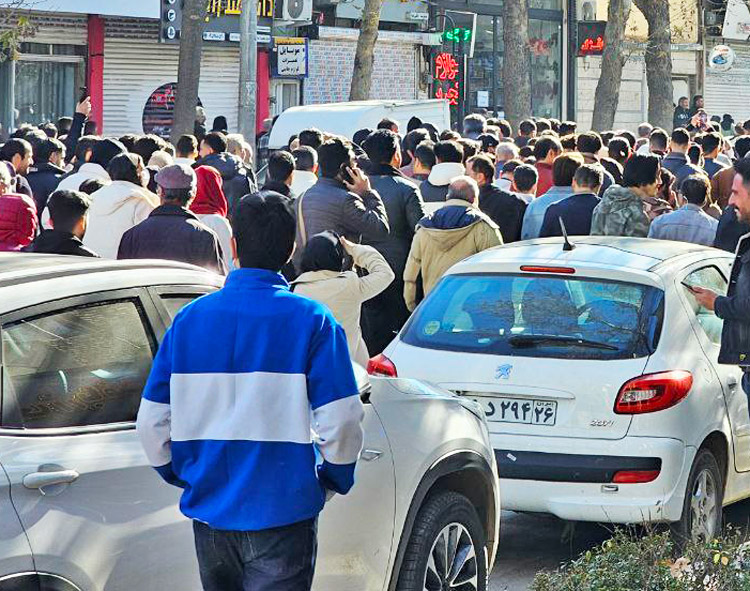
The Iranian regime’s Tasnim News claimed Jan. 6 that protests that began among shopkeepers in the bazaar in Tehran Dec. 28 and then spread across the country — including to small towns and universities — were now “moving toward complete calm.” But that same day videos showed police and Islamic Revolutionary Guard Corps thugs clashing with hundreds of merchants at Tehran’s Grand Bazaar and firing tear gas to force protesters to disperse.
The government-funded Iranian Student News Agency admitted that merchants had closed “most shops” at the Grand Bazaar and that there were so many people protesting that “it was not possible to enter.”
The government’s Fars News Agency reported protesters chanted, “Honorable merchants, support, support!” Fars said shopkeepers had closed their stalls to protest the drop in the value of the Iranian currency and “lack of price stability.”
The Dec. 28 protest began among merchants at bazaars in Tehran and then spread to other bazaars and towns around the country. Merchants and working people are being hit hard by the deepening economic crisis. This is worsened by the regime’s allocation of significant funds to build missiles and weapons for future attacks on Israel.
The value of Iran’s currency has dropped at least 40% since the 12-day war between Israel and the regime in June. While official inflation is around 42% annually, food inflation is at 72% and bread 113%.
Khamenei: Put rioters in their place
Desperately trying to quell the actions, Supreme Leader Ayatollah Ali Khamenei admitted Jan. 3 that the shopkeepers were being battered by inflation. He claimed the currency crisis, the protests and the clashes with the cops and regime thugs were largely the work of “enemies” of the Islamic Republic — Israel and Washington. “We talk to the protesters,” Khamenei threatened. “But there is no benefit to talking to rioters. The rioters must be put in their place.”
By the 10th day there had been protests at more than 250 locations in at least 27 of Iran’s 31 provinces and at 17 universities. At least 29 protesters have been killed and more than 1,200 arrested. Many of those killed are teenagers.
According to numerous reports, members of the Islamic Revolutionary Guard Corps forcibly entered Khomeini Hospital in Ilam Jan. 4 where medical workers were attending to protesters wounded earlier at a demonstration of thousands in nearby Malekshahi, a mostly Kurdish area. The thugs broke windows, fired tear gas and beat health care workers, patients and family members.
The Teachers’ Association of Aligudarz, a town in Lorestan province, condemned the attack. “Hospitals and medical centers are supposed to be safe spaces,” it said.
Jobs, marriage out of reach for youth
Poverty, corruption, “unemployment and rampant inflation have caused despair and rebellion among the people of this land,” the association noted. “Jobs, marriage and housing have become unattainable dreams for the young. They have put their lives and bodies on the line and taken to the streets to express their demands.”
Working people in Iran and many news reports compare this wave of protests with three previous ones: working-class protests that swept some 90 cities and towns from December 2017 into 2018; similar actions that broke out in November 2019 after the government announced an increase in gasoline prices; and the several months of protests starting in September 2022 after Zhina Amini, a young Kurdish woman, died after she was arrested by the hated “morality” police for allegedly violating the reactionary dress code for women.
“The current protests are not nearly as widespread” as those actions, the New York Times said Jan. 5. And key organized sections of the working class, oil workers and truck drivers, while sympathetic, have not joined the latest anti-regime protests, at least so far.
Like the earlier waves, these protests are fueled by opposition to the regime’s attempts to extend its reactionary influence throughout the Middle East, aimed at the destruction of Israel and the elimination of the Jews there; its repression of basic democratic rights and its attempt to push the capitalist economic crisis on the backs of working people.
This time a popular chant has been “Not Gaza, not Lebanon, I give my life for Iran,” a reflection of the opposition to being used as cannon fodder.
Protests in places ‘never heard of’
One difference this time is that many of the protests are in small towns, where there had not previously been significant actions. “The government’s repression is even more intense in the more deprived areas,” noted Strengthening the Nation, a Farsi-language internet site. “In places that many of us may not have even heard of, hundreds of people take to the streets and the officers shoot at them.”
Azna, a town in Lorestan province of roughly 50,000 people with little history of protest — mostly from the Lur minority — is a good example. The demonstrations there started peacefully Jan. 1. According to the IranWire news site, at first “the slogans were purely about livelihoods.” Then the “repressive forces” started shooting live ammunition and tear gas, killing several young people.
“The killing of these kids made people extremely angry,” one person told IranWire. “They pushed the repressive forces back toward the police station and set it on fire.” By then the slogans had changed to “Death to Khamenei.”
Thousands turned out for the Jan. 2 funeral for Khodadad Shirvani in Marvdasht, a city in Fars province with a population of just 150,000. Shirvani was killed at a protest the day before. Most of those who live in this area surrounded by small farms are from the ethnic Persian majority.
Along with open brutality the regime is also trying to quell the protests by announcing Jan. 5 that it will provide a monthly payment of 1 million tomans — roughly $7 — to most Iranians to help ease the economic crisis.
“They want to give people 1 million tomans each,” a truck driver said on the internet site of the Association of Truckers and Drivers Unions, “because of the protests. On the other hand, what are transportation, supplies and food supposed to cost? With 1 million they’ve made fools of the people. An hour ago I went shopping, just a 10-kilo bag of rice, not counting chicken or meat, plus a few small items — by God it came to 12 million tomans.”
The protests are continuing.