MINNEAPOLIS — Immigration and Customs Enforcement operations targeting immigrant workers have escalated here. They’ve spread from the Twin Cities area to Rochester, Willmar, St. Cloud, Mankato, Alexandria, St. James, Fergus Falls, Pelican Rapids, Waite Park and Detroit Lakes.
The assaults are prompting widespread discussion among working people about what we can do to be effective to defend workers without papers, stop attacks on constitutional protections like due process and unite the working class.
The wide-ranging arrest and deportation of immigrant workers here puts the lie to the claims of President Donald Trump’s administration that it would only target the “worst of the worst criminals.”
The nightly local news includes scenes of warrantless and strong arm seizures of working people, and even high school students, on the street, at workplaces and people’s homes — especially those thought to be Latino or Somali, regardless of their citizenship status.
Elizabeth Lugert-Thom, a resident of St. Paul, said two federal officers had asked her to identify the Hmong and Asian households in her North End neighborhood. “I don’t know anything about that,” she told them. Lugert-Thom told the Chicago Tribune she was shocked about “what I was asked to do.”
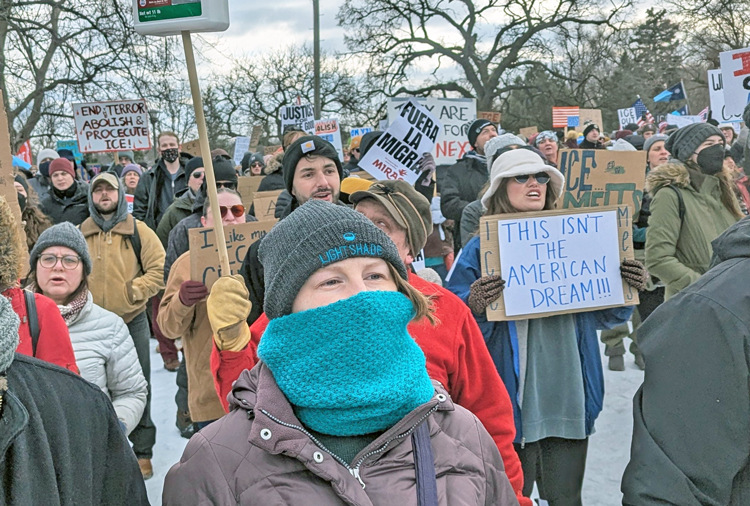
Since the fatal shooting of ICE Watch activist Renee Good and a second shooting that injured someone ICE was trying to arrest Jan. 15, thousands of working people here have looked for ways to protest. Good was trying to block the road to stop a convoy of ICE agents.
This has also led to some ultra-left actions aimed at disrupting ICE operations nightly at the Whipple Federal Building and elsewhere. Led by Stalinists and others on the middle-class left, they aim to carry out provocations leading to violent clashes. Some launch fireworks and water bottles at ICE agents and local police. Others follow, film and scream at them.
Overwhelmingly these are the actions reported by the bourgeois media, which largely ignores the disciplined, peaceful protests that attract workers and their families, union members and others during the daytime.
“I would like to speak out against what is happening,” Gabe, a delivery driver whose family is originally from Kenya, told the Militant. “But I’ve never been to a protest and the ones I see on the news seem very dangerous. I don’t think they will help.”
The destructive, anti-working-class course builds on the ultra-left course of Black Lives Matter and similar groups that orchestrated weeks of rioting in the wake of the death of George Floyd in 2020. Their thuggish actions set back prospects for organizing working people to fight cop brutality.
On Jan. 18 some 30 Black Lives Matter and other activists disrupted a service at the Southern Baptist Church in St. Paul. Using the pretext that a pastor there is working for ICE, they marched into the church, chanting “ICE Out” and “Justice for Renee Good.” The Minnesotan-Wisconsin Baptist convention said the service “was forced to end prematurely.”
The Trump administration Jan. 19 ordered 1,500 U.S. troops on stand-by for possible deployment to Minneapolis and use against anti-ICE activists .
The Trump administration announced Jan. 6 that it was ending Temporary Protective Status for Somalis on March 17. The move has been accompanied by Trump’s chauvinistic denigration of Somalis, who he claims “come from hell” and “contribute nothing.”
Dozens of walkouts at high schools protesting ICE actions have occurred throughout the state, culminating with a rally of several hundred students at the state Capitol in St. Paul Jan. 14. Socialist Workers Party members who participated reported it drew in forces new to the fight to defend immigrant workers. It was peaceful and marshaled by parents.
Speakers at a press conference there the same day included Minnesota Farmers Union President Gary Wertish. He said the stepped-up raids were hitting farmworkers. Some 3,500 holders of H-2A visas have legal authorization to work in Minnesota agriculture. But fear of being seized by ICE is keeping many from reporting to work.
Wilber De La Rosa, owner of a Mexican restaurant in Rochester, told the press he has been delivering food to immigrants who have nothing to eat, “who are afraid to travel outside.”
2006 mass protests set example
Thousands have joined similar church-run efforts, a sign of the widespread solidarity that exists among working people. But a headline in the New York Times “Volunteers in Minnesota Deliver Groceries So Immigrants Can Hide at Home,” shows the weakness of this approach. The goal can’t be to help immigrants to “hide out.” What’s needed is a mass movement they can safely join with clear demands to push government attacks back.
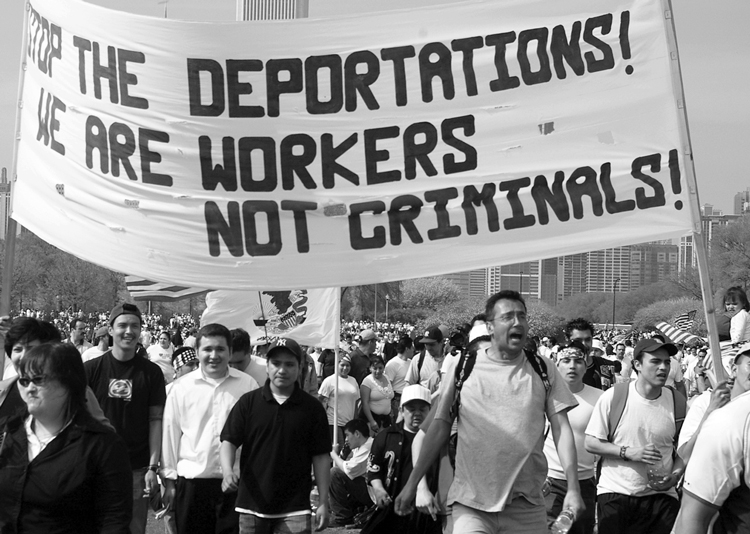
In 2006 and 2007 millions of immigrants turned out on May Day in cities and small towns all across the country to demand a halt to raids and deportations, proudly asserting “we are workers, not criminals.” They acted not in fear, but confident of the broad support that existed for their fight. In Minneapolis alone 30,000 demonstrated in 2006.
Actions like these are also the best way to force ICE to back off.
These historic actions and what they accomplished need to be more widely known.
Today the trade unions are increasingly speaking out in defense of immigrant workers. In the last week statements by the AFL-CIO have been endorsed by the United Food and Commercial Workers, the Bakery, Confectionery, Tobacco Workers and Grain Millers and other unions. Service Employees International Union Local 26’s president said the current ICE attacks will lead to greater attacks on unions when they resist bosses in the future.
Geof Paquette, lead internal organizer for UNITE HERE Local 17, told the Militant, “A dozen of our workers have been arrested after passing through security heading to their jobs at the airport.” He said “that to work at the airport you must first pass a 10-year background check to get work authorization, so all these workers had documents to work. They have been sent to Texas where union lawyers are working on their cases.”
Growing numbers of working people are deeply disturbed by the all-out assault on their immigrant co-workers and neighbors for the “crime” of being foreign born.
Socialist Workers Party member Joanne Murphy showed several co-workers pictures of herself carrying a sign demanding an amnesty for workers without papers at the Jan. 10 march and rally of 10,000 people for immigrant rights at Powderhorn Park in Minneapolis. “La migra was nowhere around at this big action,” Murphy told workers at the bakery where she works.
Amnesty for all immigrant workers
She described how almost 3 million workers had won amnesty in 1986 when Ronald Reagan was president. She pointed to the possibility of winning amnesty now through a union-led fight. A worker from Ecuador, who had been translating the discussion for others, said that when she’d brought up amnesty at home, her uncle had said that was how he became legal.
Today there is no leadership coming from any Democratic or Republican politician that points to the need to fight for an amnesty. Gov. Timothy Walz tells people to “carry their phones with them so that when they see federal agents in their area, they can take out their phone and hit record.”
Robin Wonsley, the Democratic Socialist city council member in Minneapolis, calls for confrontations. “Officials and government won’t try to stop ICE,” she says. “We are only ones who can do it.”
This is a course for disaster. What’s needed here and across the country is a union-led fight for amnesty for all undocumented workers, a movement that would unify the working class. One that immigrant workers and others can participate in and help lead.
SWP members are discussing that perspective with fellow working people on their doorsteps, in their unions and at actions called to protest ICE actions.
A march co-sponsored by many unions and the Minnesota Immigrant Rights Coalition is set for Jan. 23. SWP members will attend the action to discuss a road forward for the working class.
Edwin Fruit and Helen Myers contributed to this article.