Due to the government’s blackout of internet and cellphone services, it’s still unknown how many people in Iran were massacred by the reactionary bourgeois clerical regime Jan. 8-10. One government official told Reuters at least 4,500 protesters had been killed. The Human Rights Activists News Agency says it could be triple that, along with some 5,800 people severely wounded and 26,000 arrested as of Jan. 19.
While the bloody attacks ended the two-week protest wave, opposition to the regime has deepened. The working classes are battered but unbowed.
No significant wing of the capitalist regime has repudiated the regime’s murderous assaults on the protests that began with merchants and capitalists in Tehran’s central bazaar Dec. 28. Then they spread across the country, drawing in workers and oppressed nationalities.
The protests began in response to the plummeting value of the Iranian currency and rising prices. But they soon took up opposition to the regime’s trampling on democratic rights as well as its efforts to extend its reactionary influence throughout the Middle East.
A popular slogan was “Not for Gaza, not for Lebanon; I give my life for Iran,” an expression of opposition to the regime’s drive to destroy Israel and eliminate the Jews there.
Some cracks are emerging in the regime’s facade. Alireza Rafiei, CEO of Irancell, Iran’s second-largest mobile phone company, was fired for “disobeying the order” to immediately shutdown internet access Jan. 8. The several-hour delay allowed initial videos of the massacre to reach the world.
The daily Ham-Mihan published articles about the protests and repression until Jan. 19, when the regime’s Press Supervisory Board closed the paper down. It objected to several articles, including a Jan. 17 editorial advising the regime to adopt the “skill of listening” and not confuse protesters with “rioters.” That was enough to get it banned.
Baluchis and Kurds join protests
As the protests grew larger and spread to small towns and universities across the country, the regime’s Islamic Revolutionary Guard Corps, Basij paramilitary thugs and police attacked with tear gas, rubber bullets and live fire.
A coalition of Kurdish parties issued a call for a Jan. 8 general strike saying, “Kurdistan supports protests and popular uprisings.” One Baluchi party called on the people of Sistan-Baluchistan province to “act in unity” with protests elsewhere.
Seeing the growing participation by oppressed nationalities as a serious threat, the regime unleashed a massive assault on protesters Jan. 8. The repression fell especially hard in the Kurdish region, where there is a long history of opposition to the regime.
Some 40% of the Iranian people are from oppressed nationalities — Kurds, Baluchis, Azerbaijanis, Arabs and more. They faced discrimination and denial of their rights under the U.S.-backed regime of the shah, which then continued and worsened under the repressive regime of the Islamic Republic.
Following the death of the Kurdish woman Zhina Amini after her arrest by the hated “morality” police in Tehran in 2022, actions by Baluchis began in the city of Zahedan in solidarity with the “Women, Life, Freedom” movement. They protested for over 30 consecutive weeks against the death penalty and for freeing political prisoners.
Prominent Sunni cleric and leader of the Baluchi people, Sheik Abdul-Hamid, spoke out at the weekly Friday prayer service in Zahedan Jan. 16. “We strongly condemn this killing and extend our condolences to each and every family that lost loved ones in these protests,” he said, calling for all those arrested to be freed.
More facts on crackdown emerge
More videos of the crackdown are now coming to light. Virtually nonstop semiautomatic weapon fire can be heard for long stretches as the thugs murder unarmed protestors. CCTV videos show large groups of Basij thugs armed with clubs breaking into apartment buildings whose residents had given refuge to protesters fleeing the assault.
Other videos show family members looking for their loved ones among hundreds of slain protesters in body bags at the morgue in Tehran. Some bodies were still in hospital gowns, with catheters or breathing tubes attached, indicating that the regime kidnapped hospitalized protesters and murdered them in cold blood.
After the protest wave had been pushed back, President Donald Trump issued a statement Jan. 13 calling on the protests to continue and promising “help is on the way,” a threat to unleash military retaliation. That promotes the illusion that U.S. imperialism is on the side of the Iranian people. But the U.S. rulers only concern is in advancing their plunder of the resources and labor in the region.
Trump rapidly retracted his threat, saying the regime had promised there would be no executions. At the same time the Wall Street Journal reported Jan. 20 that the USS Abraham Lincoln aircraft carrier and its strike group, including combat planes and jamming aircraft, are on their way to the Persian Gulf.
The mass repression is a sign of the regime’s weakness, not strength. Over the past two years, Israel has dealt big blows to Hezbollah in Lebanon and Hamas in Gaza, Tehran’s closest allies, which the regime is helping to rebuild. The Bashar al-Assad dictatorship in Syria, Tehran’s ally, was overthrown. Washington has kidnapped Venezuelan President Nicolás Maduro, Tehran’s closest ally in Latin America, and is seizing millions of barrels of oil there.
Black-clad riot police are roaming the streets of Tehran and other cities. In Tabriz, regime thugs inspect cell phones and search vehicles at checkpoints across the city.
But the show of force can’t prevent new actions from breaking out. Prior to the latest anti-regime protests, thousands of oil workers, as well as retirees from the steel, telecommunications and sugar industry, had been holding weekly protests. They will find a way to continue to fight.
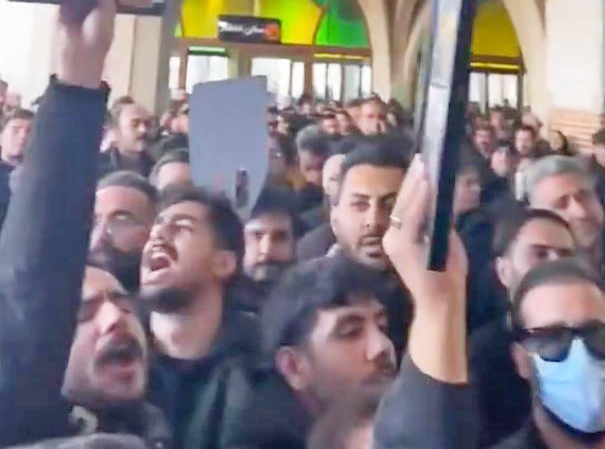
Hundreds chanted anti-government slogans at the Jan. 19 funeral of 21-year-old Ahmad Khosravani at the Behesht Zahra Cemetery in Tehran. Khosravani, a well-known basketball player and student at Sharif University of Technology, was shot and killed during the protests in Tehran.