The view presented by capitalist politicians and the bourgeois press — echoing the claims by Iran Supreme Leader Ali Khamenei — is that the bourgeois clerical regime in power in Iran today is the defender and continuity of the 1979 revolution that overthrew the U.S.-backed dictatorship of Shah Mohammad Reza Pahlavi.
That turns reality on its head. The reactionary regime in Tehran comes from a political counterrevolution that pushed back the gains of the 1979 revolution.
That revolution was a deep-going, modern, popular social revolution in city and countryside, not a religious jihad as it is falsely portrayed by bourgeois voices. It reverberated across the Middle East and the world.
For decades the shah — which means king — was a staunch ally of U.S. imperialism throughout the region. After he was overthrown by a popular upsurge in the early 1950s, a CIA-organized military coup put Pahlavi back in power in 1953.
His regime — which claimed to be “modernizing” Iran — grew more and more hated. The capitalist “modernization” was carried out on the backs of Iran’s workers, farmers and oppressed nationalities.
In 1971, for example, the average per capita income was less than $1 a day, and the average monthly consumption of meat was 2.7 pounds per person! Farsi, the language of the Persian majority, was made the only official language. Oppressed nationalities, including Kurds, Azerbaijanis, Baluchis and Arabs, faced widespread discrimination.
The shah resorted to brutal repression to maintain his rule. Trade unions and almost all opposition parties and newspapers were banned. SAVAK, the secret police, trained and funded by the CIA and other U.S. agencies, was notorious for its torture chambers.
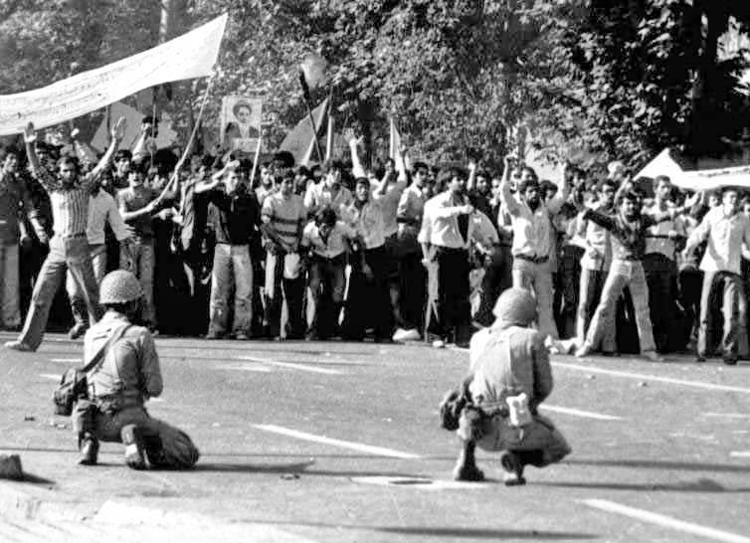
After a million people marched against the shah in Tehran on Sept. 7, 1978, the regime declared martial law. The following day troops shot and killed hundreds, possibly thousands, of protesters across the country.
The industrial working class began to play a more prominent role in the protests. Waves of strikes occurred over the following month, involving 40,000 oil workers, 150,000 textile workers, 40,000 steelworkers, 100,000 government employees and others. Peasants joined in, coming to demonstrations in the cities. The oil workers led a general strike for more than 100 days that brought the economy to a total halt.
The shah fled the country on Jan. 16, 1979, supposedly on an “extended vacation.” Ayatollah Ruhollah Khomeini — who had been exiled for publicly backing previous protests — returned to Tehran Feb. 1, fueling the popular upsurge.
Militant correspondents in Tehran provided eyewitness accounts of these momentous events. “The Iranian armed forces — with more personnel and weapons than those of British imperialism — crumbled in the face of popular defiance and a soldiers’ rebellion,” they reported.
Workers took the lead in setting up shoras — councils — in factories and neighborhoods and to fight for workers control over production and job conditions. Farmers fought for land. Oppressed nationalities fought for the right to speak their own languages and against discrimination in jobs, education and housing.
Bourgeois forces organized around Khomeini fought to establish a stable capitalist regime. They sought to get the protesters off the streets and to end the power of strike committees and neighborhood committees that were running many industries and some towns.
In 1980 Iraqi dictator Saddam Hussein invaded Iran with U.S. backing, hoping to overthrow the revolution. Hundreds of thousands of Iranian workers and farmers volunteered for the military to defeat the invasion.
Khomeini, backed by the capitalist class, over time took advantage of the war to use the newly formed Islamic Revolutionary Guard Corps, its Basij paramilitary force and other thugs to go after workers and their vanguard. Opposition newspapers were closed down. Islamist thugs broke up political rallies and tried to shut down opposition party headquarters. Revolutionary workers were imprisoned.
Revolutionary workers party in Iran
Members of the communist movement in Iran in 1979 formed the Socialist Workers Party (HKS), later renamed the Workers Unity Party (HVK). They “were in the thick of the revolutionary class struggle,” the Militant wrote. “They were workers in factories, refineries and other industrial workplaces, as well as volunteer soldiers combating the Iraqi invasion.” Many of that party’s cadres and leaders had been recruited by the Socialist Workers Party in the U.S. while they were living there during the reign of the shah.
HVK members fought to extend and unify the factory shoras. The party called for land distribution under control of peasant shoras and self-determination for oppressed nationalities. They joined with women workers fighting for equal pay for equal work, child care and against compulsory veiling.
It was not until mid-1983 that the counterrevolution was able to consolidate its stranglehold, having forcibly shut down all working-class parties and other political opposition.
Since 2017 the regime’s grip on power — including backing like-minded Hamas thugs in Gaza and Hezbollah in Lebanon to eradicate Israel and the Jews — has confronted growing opposition and is coming apart.
A record of the HVK’s proletarian internationalist course is presented in New International no. 7, which includes “Communism, the Working Class, and the Anti-Imperialist Struggle: Lessons from the Iran-Iraq War,” which presents two of the party’s documents.