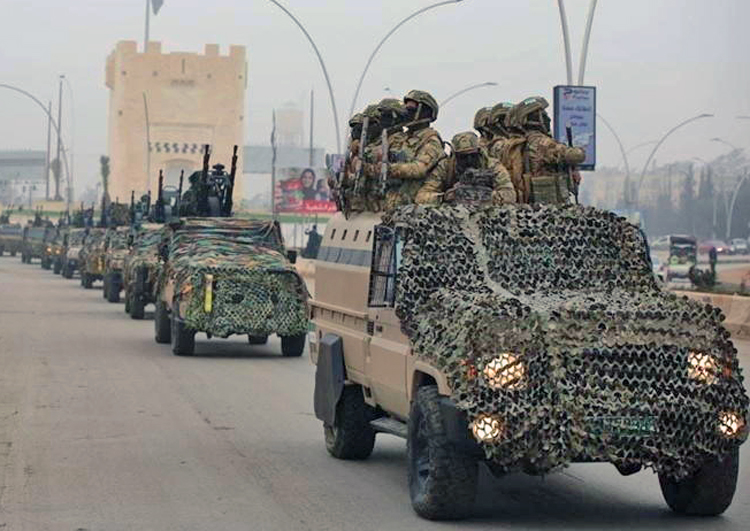
A dayslong assault by the Syrian army against the Kurdish-led Syrian Democratic Forces pushed the SDF out of large parts of Kurdish-controlled areas in northeastern Syria Jan. 18. The government tossed aside a ceasefire deal it had signed with the SDF the day before, with fighting continuing around the city of Kobani and in other areas.
Washington was formerly allied with the SDF in the fight against the reactionary Islamic State forces that had spread death and destruction across the region in 2015. But the U.S. government is now telling the SDF to give up its arms and let Syrian government forces take over the northeast region.
The U.S. rulers seek closer ties with the new Syrian president, Ahmad al-Sharaa. They view stronger relations with him as a vital part of strengthening their alliances with Arab regimes across the Middle East, as they drive to establish a “Board of Peace” to rule over Gaza and to plunder the region.
Washington is determined to ensure the unresolved struggle for Kurdish national rights does not get in its way.
Divided between Iran, Iraq, Syria and Turkey, over 30 million Kurds are the world’s largest nationality without a homeland. For decades they have refused to stop fighting for their national rights despite facing severe repression. The Kurdish-led autonomous zone in northeast Syria was carved out in the war against the Islamic State. Kurds make up 10% of Syria’s population of 23 million.
Syrian troops seized full military and administrative control of Deir el-Zour and Raqqa, the two provinces in the Kurdish-controlled region that are majority Arab. They also include areas where many of Syria’s oil and gas fields are located.
Led by fighters from the Kurdish People’s Protection Units, the SDF also includes some Arab, Turkmen and Assyrian fighters.
The SDF continues to hold areas in most of the third province of the northeast region, Hassakeh, which is majority Kurdish, as well as the town of Kobani in Raqqa province. It repelled attacks by Syrian government forces there Jan. 20. Residents say that electricity and water supplies have been cut off. The Syrian government denies its forces are besieging the city.
“We signed an agreement on Sunday [Jan. 17], but Damascus broke it immediately,” Ilham Ahmad, head of foreign relations for the SDF-affiliated civil administration said.
The agreement would have dismantled Kurdish control of northeastern Syria and led to SDF fighters joining the Syrian army one by one after being “vetted” by the government.
In a move long called for by the rulers of Turkey, the ceasefire agreement included the removal of any Kurdistan Workers Party (PKK) forces from Syria. For years the PKK has fought successive Turkish governments for Kurdish national rights. It declared a ceasefire in March last year.
Turkish President Recep Tayyip Erdogan is backing al-Sharaa as the Syrian president seeks to solidify his government’s political and military grip on Syria. Erdogan has especially prioritized dealing blows to the struggle of Syrian Kurds, fearing that any gains they make would set an example to Kurds in Turkey. In 2018 the Turkish army invaded the Afrin area in northwest Syria, forcing some 160,000 Kurds there to flee, many to the northeast region.
The current Syrian army offensive follows its drive last week to retake Kurdish-controlled areas defended by the SDF. As a result of that assault more than 500 Kurdish families have fled to Hassakeh province.
U.S. rulers back Syrian gov’t assault
Since the fall of the Bashar al-Assad regime in late 2024, Washington has cultivated ties with al-Sharaa’s government and ended U.S. sanctions on Syria. Just prior to the assault on the Kurdish region, Tom Barrack, U.S. special envoy for Syria, met with SDF leader Mazloum Abdi in Iraq Jan. 17 to force through the ceasefire and ceding of territory to the government’s forces.
After the deal was signed, President Donald Trump said, “Just so you understand, the Kurds were paid tremendous amounts of money, were given oil and other things. So they were doing it for themselves, more so than they were doing it for us.”
Washington’s backing for the Syrian government is just the latest in a long series of betrayals of the Kurdish national struggle.
Al-Sharaa, a former leader of al-Qaeda, took office claiming he would respect the rights of all Syrians. But he has sought to extend his regime’s control over the entire country and especially to impose its control over national and religious minorities. In July 2025 forces allied with his government launched assaults on Druze-majority areas in southern Syria, killing hundreds. Resistance by the Druze, backed by the Israeli government, forced an end to the attacks.
Last March, Syrian government forces carried out attacks on members of the Alawite minority, formerly a stronghold for the Assad regime, killing over 1,400.
Al-Sharaa’s government is based on a coalition whose roots were in reactionary Islamist forces. When Assad fled and Al-Sharaa took over in late 2024, the Israeli government acted swiftly to push back the threat the new government represented. Israeli forces launched 320 airstrikes demolishing the Syrian navy, and taking out its chemical weapons, missiles and other military sites.
As the Syrian government forces make big gains in the northeast region today, al-Sharaa issued a decree recognizing Kurdish as an official language and outlawing discrimination against Kurds Jan. 17. The goal of these measures was to try to mask the fact his forces were dealing serious blows to the Kurds’ right to self-determination.
Around the world Kurds and their supporters have taken to the streets to protest the assault. Demonstrations in solidarity took place in the Kurdish region of Iraq, in the cities of Erbil and Sulaymaniyah.
Some 150 people demonstrated in Montreal Jan. 17, following the assault on the Kurdish neighborhoods in Aleppo.
Two days earlier hundreds of people rallied in Manchester, England, the largest action in solidarity with Kurds in that city in many years. Demonstrators rallied behind a banner reading “No peace without justice for Druze, Alawites and Kurds in Syria.”