HAVANA — A team of Militant correspondents arrived here Feb. 6 to report on the response of the Cuban people and their government to the sharp escalation in the U.S. rulers’ economic war against them.
Combined with direct military threats, Washington hopes its brutal economic squeeze can bring about what they euphemistically call “regime change,” that is, overturning Cuba’s socialist revolution. It’s the goal the U.S. capitalist families and their government have vainly pursued for six and a half decades.
We tell everyone we speak with that we’ll return home to explain to fellow workers in the U.S. and other countries the truth about what we’ve seen. The following are just a few examples.
Brutal U.S. oil blockade
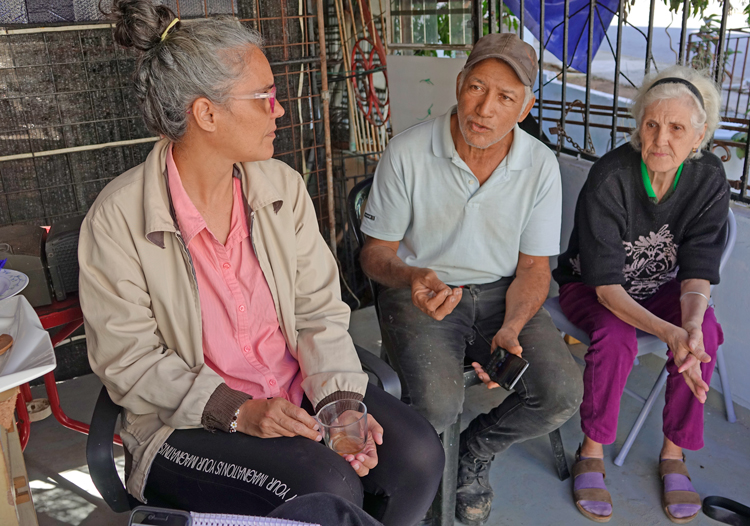
During our first days on the ground here, we stopped by the home of Carlos Muñiz and Magela Elepán. Muñiz, 58, a self-employed welder, confirmed that daily blackouts of many hours, a result of the U.S. government’s economic war, have become longer and more frequent since Washington’s Jan. 3 assault on Venezuela and blockade of oil shipments to Cuba.
“Two weeks ago, we had electric power for just two hours a day,” he said. “I couldn’t do my job for a few days.”
The oil cutoff and resulting blackouts, Muñiz noted, have affected everything, from industrial and agricultural production to bus and car transportation — every aspect of daily life.
The day after we arrived in Havana, the government sharply increased the rationing of gasoline sales to conserve fuel. No gas will be sold to individual Cuban vehicle owners. Government administrative offices will be operating on curtailed schedules. Small shopkeepers told us they already face delays and higher costs in truck deliveries of agricultural produce to the city. And the heightened rationing will make this worse.
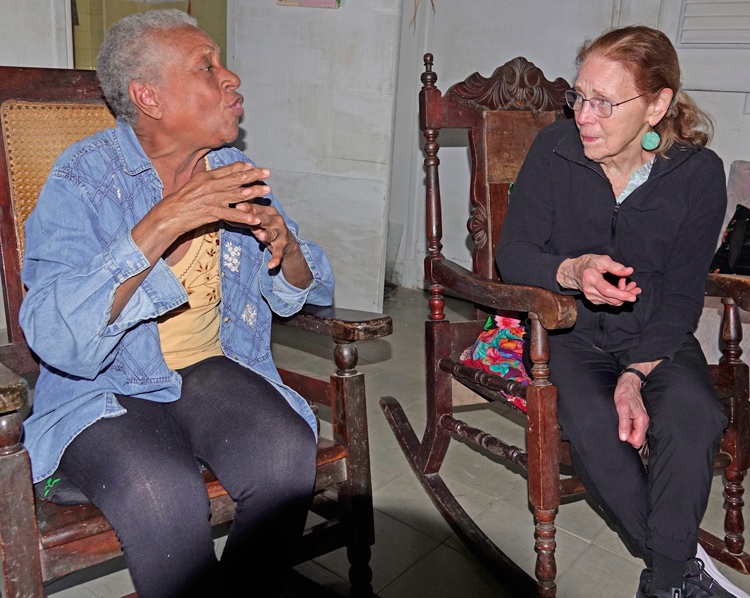
María Eugenia Arnet, a retired garment worker, told the Militant reporters, “The shortages of energy and other resources, the long blackouts — all that is part of the aggression against us that the U.S. empire has intensified. They will never forgive us for making a socialist revolution.”
Response to U.S. attack on Venezuela
“Early in the morning of Jan. 3, we woke up to the news of the U.S. aggression against Venezuela,” Muñiz told us. “We were stunned. My first thought was: we need to be in the streets. We were glad our government issued a call for a demonstration that same day at the Anti-Imperialist Plaza” on Havana’s seafront.
“The response to the call was incredible. Thousands of people turned out,” said Magela Elepán, 47, an office worker at a government agency responsible for Cuba’s national museums. “Unlike other rallies where participation is facilitated by workplaces or unions and student organizations, the turnout was spontaneous. People heard the call and came on their own, mostly on foot.”
Muñiz added, “This was even before we learned that Cubans had been killed in the attack. People were expressing solidarity with the people of Venezuela, outrage at the kidnapping of Venezuela’s president.”
When news came that 32 Cubans had been killed during the U.S. assault in Caracas, “it had a huge impact here. There was a deep feeling of anger and grief,” Elepán said. “And not only among supporters of the revolution like us. Even among many who don’t support the government.”
On Jan. 18, half a million Cubans in cities across the island turned out to pay homage to the 32 internationalist volunteers. In Havana the tribute was held at the Revolutionary Armed Forces Ministry building, near the Plaza of the Revolution, where coffins with the remains of the fallen combatants were displayed.
‘The enemy doesn’t understand us’
“The line of people, young and old, who came to pay their respects to our martyrs was unending,” Elepán said. “We were hit by a downpour and got drenched. But people didn’t leave. The procession began in the early morning and was supposed to end at 6 p.m., but there were so many in line that it continued until 10 p.m.”
“The enemy doesn’t understand us,” Muñiz said. “In 1961 the Cuban people defeated U.S. imperialism at Playa Girón,” referring to the U.S.-organized mercenary invasion at the Bay of Pigs.
“Millions of Cubans value what we’ve gained through the revolution. We learned from Fidel [Castro] and from our experience that a socialist revolution means human beings becoming more educated, more cultured. Becoming freer, more able to think for ourselves. It means a culture of solidarity.”
“It’s true that, with the intensification of the U.S. economic blockade against Cuba over the years, we’ve seen an erosion of solidarity among some people,” Elepán said. “The younger generations have known nothing but shortages of many things.”
We mentioned that the day before, an employee of a small store had told us bluntly he was glad Washington was seeking to increase popular discontent and bring about “regime change” in Cuba. Referring to the oil cutoff by the U.S. government, he said, “What they’re doing now is the best thing that could happen to us. I’m tired of living like this.”
That view remains a small minority, Elepán said. “One thing is certain,” she told us, “most Cubans — of all ages — don’t want to be colonized and subjected to a foreign power. Yes, we have many, many problems, which we have to solve ourselves. But we don’t want anyone from the outside telling us how to do things.”
As an example, they pointed to the tens of thousands of students and young soldiers who turned out for the Jan. 27 nighttime “March of the Torches.” This year’s event, which is organized annually by the Federation of University Students to honor the anti-imperialist legacy of José Martí, Cuba’s national hero, was seen as a defiant answer to Washington’s stepped-up threats.
‘I’m learning to shoot a rifle’
People also described to us the nationwide military training exercises that have been stepped up since Washington’s assault on Venezuela.
Since the early days of the revolution, every Cuban receives military training on one level or another. They know what to do, where to go, in case of a military attack.
For many years, preparedness drills have been held twice a year. Beginning Jan. 10 — one week after the “shock-and-awe” military attack on Venezuela — they have been held every Saturday, each time in different areas of the island. Tens of thousands have participated through the volunteer Territorial Troop Militias, organized by geographic areas, and the Production and Defense Brigades, organized in workplaces. The exercises also include units of the Revolutionary Armed Forces.
“I took part in the training two weeks ago at Martí Park,” here in Havana, Elepán said. “I had been part of previous National Days of Defense, but this was the first time I heard live grenades exploding. It was the first time I held an actual rifle in my hands and began to learn to fire one,” she said with a proud smile.
Response to new economic measures
On Jan. 29, the U.S. government declared a de facto total oil blockade against Cuba. “It’s outrageous that a big country like the United States won’t allow a small nation like ours to get oil,” Muñiz told us, paraphrasing the words of President Miguel Díaz-Canel. “Think what it means for hospitals, for schools, for transportation, for farmers who grow food.”
In face of the oil blockade, the Cuban government announced immediate measures to maximize the use of scarce energy resources, prioritizing essential services and social needs.
“It will mean tightening our belts even more,” Muñiz said. “There is a lot of uncertainty about what will happen in the coming weeks. But I agree with giving priority to protect those who are most vulnerable. Assuring fuel for hospitals, facilities for older adults, centers for children with special needs. Allocating our limited supply of solar panels to isolated rural communities, medical centers, and so forth. Most Cubans can understand that.”
As part of the rationing of resources, a number of major countrywide cultural events have been canceled, including the University 2026 conference, which in the past drew thousands of educators from across Latin America as well as Cuba. The Havana International Book Fair, Cuba’s largest cultural festival, held every February, was postponed until further notice.
Washington’s economic squeeze may lead to more electrical blackouts, but “there will be no cultural blackout,” declared Cuba’s ministry of culture in a Feb. 7 statement. “Art will continue to be a space for resistance, creativity, and support.”
Ana Morales, the program coordinator at Casa de África, a cultural center in Old Havana focusing on Cuba’s African heritage, told us large national cultural events — which involve substantial transportation and other fuel costs — will be shifted to community-based activities, from concerts to book presentations and art classes.
One of the people we visited was Herminio Fernández, a longtime trade unionist who manages a minihotel run by the Central Organization of Cuban Workers (CTC), the national trade union federation. His deeply felt words captured the attitude of a broad range of Cubans we’ve talked with, especially among working people.
“We face a severe lack of fuel, electric power, and many other things because the U.S. government is trying to strangle us,” Fernández told us. “But we’re not about to give up, and they won’t defeat us.
“They really don’t know who we are.”
Mary-Alice Waters contributed to this article.