President Donald Trump signed an executive order Jan. 29 aiming to sever Cuba’s oil supplies and bring its people to their knees. The decree, intended to force Cubans and their government to bow down to the U.S. rulers’ imperialist dictates, imposes punishing tariffs on goods from countries that sell or provide oil to Cuba.
The White House claims Cuba “constitutes an unusual and extraordinary threat” to U.S. national security. That’s the deliberate lie used by every Republican and Democratic Party president since 1959 to excuse their efforts to destroy the Cuban Revolution. The Trump administration accuses Havana of aligning itself with “malign actors” and “inviting” hostile countries “to base sophisticated military and intelligence capabilities” in Cuba.
Tightening the chokehold on Cuba builds on the White House blockade of oil supplies from Venezuela following the unilateral Jan. 3 U.S. military assault on that country.
Washington has succeeded in pressuring the government of Mexico, until recently a supplier of crude oil to Cuba, to halt shipments. The Mexican regime now claims this was a “sovereign decision” by PEMEX, the state oil company.
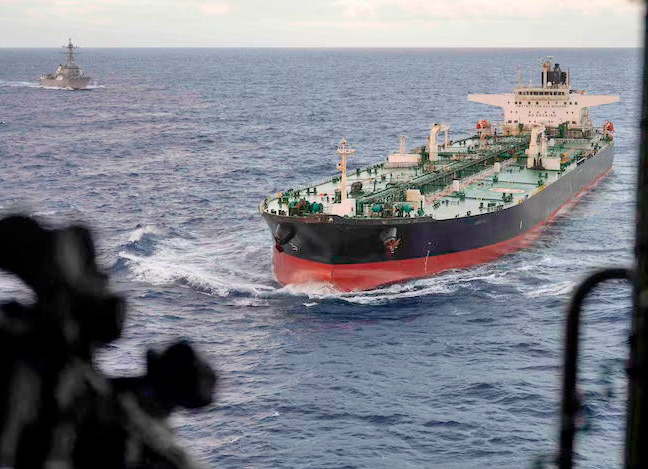
To enforce the blockade, Washington is maintaining its naval armada in Caribbean waters. So far, the U.S. military has seized eight oil tankers transporting “sanctioned” crude. The most recent, the Aquila II, was seized in the Indian Ocean Feb. 9 after tracking it from the Caribbean since early January. “No other nation on planet Earth has the capability to enforce its will through any domain,” said a warmongering post by the Pentagon. “By land, air, or sea, our armed forces will find you and deliver justice.” Pirates’ “justice,” that is.
The Cuban government is denouncing these moves toward a complete naval blockade as an act of war, rejecting Washington’s accusations.
“Cuba poses no threat to the United States,” said Deputy Foreign Minister Carlos Fernández de Cossío Feb. 5. “With the exception of the U.S. base in Guantánamo,” there are no foreign military bases in Cuba, he said. The Guantánamo Bay was seized by U.S. troops in 1898. Washington has occupied it ever since, against the will of Cuba’s people and government.
De Cossío and other government officials have also dispelled the capitalist media’s breast-beating about the Cuban government having “conceded” under pressure to talks with the Trump administration. “There is no change,” said de Cossío.
Dialogue has always been “Cuba’s historical position,” dating back to the Jan. 1, 1959, revolutionary victory under the leadership of Fidel Castro, said Cuban President Miguel Díaz-Canel at a press conference the same day. As between any governments, such talks must be “without pressure,” with “respect for our sovereignty, our independence, our self-determination.”
Seek to bring back capitalism
The U.S. capitalist rulers see an opening to deal blows to Cuba’s socialist revolution. For over six decades, the U.S. government — under both Democratic and Republican administrations — has waged a relentless economic and political war aimed at punishing the Cuban people for overthrowing capitalist exploitation and oppression, and setting an example for working people everywhere to do the same.
“A lot of people that live in [the U.S.] are treated very badly by Cuba,” said President Trump Feb. 1, “and we want them to be treated well.” These “badly treated people” are capitalist owners of big tracts of land, factories and financial interests who lost their ability to grow wealthy off the exploitation of Cuban workers and rural toilers after they took political power and began organizing society for the benefit of the majority.
A good example of the “people” Trump is talking about are capitalist interests behind two lawsuits currently in front of the U.S. Supreme Court— brought by Exxon Mobil Corp. and Havana Docks Corporation. These two U.S. corporations are seeking millions of dollars in damages from Cuban state enterprises for the nationalization of assets by the revolutionary government.
The “people” Washington says it wants “to help” do not include the 10 million in Cuba whose lives have been drastically worsened by the U.S. government’s economic war. Nor does it include the tens of thousands of Cubans living in the U.S. at risk of being deported by the Trump administration, many of whom are now joining protests against deportations across the country.
Facing U.S. aggression
“We will not waive our right to purchase oil,” said Cuban President Díaz-Canel. He called on other governments to denounce Washington’s trampling on the sovereignty not only of Cuba but of any country that wants to trade with it.
“There is no failed state” in Cuba, he said, answering U.S. officials who forecast an imminent collapse of Cuba’s economy and government. Instead, there is “a state that has had to face with great resistance” the “economic suffocation from the world’s leading power.”
Díaz-Canel described the extensive measures being taken to maintain production, farming and basic services, with special attention to the most vulnerable. He underlined preparations by the Cuban government, and by unions and other mass organizations, for a threatened U.S. military assault.
They are moving to increase domestic oil production — which currently meets about one-third of the country’s energy needs — and stepping up installation of solar farms.
A special effort is being made to install 5,000 solar panel units in homes of children with special needs, maternity and nursing homes and medical clinics. Homes in isolated areas are also being given priority, bringing electricity for the first time to communities that previously had little or no access. Throughout Cuba’s provinces, arrangements are being made to coordinate transportation for dialysis patients and others needing critical medical treatment.