A Call to Action by the Socialist Workers Party
The following statement was released February 7, 2026, by Jack Barnes, national secretary of the Socialist Workers Party, on behalf of the party’s National Committee.
There’s a pressing need today for a call to action by working people to oppose the US rulers’ tightening economic squeeze of the Cuban people and escalating military threats against Cuba.
In face of Washington’s brazen lies to rationalize its assaults on Cuban sovereignty, working people in the United States have both an obligation and an opportunity right now to get the truth about Cuba’s socialist revolution to the broadest layers of the population. The US rulers’ dangerous actions bring closer the prospects of war against Cuban working people, toilers who made and have defended that revolution for nearly seven decades. At the same time, these acts by the war makers threaten workers and the oppressed in the United States and the world over.
Washington’s course since the opening of 2026 poses the biggest US imperialist dangers to the Cuban Revolution and Cuban people since the October 1962 “missile crisis.” Then the John F. Kennedy administration, with bipartisan support, brought the world to the brink of nuclear war and ultimately had to back off plans to invade the island. The stakes for working people and the labor movement in opposing the US government’s course today are enormous.
Washington has mobilized naval and air power in the Caribbean on a scale unprecedented for nearly half a century. The US rulers unleashed those brutal forces January 3 to carry out their “shock and awe” assault on Venezuela, kidnapping and imprisoning President Nicolás Maduro and Cilia Flores, his wife. The Trump administration has leveraged that assault on Venezuela’s sovereignty to increase its economic and military pressure on the Cuban people.
At the center of this escalation have been measures to cut off Cuba’s access to imported oil and other energy resources, steps that increase blackouts and are leading to sharp reductions in the availability of the most basic human necessities. This comes on top of a tightening squeeze during the previous Trump and Joseph Biden presidencies of Cuba’s access to world markets and banking credit for food, for the most elementary medical and health products (resulting, among many other things, in a rise in both infant and maternal mortality and an epidemic of mosquito-borne viruses), for books and other educational and cultural conditions, and much more.
The noise and tone emanating from the current US administration have been marked by euphoria since last summer from its June 22 “bunker buster” assault on Iran and its recent attack on Venezuela. Top billing in this regard goes to Secretary of State Marco Rubio; Pete Hegseth (the administration’s rebranded “secretary of war”); and President Trump himself.
“There will be no more oil or money going to Cuba — Zero!” Trump announced on January 11. “I strongly suggest [Cuban leaders] make a deal, before it is too late.” During Senate testimony later that month, Rubio added: “We would love to see the regime there change.”
“Washington’s aim to
cut off oil shipments to
Cuba sharply increases
the risk of war”
All this has opened a bourgeois tactical breach with others in the so-called MAGA movement who campaigned for the Republican ticket in 2024 on pledges to working people not to pursue such war policies. However these divisions play out among the Republicans and Democrats, both parties — and every single one of the thirteen US presidents since January 1959 — have been and remain committed to overthrowing Cuba’s socialist revolution.
All capitalist ruling classes in the imperialist epoch have promoted the self-serving illusion that intensifying economic and armed conflicts, either by them or among them, can somehow be “limited” and “controlled.” History proves the contrary, at the cost of many tens of millions of human lives. Small wars all too often grow into big wars.
The US rulers also have numerous other ways at their disposal to crank up the pain on Cuban working people. The US government can extend the de facto blockade to necessities beyond oil and other energy resources. Washington can further restrict or even end all flights to Cuba. The outrageous US imperialist campaign targeting Cuban doctors and internationalist medical missions can be deepened. Monetary remittances to Cuban families from relatives living in the US can be cut even more.
And, as part of the administration’s wider victimization of immigrants, deportations of Cubans back to the island are already exacerbating shortages and social tensions there.
Washington’s announced aim to cut off oil shipments to Cuba is not just another White House “tariff” extortion. It sharply increases the risk of war. If any government decides to test Washington’s demand, there is no way for the US military to stop an attempted delivery of oil or other vital goods to Cuba other than by shooting at the tanker, commandeering it, or even sinking it — whatever national flag it may be flying. It could be a ship from nuclear-armed Russia, or a ship from China. It might even be a tanker from Venezuela or Mexico, whose governments have already succumbed to pressure from Washington by effectively cutting off oil to Cuba.
Ever since the victory of the Cuban Revolution, Washington has sought to excuse its aggression and violations of Cuba’s national sovereignty by spreading outright lies through their media, schools, and other propaganda mouthpieces. The US rulers warn of “a danger to national security” from a country with 3 percent the population of the United States. What’s more, while the Cuban government has sought normal economic and diplomatic relations from the outset of the revolution, it was Washington that unilaterally ruptured such ties at the opening of the 1960s. Cuba’s armed forces have no nuclear arms or any program to develop them, nor have they ever initiated military action against a US target.
What the US rulers truly fear is none of this. They fear the political and moral example and attraction among working people and the oppressed the world over of Cuba’s socialist revolution and its internationalist solidarity.
The Cuban government is willing and ready to have talks with the US government, as it always has been, said Cuban president Miguel Díaz-Canel at a two-hour February 5 press conference in Havana.
“It is very reprehensible that a power, with the size of the United States, should adopt such an aggressive and criminal policy towards a small nation,” Díaz-Canel said. “Because what does it mean to not allow a drop of fuel to reach a country? . . . How do we keep children in school without fuel? How do our vital systems function without fuel? How do we distribute food? How do we plant? How do we plow? How do we prepare the land? How do we harvest the crops? How do we get around?”
“US rulers fear the political
and moral example among
working people the world
over of Cuba’s socialist
revolution”
The Cuban president pointed to immediate measures the government is taking to ensure that increasingly scarce resources are reallocated to confront these worsening conditions. Gasoline and other energy sources are being rationed, with conscious attention to doing so in ways that don’t fall most heavily on those in rural areas, the elderly, primary schoolchildren, and other working people.
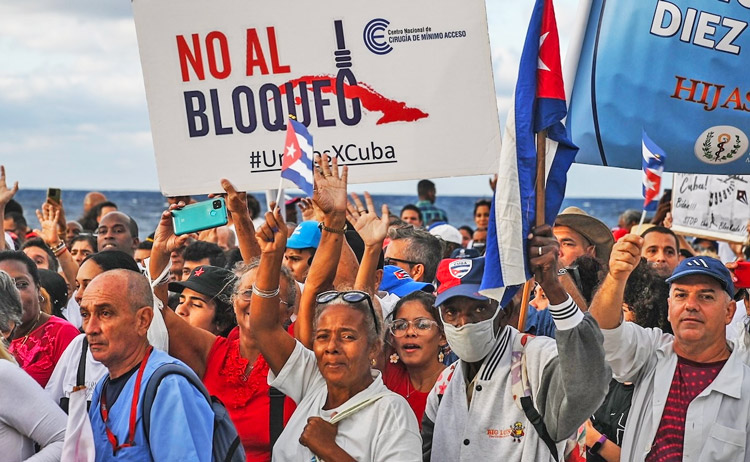
Díaz-Canel described the massive popular mobilizations across the island in recent weeks against the US government’s stepped-up aggression in the Caribbean and against Cuba itself. “The reality is that Cuba is a peaceful country,” he said. “Our country’s defense doctrine or military doctrine is based on the concept of the War of the Entire People” — pioneered in the 1980s by Cuban leader Fidel Castro — “which is a concept of defending the sovereignty and independence of the country. It does not contemplate, at any time, in any section, in any concept, aggression against any other country. We are not a threat to the United States.”
In that regard, Díaz-Canel said, in light of “the implications for Latin America and the Caribbean” after Washington’s January 3 assault on Venezuela, the Cuban population is being organized once again in regular volunteer military training, so that “gradually and systematically, all components of our territorial defense systems are preparing.” We are not “entering a state of war” right now, the Cuban president said, but “we are preparing for the possibility of entering a state of war at some point.”
Workers in the United States have no interest in the rulers’ brutalization of a small nation and its people simply for exercising their sovereign right to make a socialist revolution to improve their conditions of life and work. Nor for acting on what Cuban revolutionists often call “our debt to humanity” by extending internationalist solidarity to other working people — whether in Latin America, Vietnam, Africa, or elsewhere — fighting to emulate the Cuban Revolution’s example.
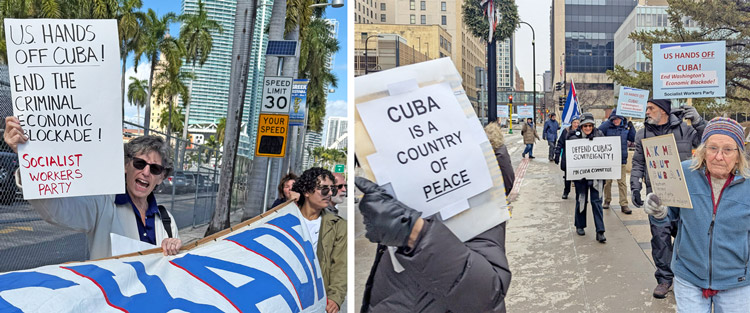
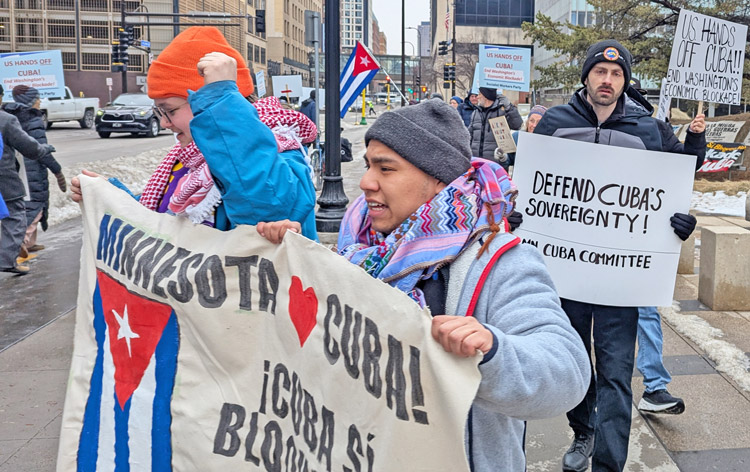
Instead, workers, unionists, and others among the exploited and oppressed in the US have an interest in demanding, “US hands off Cuba! End Washington’s economic blockade!”
Reach out to other organizations and individuals where you live and work to organize protest picket lines and public meetings to raise these demands on Washington and educate about the Cuban Revolution.
Take signs with these demands to actions across the country calling for amnesty for immigrant workers and a halt to deportations.
Discuss these life-or-death questions for working people with coworkers, other trade unionists, and those walking strike picket lines of nurses and other workers fighting to improve their wages, jobs conditions, and constitutional rights.
That’s what Socialist Workers Party members, SWP candidates for public office, and supporters are doing, through party election campaigns, sales of the Militant newspaper and books by revolutionary leaders in working-class neighborhoods, at weekly Militant Labor Forums, and other political activity.
Join with us in these efforts. And join the Socialist Workers Party.