

While Israel has dealt major blows to the reactionary, Jew-hating capitalist regime in Tehran and its key allies in the so-called axis of resistance — Hezbollah in Lebanon, Hamas in Gaza, the Houthis in Yemen — nothing is settled.
Israel continues to defend its existence as a refuge for Jews on multiple war fronts. This includes Iran, where the regime boasts that it is rebuilding its ballistic missile capacity; Lebanon, where Hezbollah has introduced more advanced drones in its war against Israeli forces; and Gaza, where Hamas is reestablishing its dictatorial grip.
None of these groups are interested in “peace” with Israel. They openly seek its destruction and the expulsion or elimination of the Jews who live there.
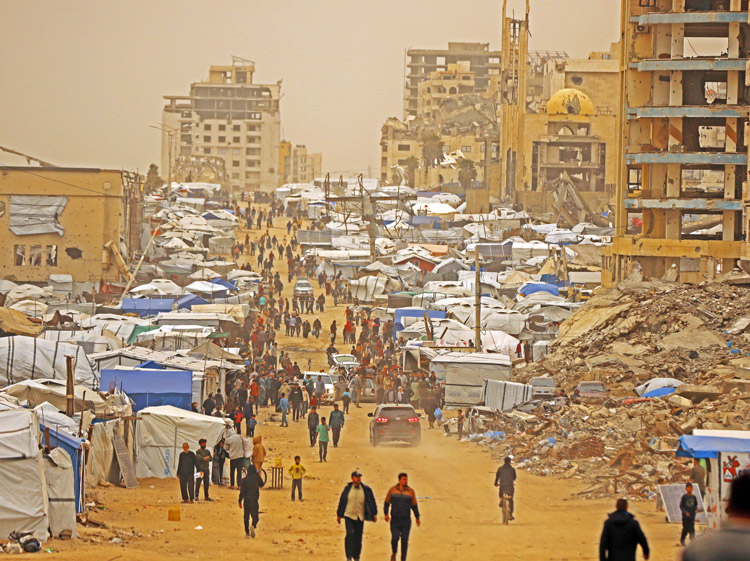
When the Donald Trump administration forced Israel to agree to the ceasefire in Gaza, which began Oct. 10, 2025, Israel maintained control of some 53% of the territory. All but 20,000 of the 2 million Palestinians there are on the other side of the “yellow line” living under Hamas rule. In the face of ongoing provocations by Hamas, Israel has recently expanded its control to about 64% of Gaza.
Some 600 trucks with food, fuel, generators and other humanitarian aid are now entering Gaza every day — the same number or more than before the war.
Because of the sheer volume, Israel Hayom newspaper reports that “dual-use materials,” and some weapons, are being smuggled in. Hamas is taxing merchants, seizing goods and stockpiling food in its warehouses to exert control over distribution and finance its operations.
Firmly in control of the governmental apparatus and with its “police” walking the streets, Hamas continues to threaten, kidnap, torture and kill its opponents, as well as those who stand up to its extortion racket.
Despite the brutal repression, some residents of northern Gaza took to the streets the evening of May 12 to protest the murder of civilian Momen Abu Morseh. They demanded Hamas “get out!”
According to the so-called peace plan Washington negotiated with Hamas as part of the ceasefire, Hamas is supposed to be “demilitarized” and a new police force, trained outside Gaza, would come in to take the place of the Hamas-run force.
No new force has been formed and Hamas refuses to disarm.
“What do you need more than an AK-47 to crack down on people, scare me and scare many other people and to coerce people?” one man from Gaza told Washington, D.C.-based Realign for Palestine. In fact, the main weapons Hamas used to massacre 1,200 people in Israel on Oct. 7, 2023, were light weapons.
Conflict over future of Gaza
So far the government of Prime Minister Benjamin Netanyahu has been willing to give Trump’s Board of Peace for Gaza the opportunity to convince Hamas to turn over its weapons. But months have gone by with no action. In reality the only force willing and capable of disarming Hamas is the Israel Defense Forces.
Hamas apologists and complicit United Nations bodies claim that Israel wants to remove Palestinians from Gaza and carry out “ethnic cleansing.” They seize on statements by Bezalel Smotrich and Itamar Ben Gvir, two rightist ministers in Netanyahu’s ruling coalition, who want the Israeli government to “encourage” Palestinians to leave and build Israeli settlements in Gaza.
But Netanyahu has repeatedly said he opposes this course.
Instead, the Israeli government is looking for ways to get Palestinians in Gaza out from under Hamas’ boot.
One sign of that is the Israeli government’s collaboration with plans to build new housing for tens of thousands in Rafah, which is under Israeli control, funded by the government of the United Arab Emirates.
Workers who live in Hamas-dominated parts of Gaza were set to begin work in mid-May. But Hamas thugs threatened the contractors at gunpoint when they were heading to the site and forcibly turned them away.