NEW YORK — After 3,500 rail unionists on the Long Island Rail Road had been on strike for three days, officials from the Metropolitan Transportation Authority and union negotiators announced May 19 that an agreement had been reached and ended the walkout. The tentative agreement will be voted on by the union memberships. As we go to press, the terms of the contract have yet to be publicly announced. The LIRR is the largest commuter railroad in the country.
The strike, which began May 16, was the first on the Long Island Rail Road in 32 years. The workers’ contract had run out in 2023, but they were prevented from striking since then by the red tape in the notorious anti-union Railway Labor Act.
The workers are members of five unions — the Brotherhood of Locomotive Engineers and Trainmen, Brotherhood of Railroad Signalmen, International Association of Machinists, International Brotherhood of Electrical Workers, and the Transportation Communications Union.
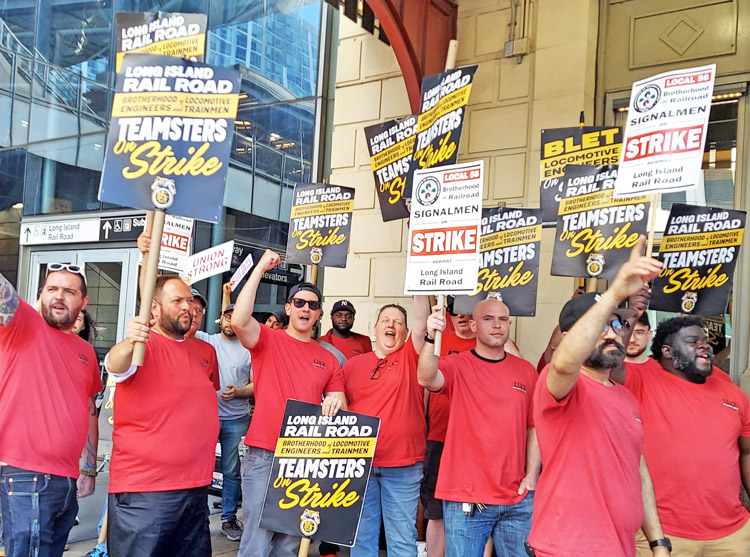
Their fighting spirit and determination marked the lively picket lines set up during the walkout. Chanting “New York is a union town. No contract, no trains!” dozens of rail workers picketed outside Penn Station here May 17.
“I’ve been working without a contract since I’ve been on the job,” Adrian Thomas, a member of the Transportation Communications Union who has worked on the LIRR for three-and-a-half years, told the Militant picketing at the station. “We’ve had no wage raise over this time while the prices of everything is going up, including medical care. It’s a struggle to keep up.”
The MTA — which owns and operates the LIRR as well as the city’s subways and buses — and union officials had earlier agreed on the terms of the first three years of a contract, with a retroactive annual pay raise starting in 2023 at 3%, then 3%, then 3.5%. But the bosses refused the unions’ demand for a 5% raise for a fourth year, to start in a few months.
The bosses countered with just 3%, and said it could be increased by another 1.5% if the unions agreed to the changes they were demanding in longstanding work rules. What the bosses wanted is an attack on workers’ jobs and safety protections that would involve speedup and contracting out union jobs.
The unions said no. And they also rejected the MTA’s proposal that the 1.5% “raise” would be a lump-sum bonus, not a wage raise. This means it wouldn’t set a precedent for future wages.
Then at the last minute the bosses added a new demand, calling for new hires to pay substantially more for healthcare coverage. The union negotiators said no to that as well and went on strike. The unions set up joint picket lines at a number of stations, from the Penn Station hub, other stops in the city, and in a number of towns on Long Island.
At the picket line at Jamaica Station May 17, several UPS workers, members of the Teamsters union, came to join the LIRR strikers in solidarity. “We came here to support our union brothers and sisters, to stand in unity,” UPS worker Jodi Kipping told the Militant.
Many other workers stopped by to show support, including members of Transport Workers Union Local 100, whose 44,000 members work on the New York City subways and buses. Their contract also expired May 16, but New York state’s anti-union Taylor Law says it’s illegal for them to strike, period.
Capitalist politicians and the big-business media lined up against the strike. Democratic Gov. Kathy Hochul denounced rail workers’ fight for higher wages and safe working conditions as “unacceptable” and “reckless.”
The liberal Washington Post and the conservative New York Post both ran editorials slandering the striking unionists, seeking to turn public support against them. This ignored the fact that two Presidential Emergency Boards called to deliberate on the dispute by President Donald Trump had both recommended the LIRR meet the unions’ proposals on both wages and work rules. The bosses refused.
While the bosses claimed they couldn’t afford a 5% raise for the workers, they say nothing about the huge interest payments they make yearly to the MTA’s wealthy bondholders on $40.9 billion in long-term debt. These bonds are a lucrative investment for area capitalists. “When debt servicing costs are paid from the operating budget,” notes a June 2025 report from the Office of the New York State Comptroller, “it can potentially crowd out operating spending of other types.”
‘Capitalism at its finest’
The MTA’s debt service — at some $3 billion this year — is expected to more than double over the next decade.
“This is capitalism at its finest,” Transportation Communications Union member Thomas told the Militant on the picket line. The rail bosses “are trying to play us against others who work for the MTA. They say we’re rich from working on the railroad. But that’s not the case.”
“Our members stood together for a fair agreement that recognizes the dedication and sacrifices railroad workers make every day while keeping pace with the rising cost of living,” said a statement released by the Brotherhood of Locomotive Engineers and Trainmen announcing the tentative agreement. “We appreciate the support and patience of the riding public, and now the final decision rests with the membership.”