
Tens of thousands of people in Ukraine and around the world marked the 82nd anniversary May 18 of the savage deportation of the Crimean Tatar nation by the Stalinist regime in Moscow as the end of World War II neared. And after more than a decade of the Kremlin’s seizure and occupation of Crimea in 2014, the Crimean Tatars continue to resist. They are part of Ukraine’s battle against more than four years of Russian President Vladimir Putin’s war targeting civilians as part of Moscow’s attempt to conquer the country.
In 1944 Joseph Stalin smeared the entire indigenous Tatar people of the Crimean Peninsula, claiming they had been collaborators with the Nazis while they were under the boot of the German imperialist occupation. Tatar families, including recently demobilized Red Army soldiers, were given minutes to gather whatever they could carry.
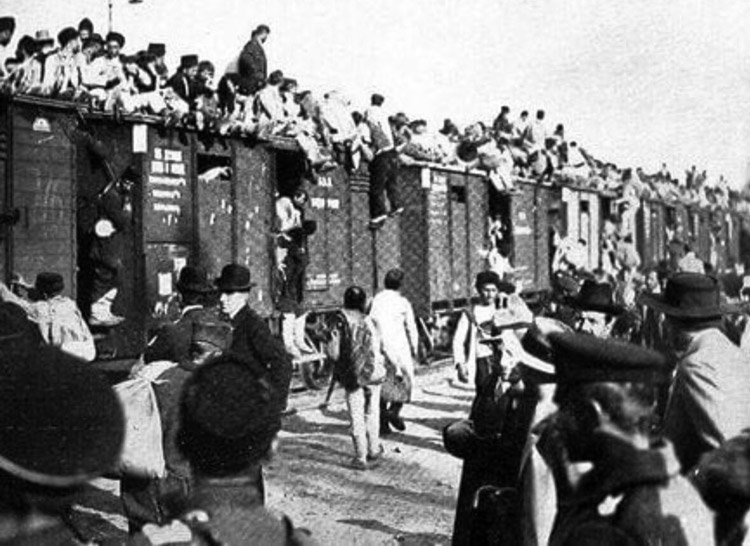
Over 200,000 men, women and children were rounded up, herded onto cattle cars, and taken far across Russia and dropped in the Urals, Siberia and Uzbekistan. Tens of thousands perished from starvation, disease and inhuman conditions in one of the largest mass deportations in history.
Some never made it into Russia. Residents of Arabat Spit, a remote fishing area, were pushed onto a barge that was taken out into the Azov Sea and sunk. Russian machine gunners nearby made sure no one survived.
The Crimean Tatars struggled to return to their homeland after the war. Finally, as the Soviet Union collapsed in 1991 and Ukrainians won their independence, the Tatars were able to move back. But they found their homes and property had been seized by Moscow and distributed to new residents to “Russify” the population. As part of newly independent Ukraine, the Tatars’ culture flowered and their identification as Ukrainians grew.
“Overcoming enormous difficulties, we began to return to our homeland and restore the remnants of our destroyed culture,” Mustafa Dzhemilev testified last Sept. 25 at a Summit of the Crimea Platform held in New York. “I am one of the few still surviving representatives of the generation of Crimean Tatars who survived the total deportation and genocide of their people in 1944,” he said in his native language.
Dzhemilev is the longtime head of the Mejlis, the Crimean Tatars’ elected self-governing national council. His talk was called “Crimea’s liberation is a question of survival for Crimean Tatars.”
Crimean Tatars’ battle for survival
Dzhemilev was less than a year old when his family was deported to Uzbekistan. He became a leading voice for Crimean Tatar rights and an outspoken opponent of Stalinist repression in the Soviet Union. He was repeatedly imprisoned, serving 15 years in the Gulag, where he carried out a 303-day hunger strike. The Militant was part of the international campaign that successfully fought for his freedom.
Tens of thousands of Tatars mobilized in 2014 against the seizure of the Crimean Peninsula from Ukraine by the Putin regime. Under Russian occupation, they faced intensified persecution. Russian political police raided their homes, mosques and schools. Tatar-language newspapers and the only Tatar-language TV channel were shut down. Some 30,000 Tatars left Crimea for mainland Ukraine.
Dzhemilev and other Mejlis leaders were expelled again from their homeland. In 2014 and 2015, as part of reporting trips to Ukraine, John Studer, now the editor of the Militant, interviewed Dzhemilev to help publicize the struggle of the Crimean Tatar people.
After occupying Crimea, Moscow “began to rapidly transform the entire peninsula into a powerful military base with the clear goal of further expansion into mainland Ukraine,” Dzhemilev testified at the New York meeting. “Representatives of the indigenous people and ethnic Ukrainians were the first to be subjected to large-scale repressions.
“About 50,000 Crimean Tatars — some 15% of the entire population — and up to 100,000 ethnic Ukrainians have left Crimea,” Dzhemilev said. “And the number of Russian citizens resettled in Crimea already exceeds 1 million people.”
“Today, Ukraine is bleeding, fighting off the aggressor and trying to liberate its occupied territories, to liberate millions of our fellow citizens who have fallen into the hands of cruel occupiers.”
Dzhemilev rejected any idea of “peace” initiatives floated at times by the Donald Trump administration, which “largely coincide with the plans of the aggressor” by demanding “recognition of Crimea and some other occupied territories of Ukraine as territories of Russia.” He said that such a settlement, signed under the duress of military force, “will be a very short break before a new, even bloodier war.”
Decades of struggle
The Crimean Tatar people have fought for centuries to defend their national rights as a people, since they were conquered and subjugated by Czarina Catherine II of Russia in 1783. The Ukrainian commemorations of the victims of the Crimean Tatar genocide are also a celebration of the resilience of an indigenous people whose history is part of shaping Ukraine today.
The memory of the past is vital to strengthen the Crimean Tatar people’s struggle today for their national rights and identity, including being able to live freely on their land.
“If for Ukraine in general the liberation of Crimea is primarily a question of restoring its territorial integrity and ensuring its security,” Dzhemilev said, “then for the indigenous people of Crimea, it is also a question of survival and further development or complete disappearance as an original nation.”