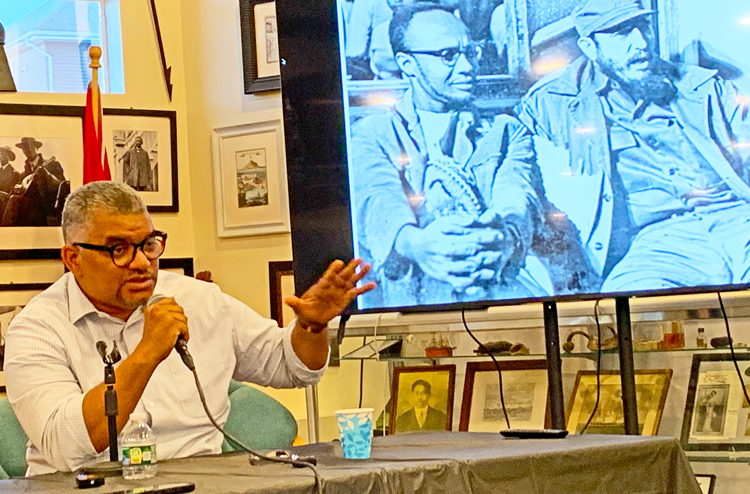
PAWTUCKET, R.I. — Surrounded by exhibits about the immigration of Cape Verdeans to the U.S. and their rich history of struggle, some 40 people attended a June 28 discussion at the Cape Verdean Museum here on Pathfinder’s new book Cuba and the Independence War in Guinea-Bissau and Cape Verde: The Fall of the Last Colonial Empire in Africa by Cuban revolutionary leader Víctor Dreke.
Pawtucket and other cities in Rhode Island and neighboring Massachusetts are home to a substantial population of people from Cape Verde, going back to the early 1800s. Run by volunteers, the museum regularly hosts educational and cultural activities. Those visiting for the first time were treated to a fascinating tour.
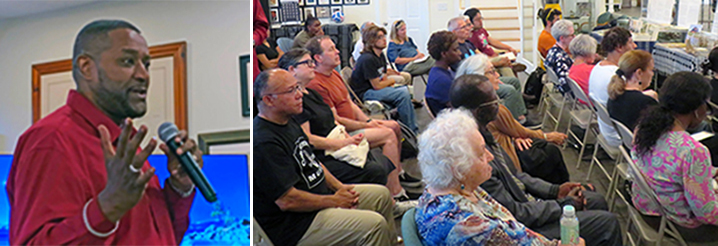
Joe DaMoura, the museum’s director, welcomed participants to the meeting to learn more about the independence struggle and the little-known contribution of Cuban internationalist volunteers.
The audience viewed a video greeting from Dreke, who also sent a written message. “We’re honored to hear of your interest in learning about the part of African history that is told in this book,” he said. “Cuba has been tied to the African liberation movement since the Jan. 1, 1959, victory of the Cuban Revolution as a way of paying our debt — an unpayable debt — resulting from historical events that have bound our peoples together since the times of slavery.”
In 1967-68 Dreke headed Cuba’s military mission in Guinea-Bissau, where he worked closely with Amílcar Cabral, the central leader of the African Party for the Independence of Guinea and Cape Verde (PAIGC), which led the war that put an end to 500 years of Portuguese colonial rule there. That victory triggered the collapse of Portugal’s entire empire in Africa and brought down the decaying fascist dictatorship at home.
In 1965, Dreke had been second-in-command as Ernesto Che Guevara led 130 Cuban combatants fighting alongside national liberation combatants in the Congo.
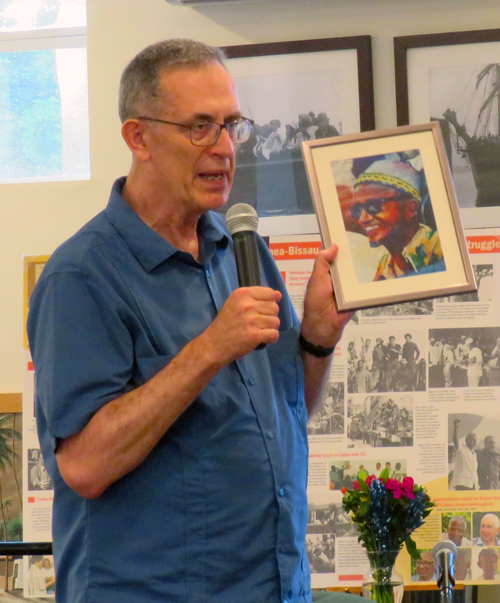
Martín Koppel, co-editor of the book, presented Corsino Delgado, president of the museum’s board of directors, with a framed reproduction of a portrait of Cabral. It had been painted as part of a large mural on the wall of the six-story Pathfinder building in New York in the 1980s that depicted revolutionary leaders whose works Pathfinder has published.
‘Why this book’
Also speaking on the panel was Abel Djassi Amado, a professor at Simmons University in Boston, who is active in the local Cape Verdean community. Mary-Alice Waters, president of Pathfinder and co-editor of the book, joined the discussion from the audience.
The event also reflected the celebratory atmosphere following the successes of the Blue Sharks, Cape Verde’s soccer team, the smallest nation to ever reach the knockout stage of the World Cup.
“This book is above all for working people and youth here in the U.S., especially for those learning in struggle to defend their livelihoods, job conditions and rights in today’s world of economic and social disorder, of international wars for profit and plunder,” said Koppel. “It’s for workers like the New York nurses and Colorado meatpackers who have gone on strike in recent months. For the Puerto Ricans who this week spoke out at the U.N. about their fight for independence from U.S. colonial rule.”
Cabral’s leadership highlighted
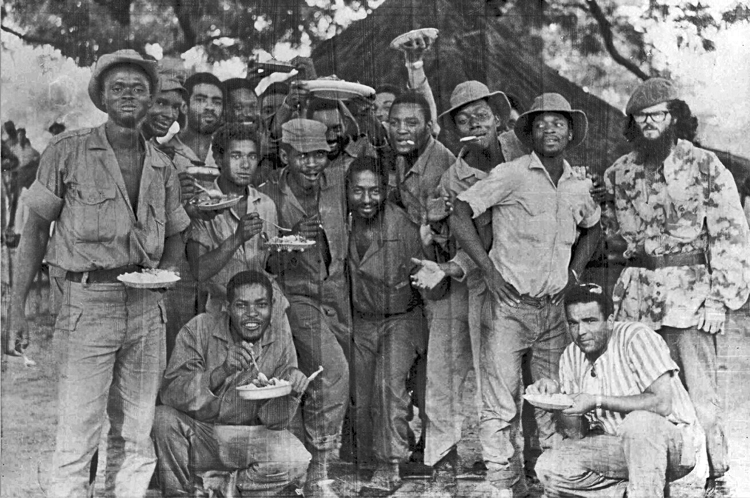
Koppel pointed to both Cabral’s leadership capacity and the decisive role played by the 400 Cuban combatants and doctors, who served alongside the African liberation fighters during the war.
“Going through the U.S. educational system I never learned about Cape Verde,” DaMoura, who came to this country from there as a child, said, “even though it’s an important part of U.S. and world history.” I was also taught “to hate Cuba, until I started to learn my own history,” he said. “All those years I hated people who helped me and my country to achieve independence.”
Several audience members remarked afterward that this was the first time they had heard about the crucial contribution Cuban internationalists made to winning independence.
Koppel and Amado both noted the course Cabral led to overcome tribal antagonisms among Guineans, as well as divisions between Guineans and Cape Verdeans, all fostered by the Portuguese colonialists. Cabral “was very clear that we were not going to get our independence if someone else is dying for us,” said Amado.
Cabral stands out because he had confidence in the capacities of working people to transform society and themselves, Koppel said.
The PAIGC’s leadership under Cabral organized rural toilers in liberated zones to create schools to reduce illiteracy, set up clinics offering medical care for the first time, and formed local militias to defend the villages from Portuguese attack. Cabral promoted equal rights for women, opening the door for them to take leadership roles in the struggle.
Both speakers noted Cabral’s insistence that the struggle was above all political, not military, and how he stood out by his rejection of brutality or glorification of violence. “This perspective was important both for the success of the independence struggle, but also for the future society Cabral was confident working people were capable of building,” said Koppel.
“The examples about Cabral’s leadership capacities, which are the greatest strength of the book,” Waters said, are “needed desperately in the world today for those who are fighting in various ways for the liberation of humanity.” Cabral understood and educated others about the international scope of what they were doing, she said. They were, as Cabral put it, “soldiers of humanity.”
Waters, a long-time leader of the Socialist Workers Party, underlined Cabral’s efforts to explain the materialist basis of social relations and capitalist exploitation. When he went to study in Portugal, “he chose agronomy because he wanted to find out the root causes of the drought-induced famines that afflicted Cape Verde,” she said. “The drought was not the product of inevitable natural disasters but of rampant deforestation and overgrazing under colonial rule.”
He also worked as an agronomist in Alentejo, the poorest region of Portugal, where he witnessed the exploitation, illiteracy and repression facing landless peasants and farmworkers. Cabal stressed the “Portuguese people were not the enemy of the African toilers,” Waters said, “but Portuguese colonialism was, and working people in both countries had common interests in fighting imperialist rule in Africa.”
Cabral’s work in Alentejo, added Amado, underlined “not only his preoccupation with the land itself, but his preoccupation with the people.”
Cuba’s internationalist record
During the discussion period, participants asked for more information on Cuba’s internationalist mission in Guinea-Bissau and other African countries.
“Hundreds of thousands of Cubans went to Africa and other parts of the world as volunteers to join national liberation struggles,” Koppel replied.
They “learned about the conditions imperialist exploitation imposed on millions of people in Africa. Fighting side by side with the Angolans, with the Guineans and others, broadened their understanding of the world, and of themselves.”
“They came back as changed people,” he said. “That strengthened the Cuban Revolution.
“These experiences give them confidence to stand up against the brutal assault on them by the U.S. government today. What other country in the world would have survived 67 years of a ruthless U.S. economic war? That is only possible because of the transformation of millions of Cubans through a revolution.”
The program was followed by lively discussions among audience members over traditional Cape Verdean snacks. Some 20 copies of Dreke’s book were sold.