
The indomitable people of Ukraine and their battle to defend their country’s sovereignty have fought far larger Russian forces to a standstill on the frontline after almost four and a half years of war. Ukraine’s use of drone warfare is increasing the challenges Russian President Vladimir Putin’s regime faces at the front and at home, while Moscow accelerates its own deadly missile assaults at Ukraine’s civilian population.
Kyiv’s drone strikes on oil refineries near big cities in Russia have made the consequences of the war far more visible to millions of working people there, without directly targeting them. Despite the huge financial and human cost of his attempt to conquer Ukraine, Putin is doubling down on the war, claiming again July 3 that Ukraine is “historically Russian land.”
Moscow’s troops are thrown into deadly “meat assaults” after only 10 to 21 days of military training. They face swarms of Kyiv’s anti-personnel drones causing casualty rates to rise to eight times those of Ukraine’s forces.
Russian soldiers are refusing deployment to front-line island outposts in the Dnipro River, where they’re especially vulnerable. Across the occupied territories, Ukrainian medium-range airstrikes are choking off Moscow’s fuel and ammunition supply lines.
By July 1, some 1.4 million Russian workers in uniform had been killed or maimed since the war began. In June alone, the invading forces suffered almost 40,000 casualties, far outstripping Moscow’s recruitment rate. To try to fill the shortfall, Moscow is seeking to pressure university students into the army. Promised higher pay and drone operator training, many end up on the frontlines.
Crimea is being isolated
Kyiv launched over 50,000 successful strikes in June alone. Air defense and radar posts, warships and fighter jets have been hit. Oil refineries have been set ablaze as far away as Siberia. Russia’s fuel production has been cut by more than a quarter. Gasoline rationing is now in place in many regions.
The scale of the damage forced Putin to admit Ukraine drone attacks were “creating problems.”
Kyiv’s airstrikes have targeted the road and rail connections to the Crimean Peninsula, which was seized from Ukraine and occupied by Moscow in 2014. Power outages and food, fuel and water shortages there are now widespread.
Moscow’s authorities in Crimea declared a state of emergency June 26. Thousands are attempting to flee. The Kerch Bridge, the route back to Russia, has been closed to heavy trucks as a result of previous strikes by Kyiv’s forces.
Putin’s claim that Crimea is Russian territory has suffered a blow. Moscow moved its naval command post from Sevastopol in Crimea to the port of Novorossiysk on the Russian mainland June 14. The move follows the relocation to Novorossiysk of the surviving half of Moscow’s Black Sea Fleet not sunk by Ukrainian drones.
Ukraine’s defense missile shortage
In response to the challenges it confronts, Moscow is taking advantage of Ukraine’s growing shortage of Patriot defense systems to intensify its bombardment of civilian centers. It has more than doubled the number of ballistic missile strikes on Ukraine since January compared to the same period last year.
The Ukrainian government depends on capitalist powers in Europe to supply it with Patriot missile defense systems that it previously got from Washington. The U.S. rulers are increasing their production of Patriots but primarily to replenish their own short supplies following the war on Iran.
During the night of July 2, “the Russian Federation launched yet another massive combined attack against Ukraine using missiles and attack drones,” noted a statement by the Confederation of Free Trade Unions of Ukraine (KVPU).
In Kyiv, “residential apartment buildings, energy infrastructure facilities, and a hotel were destroyed or damaged,” the KVPU statement said. At least 31 people were killed and scores injured. Ukrainian defenses intercepted only four of Moscow’s 24 ballistic missile salvos.
“Workers are being killed directly at their workplaces,” Mykhailo Volynets, chairman of the KVPU, said in the appeal for solidarity from the international trade union movement. During the first five months of 2026, 127 workers were killed at work as a result of Moscow’s assaults.
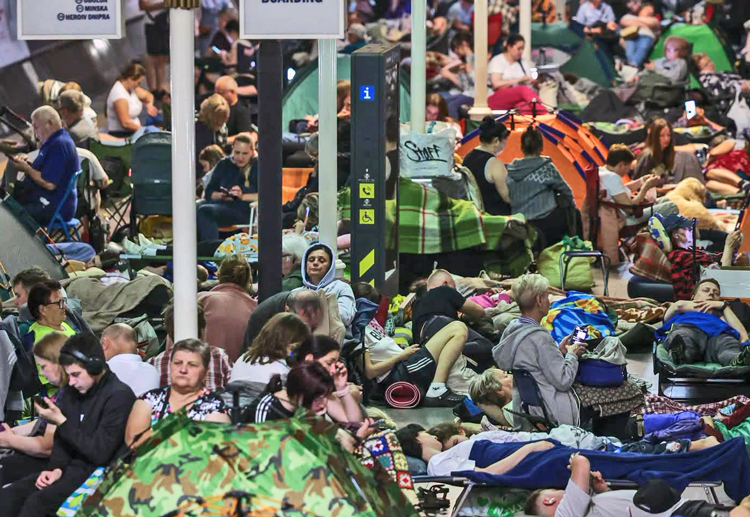
During the July 2 airstrikes, a record 52,000 Ukrainians, including 4,500 children, were evacuated from their homes and crowded into 46 underground stations of the Kyiv Metro. They took bedding and essential supplies into the shelters, as well as their pets.
The KVPU statement says that Ukraine’s union movement continues to call for “the full, immediate, and unconditional withdrawal of Russian troops from the internationally recognized territory of Ukraine.”
The only truly dependable allies of working people in Ukraine are working people worldwide, especially in Russia. Workers in and out of uniform there face assaults from the same enemy that Ukrainian workers face on the battlefield — the Putin regime.