From the mid-1950s on, the Black-led working-class movement to end Jim Crow segregation was propelled by a series of pitched battles in areas across the South, like the victorious Montgomery bus boycott, and the nationwide solidarity they inspired. In 1960, sit-ins to desegregate the lunch counters at Woolworth’s and other chain stores spread rapidly from town to town. They were led by young fighters who built their own nationwide organization, the Student Nonviolent Coordinating Committee.
For decades, Woolworth’s, Walgreens and other chain stores had taken money from Black customers, but banned them from eating at the stores’ lunch counters.
In February 1960 a group of youths in Greensboro, North Carolina, dressed up smartly and sat down at the Woolworth’s lunch counter and refused to move. Two months later, lunch counter sit-ins had mushroomed to 70 cities and towns across the South.
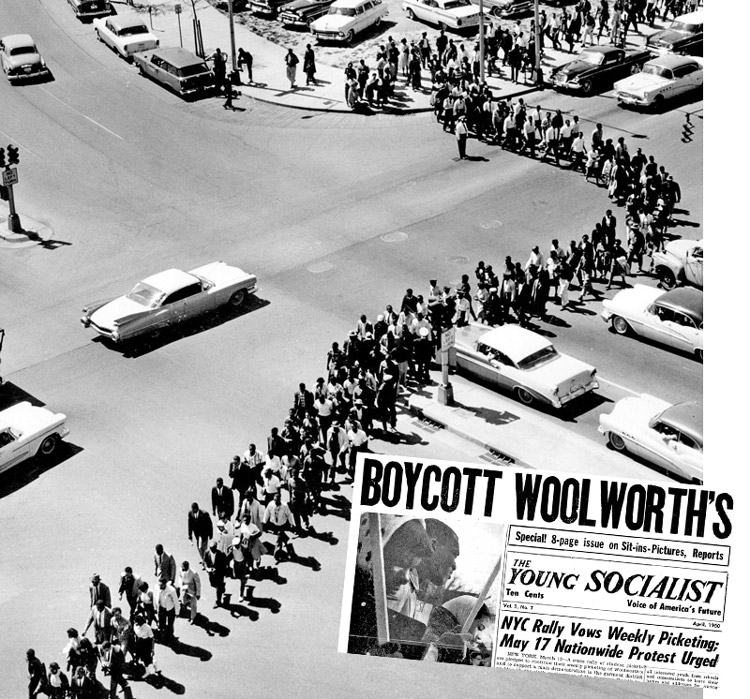
These actions were carefully planned, organized by audacious fighters, and reinforced by pickets at the stores in northern cities and a nationwide boycott called by the NAACP. The Militant featured the protests regularly on its front page, and Socialist Workers Party members in New York and elsewhere participated in the actions.
By the end of the year, 70,000 people, overwhelmingly young Blacks, had joined in, with more than 3,000 arrested.
“With what we were doing, trying to abolish segregation, we were coming up against governors, judges, politicians, businessmen,” Diane Nash, the central leader of the sit-ins in Nashville, Tennessee, recalled. “The movement had a way of reaching inside you and bringing out things that even you didn’t know were there.”
The sit-ins, started by four students in Greensboro — Ezell Blair Jr., Franklin McCain, Joseph McNeil and David Richmond — rapidly became mass actions that were met with fierce repression. In Orangeburg, South Carolina, a town of 14,000, some 1,000 students marched downtown to protest segregation March 15. When cops assaulted them with clubs and tear gas, they stood their ground. Some 400 were arrested and held in the town’s stockade. A picture of the detainees was featured on the front page of the Militant, along with a call for solidarity actions.
The lawyer representing the Orangeburg young protesters was arrested, students were threatened with expulsion if they continued to protest, and the state passed a law making it a crime to refuse a store owner’s request to leave the premises. Not a single store there was desegregated.
In Nashville students also faced assaults and jail, but they led a series of mobilizations that drew national press attention, forcing city authorities to announce they would begin desegregating public facilities.
Several hundred Nashville students had joined together to discuss how they would respond to provocations before beginning the sit-ins Feb. 13. When a gang of prosegregation hoodlums started beating the students at a store sit-in Feb. 27, 81 of the Black students were arrested, but not a single thug. Student leaders rejected a “compromise” proposed by city officials to divide lunch counters into segregated sections for Blacks and Caucasians.
The sit-ins were backed up with a boycott of downtown stores and carried out by a big majority of the city’s Blacks.
When segregationist goons firebombed the house of the students’ attorney, Z. Alexander Looby, April 19, some 2,500 students began a protest march. By the time it reached City Hall, it was 4,000 strong. Nash and other student leaders confronted Mayor Ben West who caved in and announced the city would become the first in the South to desegregate its public facilities.
Students win solidarity across U.S.
The refusal of students in Nashville and elsewhere to give in stirred solidarity from workers around the country. Picket lines at three midtown New York Woolworth’s were organized by the International Ladies’ Garment Workers Union, the March 14, 1960, Militant reported.
Just prior to the victory in Nashville, students from there helped organize a meeting in Raleigh, North Carolina, that brought together 200 people active in sit-ins across the South. They discussed how to extend the fight against Jim Crow and put pressure on other Black groups to join the struggle. They founded the Student Nonviolent Coordinating Committee.
The following February nine students at Rock Hill, South Carolina, after holding a sit-in were arrested and each sentenced to a $100 fine, or 30 days’ hard labor on a chain gang. They chose jail time.
SNCC responded by sending Nash and three other young veterans to the town to step up the fight. Soon they too were jailed. SNCC sent in more youths, and organized mass picketing and sent a motorcade of 600 protesters to York County Prison Farm in support the imprisoned activists. Several of the jailed students were thrown into solitary confinement for “refusing to stop singing.”
Mass meetings were held to honor the imprisoned students on their release, March 7, 1961. Days later, James Farmer, national director of the Congress of Racial Equality, announced plans for a movement of Freedom Riders to take on the segregated seating on Greyhound and other buses.
In December 1960 the U.S. Supreme Court had ruled that buses and trains involved in interstate transportation be desegregated. But the ruling was ignored by state officials across the South.
Freedom Riders face deadly attacks
CORE’s first Freedom Rides were abandoned after riders were brutally assaulted. Just outside Anniston, Alabama, a mob firebombed a bus and attacked passengers as they fled the burning vehicle. A few onlookers from the Caucasian neighborhood of Bynum stepped forward to offer the passengers assistance.
When a second bus carrying Freedom Riders arrived at Anniston an hour later, a mob boarded the bus and beat protesters. Many were sent to a hospital. Another segregationist mob gathered outside it, ready to lynch the riders when they were released. State troopers and local cops refused to provide an escort through the mob, so Freedom Rider Joe Perkins called Rev. Fred Shuttlesworth, a leader of the fight for Black rights in Birmingham, for help.
Shuttlesworth told his bodyguard, Buck Johnson, and other deacons at his church to get cars ready and to mount a rescue. When the deacons arrived at the hospital, they stepped out openly displaying their weapons and escorted the Freedom Riders to safety.
“We walked right between those Ku Klux,” Johnson later recalled.
President John F. Kennedy was nervous about breaking apart the Democratic Party coalition that included both northern labor officials and Dixiecrats — pro-segregationist Democrats in the South. His administration urged the Freedom Riders to abandon the struggle. CORE agreed to suspend the next Freedom Rides, but Nash and other SNCC leaders urged students in Nashville and elsewhere to step in. Hundreds volunteered to join and the Freedom Rides went ahead.
A previous article in the Militant describes how those fights unfolded. It’s available at: https://themilitant.com/2023/08/05/catherine-burks-brooks-helped-launch-freedom-rides-in-1961.
The courage shown by the Freedom Riders helped recruit thousands of young people to the fight, in the face of the murderous brutality of Jim Crow authorities and their Ku Klux Klan vigilantes. The cadres who came out of this struggle went on to lead the 1964 Freedom Summer in Mississippi and other parts of the South to fight for voting rights and other freedoms.