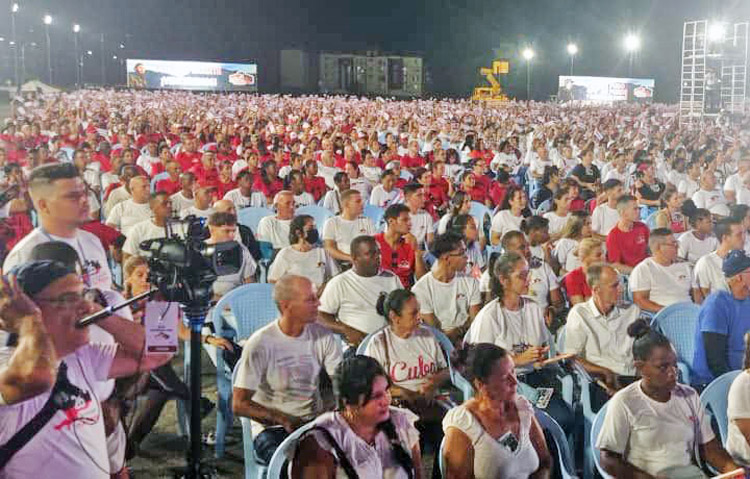
July 26 meetings celebrate the victory of the Cuban Revolution
NEW YORK — On July 25 some 80 people attended a celebration here of the 73rd anniversary of the opening battle that led to the victory of the Cuban Revolution. The meeting, sponsored by the New York/New Jersey Cuba Sí Coalition, was also a protest against Washington’s brutal oil blockade and war threats against Cuba.
On July 26, 1953, Fidel Castro led a group of mostly working-class revolutionaries in an assault on the Moncada and Carlos Manuel de Céspedes army barracks of the Fulgencio Batista dictatorship. Though it was defeated, the attack electrified the Cuban people and led to a popular revolutionary struggle that on Jan. 1, 1959, toppled the U.S.-backed tyranny and opened the road to the first socialist revolution in the Americas.
The featured speaker at the New York event was Ernesto Soberón, Cuba’s permanent representative to the United Nations. For Cubans today, he said, the celebration of the Moncada attack “is not a simple exercise of historic memory.” It signals “a renewed commitment to independence, sovereignty, social justice” and defending achievements won by the Cuban people over more than six decades.
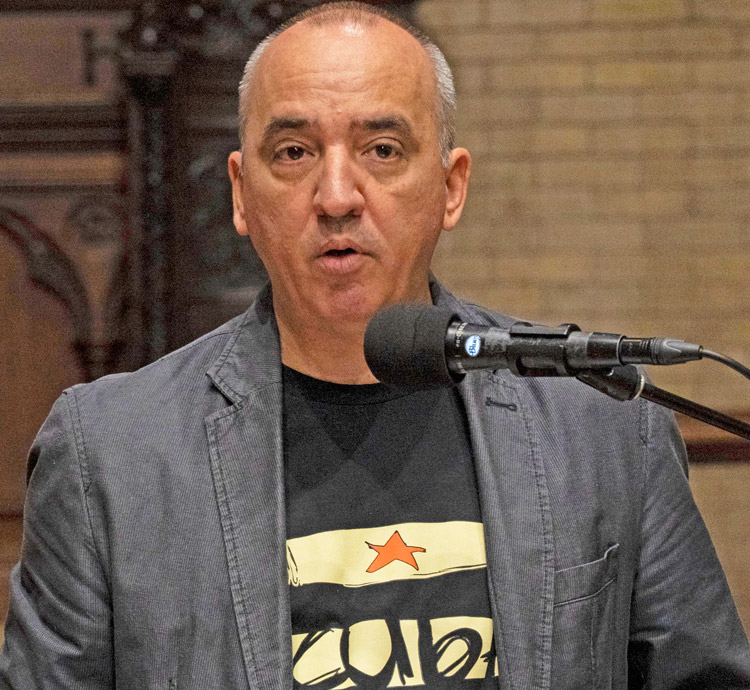
While the U.S. economic assaults “cause huge constraints on daily life,” Soberón said, Cubans are working to overcome the crisis through “collective effort, creativity and resilience.” He noted that despite the extremely difficult conditions, thousands of Cuban volunteer doctors continue to serve in other parts of the world where they are needed.
The spirit of Moncada lives on, he said, “in those who work every day to maintain service in schools, hospitals, workshops or power plants; in those who produce food, conduct research in scientific centers, teach in classrooms, or serve the homeland performing other duties.”
Soberón noted that Washington today is targeting not only Cuba but people and organizations in the U.S. who speak out against the blockade and defend the Cuban Revolution.
Ana López spoke on behalf of the Frente Independentista Boricua, which advocates Puerto Rico’s independence from U.S. colonial rule. She had just returned from participating in a thousands-strong pro-independence protest in San Juan. “The histories of Cuba and Puerto Rico are intertwined” in common struggles against imperialist domination, López said.
She reported that Fernando González, president of the Cuban Institute for Friendship with the Peoples (ICAP), had sent a message to their march championing the anti-colonial struggle. ICAP, an organization that fosters solidarity between Cuba and people around the world, was placed under U.S. sanctions June 4.
Bob Schwartz, executive director of Global Health Partners, spoke about a new “Neonatal and Maternal Healthcare Initiative” to raise funds to gather and deliver medical equipment and medicine to help reverse the current rise in Cuba’s infant mortality rate. Global Health Partners has sent some $280 million in aid and equipment to Cuba over the past three decades, including donations of much-needed syringes, pacemakers and sutures.
In capitalist Cuba, infant mortality was 70 per 1,000 live births. By 1990, through the social conquests of the revolution, that figure had dropped to below 5, Schwartz said. Today, due to the sharp U.S. restrictions on trade with Cuba, it has doubled to almost 10 per 1,000 births.
Washington’s blockade means hospitals can’t get new equipment or parts to repair old ones for neonatal units. Mothers also face nutritional deficits leading to newborns with low birth weights.
“We’ve partnered with the two hospitals in Havana that get the most complicated pregnancies and treat the most at-risk babies,” he said. “If we’re successful, the program will branch out to hospitals in the provinces,” Schwartz said, appealing for donations to this campaign.
Among the other speakers were Roger Wareham of the December 12th Movement, Kim Ives from Haïti Liberté and Bill Sacks from the Venceremos Brigade.
The audience was treated to music by Grammy-winning Afro-Latin jazz pianist Arturo O’Farrill and members of his band.
* * *
MILWAUKEE — Some 250 people attended a meeting here organized by the Wisconsin Coalition to Normalize Relations with Cuba July 21 to hear Cuban Ambassador Lianys Torres Rivera speak. The meeting was endorsed by Peace Action Wisconsin, Women’s International League for Peace and Freedom, National Lawyers Guild and other groups.
The Cuban ambassador to the U.S. was introduced by Dr. Alexandra Skeeter, a graduate of Cuba’s Latin American School of Medicine, which provides free medical training for thousands of students from around the world. The only condition is that students agree to serve working-class communities when they return home.
“I left Cuba with much more than medical training,” said Skeeter. “I left with a broadened world view. I saw that there is a different way of treating human beings, based on solidarity and the idea that healthcare is a human right.”
“These are some of the most difficult times that Cuba has faced,” Torres told the meeting. “We have only one or two hours of electricity a day in many homes, which means there is no water, refrigeration or public transportation. It’s hard to sleep and food spoils.”
Washington’s oil blockade on Cuba, imposed by the Donald Trump administration at the beginning of the year, has severely aggravated hardships on working people across the island. Its steady stream of restrictive executive orders is aimed at cutting off foreign trade and support for Cuba.
Torres described the horrific toll the cruel cuts on medical supplies have had on children in Cuba. The survival rate for childhood cancer has dropped from 85% to 65%. Still, she said, the Cuban people are coming together to resist. “We are not just waiting for a savior, we are doing the best we can.”
Torres said Cubans have prioritized installing solar panels, especially in the homes of children with special needs, as well as in essential infrastructure.
Millions of dollars worth of solar panels have been installed in hospitals, clinics, homes for the elderly, radio and cellphone stations and other critical services. Solar-powered irrigation pumps are being deployed on tobacco and other farms.
“We have to adapt. But we are still here!” Torres said to enthusiastic applause.
“We thank you for your support,” she told the crowd. “Cuba is not alone because we have people like you.”
— Amy Husk
* * *
MINNEAPOLIS — Some 30 people gathered here July 26 for a meeting to commemorate the 73rd anniversary of the opening battle of the Cuban Revolution. The event was sponsored by the Minnesota Cuba Committee and the Solidarity Committee on the Americas.
Gary Prevost, a leader of the Minnesota Cuba Committee, described the history of the Moncada assault, the dictatorship’s brutal torture and murder of captured combatants and the subsequent trial of Fidel Castro. Prevost pointed to Castro’s courtroom defense speech, which laid out the revolutionary program of the July 26 Movement. This speech was smuggled out of prison and distributed widely across Cuba with the title, “History Will Absolve Me.” Other speakers read excerpts from the speech.
Prevost condemned the State Department’s recently released document “Cuba: The Capital of 21st Century Communism,” which slanders the Cuban government and targets Cuban solidarity activists in the U.S.
Meeting participants viewed excerpts from the film “Cuban Story,” made by U.S. actor Errol Flynn. The film includes footage showing how Castro built and led a revolutionary movement of millions that ousted the Batista dictatorship. It also shows how masses of people turned out to greet him and the “Men of Moncada” as they marched across Cuba to Havana after the revolution triumphed in 1959.
Speakers from the audience included Miguel Fiol, a longtime Puerto Rican independence activist, who gave greetings and expressed solidarity with the Cuban Revolution.
Kevin Dwire, the Socialist Workers Party candidate for U.S. Senate from Minnesota, said the best way to defend the Cuban Revolution is to keep building broad public activities. That’s also true, he added, for defending Cuba solidarity activists in the U.S. who face government attack after being subpoenaed by the House Ways and Means Committee.
— Mary Martin
* * *
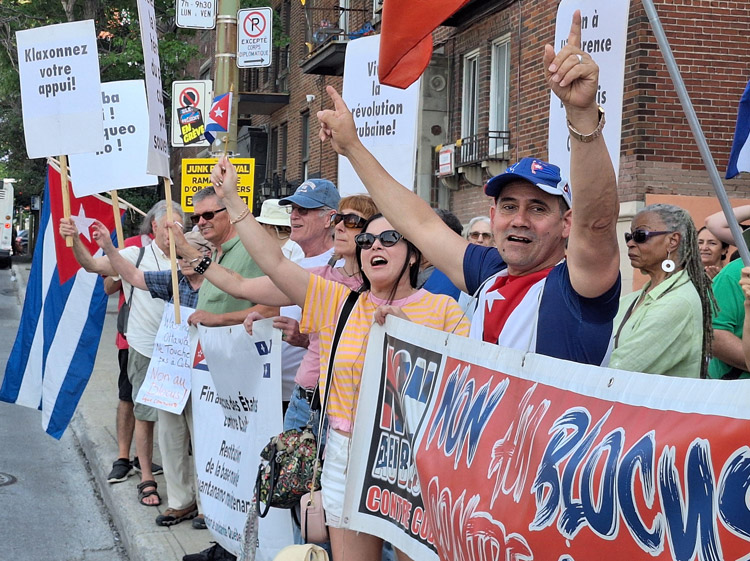
MONTREAL — More than 80 people celebrated the 73rd anniversary of the July 26 assault on the Moncada and Carlos Manuel de Cespedes garrisons.
The Quebec-Cuba Solidarity Roundtable called an action in front of the Cuban Consulate where participants loudly chanted, “¡Cuba sí, bloqueo no!” Participants cheered when drivers and passengers in vehicles traveling on the busy street responded to the large sign urging people to “Honk to show your support!”
At the reception in the yard behind the consulate afterward, Yamari Pérez Viera, Cuba’s consul general in Montreal, spoke. “The U.S. threat of military intervention is real as they are trying to destroy the revolution,” she said. “But we have a generation born during the blockade that is determined to see that Cuba remains sovereign, free and socialist.”
Pérez Viera thanked everyone for “showing their solidarity and being on the side of justice.” The crowd responded with shouts of “Venceremos!” and “Down with the blockade.”
Representatives from several groups in the roundtable gave greetings, then the program adjourned for refreshments and music. It concluded with Pérez Viera cutting a beautifully decorated cake to celebrate the July 26 anniversary and the living example of the Cuban Revolution.
— Beverly Bernardo