
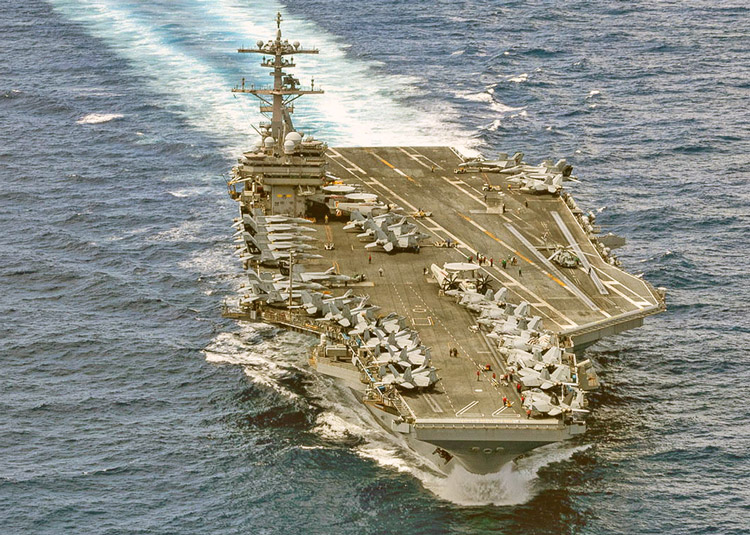
Following 13 consecutive nights of air strikes on Iran, President Donald Trump ordered a pause July 24, right after sending more U.S. special forces, warships and planes to the region and threatening to launch “a massive attack. Bigger than anything we ever had before.” He said the pause is intended to open the door to talks with Tehran.
Washington’s imperialist threats are not bluster. With Iranian air defenses largely destroyed, the U.S. military can strike almost anywhere in Iran at will.
Since mid-July the Pentagon has brought the total number of U.S. troops in the region to over 50,000, similar to the size of its forces there during the peak of Washington’s 38-day war before the often-violated ceasefire began April 7.
Washington hopes it can force Tehran to give in to U.S. demands by threatening more powerful military attacks, combined with the reimposition of the U.S. blockade of Iranian ports and its financial sanctions that have worsened the capitalist economic crisis that is battering working people there.
While the U.S. forces’ stock of “precision weapons” has been running lower than the Pentagon would like — especially Patriot and THAAD anti-missile weapons — Secretary of War Peter Hegseth boasts that the U.S. military has “a nearly unlimited stockpile” of its less sophisticated, but just as deadly, “laser-guided precision gravity bombs.”
During the 13 days of air strikes, Tehran counterattacked, demonstrating its ability to evade U.S. missile defenses and striking nine of its bases in the region. It also hit a water desalination plant and oil facility in Kuwait. Though not insignificant, Tehran’s assaults pale in comparison to the 1,000 U.S. airstrikes against military sites and civilian infrastructure over the same period.
Iran’s foreign ministry said July 27 that “intermediaries” were conveying “messages … regarding ongoing developments in the region.” In other words, they are negotiating.
U.S. seeks deal with Tehran regime
Washington’s goals have not changed. It wants some cooperation with the faction-ridden reactionary regime in Tehran to achieve a measure of stability that will allow the U.S. rulers to shore up their domination of the Middle East, deepen their plunder of the oil, gas and other resources there and push back competition from its rivals, especially Beijing.
This includes an agreement placing limitations on Tehran’s nuclear program and an end to its attacks on ships passing through the Strait of Hormuz.
Israeli officials point out that Tehran has been building a new nuclear facility deep underground in Pickaxe Mountain and is storing thousands of centrifuges that could enrich uranium to nuclear weapons grade levels. It still has more than 1,000 ballistic missiles and has been able to restart new production. Tehran claims that it has increased its drone production threefold as well.
For Israel, these are life-or-death questions. Israel is just 260 miles long and 10 miles wide at its narrowest point, and 70 miles at its widest. The Iranian rulers repeatedly state their determination to wipe it out. With nearly half of all the Jews in the world living there alongside Arab citizens of Israel, one Iranian nuclear bomb could cause a new Holocaust.
U.S. rulers see Israel as obstacle
That is of little concern to the U.S. rulers. They see Israel’s war to defend itself as a refuge for Jews as an obstacle to Washington reaching a deal with Tehran and deepening U.S. relations with other governments throughout the region, from Turkey to Syria and beyond.
That’s why the Trump administration keeps chastising Israeli Prime Minister Benjamin Netanyahu and barred Israel from carrying out new strikes against Iran. On the eve of Netanyahu’s July 28 visit to the U.S., Trump scolded the Israeli leader publicly, saying Netanyahu was trying to influence the U.S. by making public announcements about the dangers of Pickaxe Mountain and Tehran’s missile programs.
“I don’t need Bibi to tell me that,” Trump complained. “We know exactly what’s going on.”
The Washington-Tehran conflict threatens to widen beyond the Arab-Persian Gulf and spiral out of Washington’s control. Ukrainian forces launched drone attacks on a convoy of Russian warships accompanying an Iranian vessel carrying military equipment in the Caspian Sea, Ukraine President Volodymyr Zelensky announced July 25. Tehran threatened to retaliate against Ukraine.
Tehran has provided thousands of drones to Moscow since its invasion of Ukraine began. Moscow also aided Tehran with satellite surveillance data it needed to target U.S. bases. The Caspian Sea is one route Tehran can use to circumvent the U.S. blockade of its Gulf ports.
Asr-e-Iran, an Iranian news site, urged Tehran July 28 to show “restraint” to prevent the opening of “a new front” that would force Tehran to divert military forces to the Caspian Sea.
Stepped-up U.S. arms production
The U.S. military has used up at least 1,500 Patriot interceptors against Iranian missiles and drones since the war began, leaving less than 1,000 on hand, the Wall Street Journal reports.
The problem, the Journal fears, is that this smaller number “could hamper the U.S.’s ability to deter adversaries around the globe, including China.”
While Washington prefers to avoid a direct military conflict with Beijing for now, it’s also driving to weaken the Chinese rulers’ influence worldwide, especially in Latin America, and shore up its own domination of the world imperialist order. To that end it’s rebuilding its military and war-related industries.
The Pentagon has allocated billions of dollars to companies like Lockheed Martin, Northrop Grumman and Raytheon to replenish and get production of Patriot and THAAD anti-ballistic missile systems and Precision Strike Missiles on a “war footing.”