Hoping to intimidate working people and head off further challenges to its dictatorial rule, the reactionary Islamist regime in Iran has stepped up the pace of executions of political opponents, especially in the wake of the war with Washington. But, public opposition to the death penalty is growing.
In an unprecedented action, despite a large police presence, crowds gathered in Isfahan after learning that the regime was planning to publicly hang two participants in the massive anti-regime protests that swept the country in January. The regime slaughtered more than 7,000 protesters, mostly on the last two days of the demonstrations.
The regime had erected scaffolding at Isfahan’s Shahid Alikhani Square in preparation for the public hanging of Abolfazl Sepahi and Amir-Hossein Safari July 28. The regime claimed that the two, along with 12 others, had killed four members of the police force and Basij paramilitary thugs during the January protests. Two other defendants in the case were executed July 19.
According to the Hengaw Organization for Human Rights, the defendants were denied their own lawyer and tortured into giving forced confessions.
Family members and others opposed to the execution began arriving early. According to Iran Wire, the mother of one of the condemned youths asked the crowd to remain silent and refrain from protesting, to no avail.
Police special forces dispersed the crowd with tear gas and paintball guns and chased them through the streets. In blurry videos of the clash, protestors can be heard calling the cops “Bisharaf!” — an insult meaning you are shameless and have no honor.
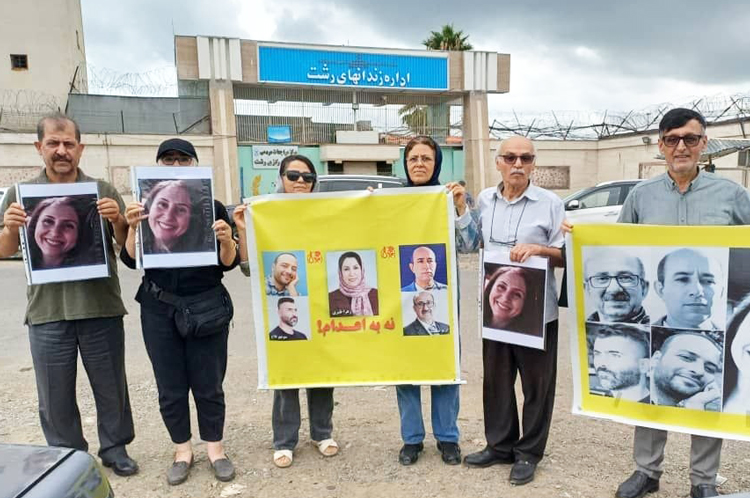
Just hours after the hangings in Isfahan, a group of trade unionists and others protested outside the Rasht Prison in Gilan province. “Let us rise before it is too late,” they said.
Some 1,500 prisoners at Qezel Hesar Prison in Karaj, northwest of Tehran, ended a 16-day hunger strike July 28 after prison and judicial authorities agreed to temporarily suspend executions there of prisoners found guilty of drug offenses.
Videos of the prisoners sitting in the cellblock hallway chanting and carrying signs against the death penalty were widely circulated. Some prisoners sewed their lips shut.
According to Amnesty International, the regime executed at least 2,159 people in Iran in 2025, double the number of the year before. At least 303 people have been executed this year since March, according to the “No to Execution Tuesdays” campaign — a weekly hunger strike by inmates that began nearly three years ago and has spread to 59 prisons.
While most of those executed are accused of criminal offenses, like drug trafficking, the number of those executed charged explicitly with political offenses is increasing. Kurds, Baluchs, Arabs and other members of oppressed nationalities in Iran are disproportionately victims of the death penalty. Baluchs comprise just 6% of Iran’s population, but account for 20% of those executed. Kurds, just 10% of the population, are some 50% of political prisoners.
“The devastating war that has engulfed Iran and whose flames grow ever more intense with each passing day has destroyed the livelihoods of working people,” the Council of Retirees of Iran said in its call for the July 26 protest in Rasht. “Yet the authoritarian capitalist establishment still shows no willingness to address the people’s economic hardships. Instead, it imprisons every dissenting voice. Hardly a day passes without official government media announcing new executions. The gulf between the people and the ruling authorities has become a deep chasm filled with blood and the bodies of those who have been hanged.”
Opposition to the death penalty and calls for freeing political and trade union prisoners was a feature of a number of the weekly retiree protests in more than a dozen cities July 26.
“Out of fear of confronting a protesting population, the government’s killing machine has taken advantage of wartime conditions to accelerate the issuance and implementation of death sentences,” said a coalition led by the Council for Organizing Protests of Contract Oil Workers in a July 23 statement. They called on fellow workers to join protests and demand the “permanent end of the death penalty.”