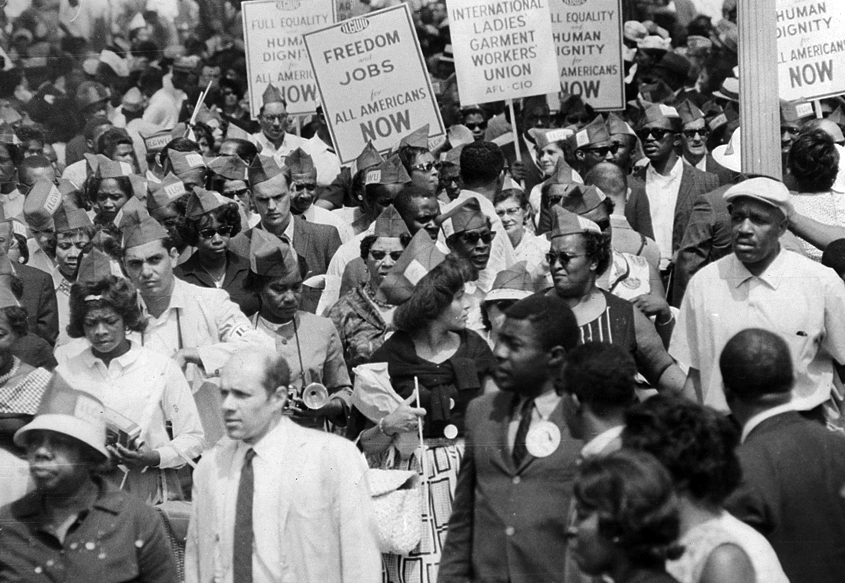
By the end of 1963 the nationwide movement fighting to abolish Jim Crow segregation was drawing in hundreds of thousands of working people and youth, imparting new confidence to fighters on frontline battles in the South and having a growing impact on struggles unfolding in cities across the North. It was transforming the attitudes of millions of workers — Black and Caucasian alike.
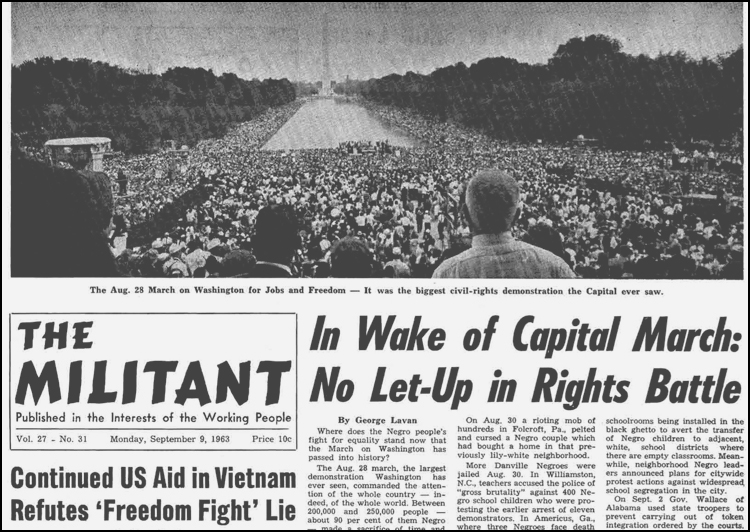
In August 250,000 joined the March for Jobs and Freedom in Washington, D.C., the largest-ever action against Jim Crow. Months earlier the battle to desegregate Birmingham, Alabama, had been followed avidly on TVs in the U.S. and worldwide. These actions marked a turning point in the fight to topple Jim Crow.
Desegregation struggles that broke out in cities large and small were less and less contained there. The movement was acquiring a mass character, openly declaring its aim was to eradicate every aspect of racial segregation. A new generation of fighters who had led lunch counter sit-ins, Freedom Rides and other protests were acting on the fact that the U.S. rulers would never grant concessions unless massive pressure was put on them.
And their actions were increasingly impacting the Democratic Party administration of President John F. Kennedy and the U.S. ruling class that it served. For decades the Democratic Party was based on a coalition of big city governments, the union officialdom and the racist Dixiecrats in the South.
The Aug. 28 March on Washington drew thousands more in support actions around the country. Several thousand turned out in Charleston, South Carolina, to see off a contingent heading to the march, the Sept. 2, 1963, Militant reported. “In ’63 we shall be free,” one teenager shouted joyously from the train window.
Harold Reape carried a placard on the march that read, “I face life imprisonment in Monroe, N.C., for fighting racism,” the Militant said. Reape was a defendant in the Monroe “kidnapping case” — an attempt to frame up Robert F. Williams, who led the armed self-defense of the Black community against deadly Klan assaults there.
At the rally, A. Philip Randolph paid tribute to some of the women leaders of the fight. These included Rosa Parks, who helped lead the victorious Montgomery bus boycott and who went on a speaking tour to win support for that fight across the country; Diane Nash, a founder of the Student Nonviolent Coordinating Committee and organizer of battles in Nashville, Tennessee, and across the South; Gloria Richardson, the courageous leader of an ongoing struggle in Cambridge, Maryland; and Daisy Bates, who was at the center of the school desegregation fight in Little Rock, Arkansas. All of these struggles had been reported on TV, radio and in newspapers nationwide.
Lewis: ‘We will not wait’
The march organizers were concerned that the program not be too militant. They forced SNCC Chairman John Lewis to tone down his prepared speech after pressure from the archbishop of Washington, the Kennedy White House and others. The Militant reprinted the entire uncensored speech.
“We will not wait for the President, the Justice Department, nor Congress, but we will take matters into our own hands,” Lewis’ uncensored talk said. “We cannot depend on any political party, for both the Democrats and the Republicans have betrayed the basic principles of the Declaration of Independence.”
Lewis pointed to SNCC’s plan to take the fight to end Jim Crow across the country. The forces of reaction, he planned to say, “won’t stop this revolution. The time will come when we will not confine our marching to Washington. We will march through the South, through the Heart of Dixie, the way Sherman did.”
The officialdom of the AFL-CIO had shamefully defaulted on its responsibilities to throw the power of the unions behind the protest. It refused to endorse the march, fearing that doing so would weaken the Democratic Party heading into the 1964 presidential election.
The newly formed Freedom Now Party used the march as a launching pad for its candidates. It issued a rousing Declaration of Washington, printed on the front page of the Sept. 2 Militant. “One hundred years after Lincoln’s Emancipation Proclamation, we American Negroes are resolved to end all political dependence upon the political parties upholding segregation and to take our destiny into our own hands,” it said.
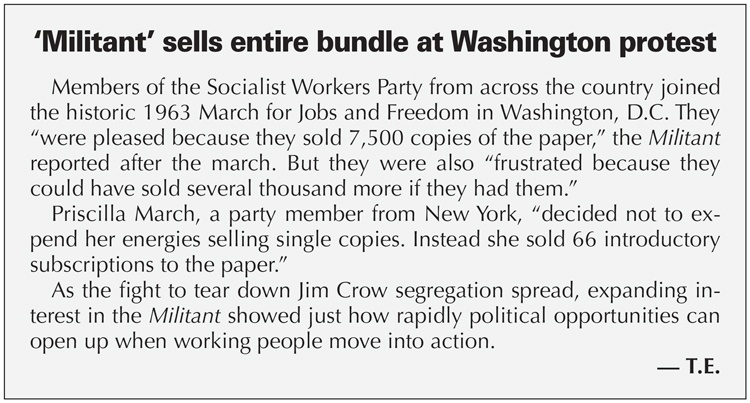
The Militant is an invaluable source of information about the movement to overthrow Jim Crow. Back issues can be read at www.themilitant.com.
Fighting racism in North
The spreading mass movement to desegregate the South was inspiring fights against racism in the North. The Sept. 2, issue of the Militant reported on protests in Chicago against city officials’ attempts to prevent desegregation of the schools; a fight in Philadelphia against slum landlords in the Black neighborhoods; and a picket by the NAACP in Elizabeth, New Jersey, demanding construction jobs for African Americans.
But in a big majority of the South, especially in most of Alabama, Georgia and Mississippi, racial segregation remained deeply entrenched. Night riders and Ku Klux Klan thugs continued to act with impunity as they carried out violent assaults, emboldened by the fact that state and federal authorities looked the other way.
A month before the March on Washington a group of Blacks tried to buy tickets at a whites-only counter at a cinema in Americus, Georgia, where SNCC was organizing a voter registration drive. Cops arrested 15 young women, aged 12-15, holding them for 60 days in squalid conditions with no working toilet or shower. They were forced to sleep on concrete floors with minimal food and water.
After SNCC discovered the girls’ location it sent a photographer to the stockade. His pictures, and the outcry that followed their publication, led to the girls’ release.
In 2023, Carol Barner Seay, one of the Leesburg Stockade Girls, as they became known, spoke to CNN about the desegregation fight and her incarceration. It “should have made me bitter,” she said. “But I stand here today to tell you it made me better.”
The Militant reprinted a special report by SNCC about the fight in Americus in its Sept. 30, 1963, issue. It reported three SNCC field workers had been accused of trying to incite an insurrection, a charge that carried the death penalty in Georgia. They were released when a federal court threw out Georgia’s insurrection law after protests and a broader public response to the attack.
New battles to come
In the face of challenges like this, the methods of struggle and leadership needed to break the back of Jim Crow were being widely discussed.
Malcolm X had emerged as a revolutionary working-class leader who was looked to by growing numbers of fighters against Jim Crow. In December 1963 he was suspended from the Nation of Islam, the bourgeois nationalist organization for which he was the most well-known public spokesman.
“They put me out because of my uncompromising approach to problems I thought should be solved,” Malcolm later told the Young Socialist magazine. “I felt the movement was dragging its feet in many areas. It didn’t involve itself” in the fight to end Jim Crow.
“The only way it could function and be meaningful in the community was to take part in the political and economic facets of the Negro struggle,” he said.
The fight against Jim Crow was spurring struggles by Blacks for equal rights on the job, and against racist discrimination and violence across the country. Expanding struggles lay ahead, including for the right to vote.