
Feminism and the Marxist Movement by Mary-Alice Waters is one of Pathfinder’s Books of the Month for September. Marxists have always explained that the economic roots of women’s oppression are an integral part of the workings of capitalism. Only the overthrow of boss rule by the working class can lead to the transformation of the entire social system required to achieve full equality for women. The except below is from the section on “Lenin’s views on female emancipation.” Copyright © 1972 by Pathfinder Press. Reprinted by permission.
Clara Zetkin’s book, Recollections of Lenin … is based on two meetings with Lenin in Moscow in 1920. These were preliminary discussions, part of the process of drafting the resolution on work among women for the Third Congress of the Comintern in 1921.
First, Lenin urged that the document should stress “the unbreakable connection between woman’s human and social position and the private ownership of the means of production.” To change the age-old conditions that subjugate women within the family, communists should seek to link the women’s movement with “the proletarian class struggle and the revolution.” …
“We derive our organizational ideas from our ideological conceptions,” he told Zetkin. “We want no separate organizations of communist women! She who is a Communist belongs as a member to the Party, just as he who is a Communist. They have the same rights and duties.”
“However,” he continued, “we must not shut our eyes to the facts. The Party must have organs — working groups, commissions, committees, sections or whatever else they may be called — with the specific purpose of rousing the broad masses of women.”…
Zetkin commented that many party members had been denouncing her for making similar proposals on the basis that such ideas were a return to Social Democratic traditions, and that “since the Communist Parties gave equality to women they should, consequently, carry on work without differentiation among all the working people in general.”
“How,” Lenin asked Zetkin, “do such guardians of the ‘purity of principles’ cope with the historical necessities of our revolutionary policy? All their talk collapses in the face of the inexorable necessities.”
“Why are there nowhere as many women in the Party as men,” he demanded, “not even in Soviet Russia? Why is the number of women in the trade unions so small?” In sharp terms he defended the need to put forward special demands for the benefit of all women, of working women and peasant women, and even women of the propertied classes who also suffer under bourgeois society.
Finally, Lenin was sharply critical of the national sections of the Comintern for not doing as much as they should. “They adopt a passive, wait-and-see attitude when it comes to creating a mass movement of working women under communist leadership.” He attributed the weakness of women’s work in the International to the persistence of male chauvinist ideas which led to an underestimation of the vital importance of building a mass women’s movement. For this reason he thought the resolution for the Third World Congress of the Comintern was especially important. …
Zetkin’s second discussion with Lenin conveys an even richer idea of how he (and Zetkin) approached the problem of winning the masses of women on a world scale. It underscored the Bolsheviks’ lack of sectarianism or ultraleftism. Their discussion makes clearer than most formal resolutions exactly how they carried out their work.
Zetkin proposed that the communist women from various countries should take the initiative in calling and organizing an international congress of women to help promote the tremendous new ferment and radicalization of women of all classes and sections of society in the post-World War I period. She suggested that they contact “the leaders of the organized female workers in each country, the proletarian political women’s movement, bourgeois women’s organizations of every trend and description, and finally the prominent female physicians, teachers, writers, etc., and to form national nonpartisan preparatory committees.”
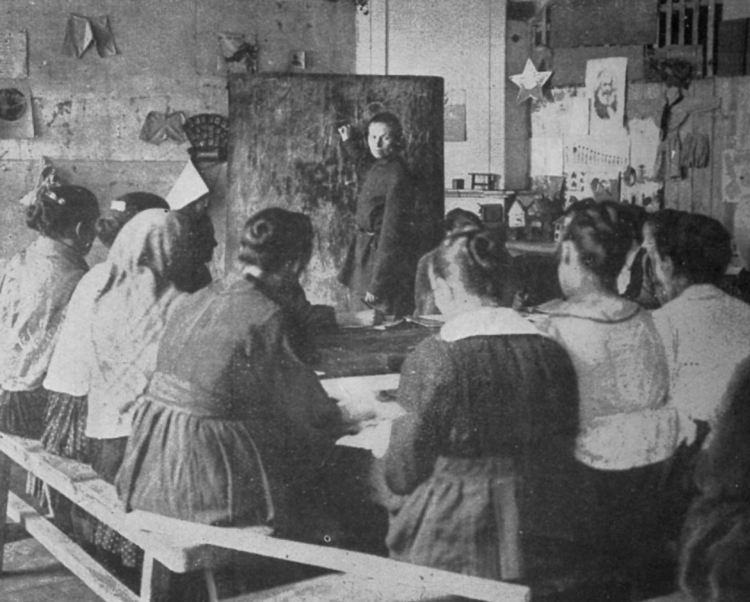
The conference, she proposed, should take up questions like the right of women to engage in trades and professions, problems of unemployment, equal pay, labor protection for women, social care for mothers, social measures to relieve housewives, and the status of women in marriage, family legislation, and legal rights. The proposal was based on similar conferences of nonparty working women being organized inside the Soviet Union at that time.
She outlined an international campaign to publicize and build such a conference, and also pointed out how it would be necessary for the communist women themselves to work together in a disciplined fashion in order to bring it off. “Needless to say, all this requires as an essential condition that women Communists work in all the committees and at the congress itself as a firm, solid body and that they act together on a lucid and unshakable plan.”
Lenin’s reaction was one of wholehearted approval. But he questioned whether the Communist fraction at such a congress on an international scale would be strong enough to win the leadership of the delegates, whether the bourgeois and reformist women might not be stronger. Zetkin responded that she thought it was not a great danger because the communist women would have the best program and proposals for action. And even if they did lose, it would be no disaster. Lenin agreed. “Even defeat after a stubborn struggle would be a gain,” he commented.
On further reflection, Lenin pointed out that this congress of women “would foment and increase unrest, uncertainty, contradictions and conflicts in the camp of the bourgeoisie and its reformist friends. … The congress would add to the division and thereby weaken the forces of the counterrevolution. Every weakening of the enemy is tantamount to a strengthening of our forces.”