Worried about deepening opposition among working people to the Iranian regime’s dictatorial rule and its wars, the country’s Supreme Leader, Mojtaba Khamenei, threatened Aug. 28 that “engaging in anything that harms social cohesion is prohibited” and will be punished.
The Iranian rulers’ fear of the working class and oppressed nationalities is reflected in many ways.
The regime has made only a tepid attempt to push back the growing number of women who have stopped adhering to the reactionary dress code, which requires them to cover up their hair. It shut down dozens of cafes and other businesses that have allowed in women customers without a hijab, but decided against ordering large-scale arrests, fearing this would spark a new “women, life, freedom” movement, bigger than the one that swept the country in 2022 following the death of Zhina Amini after her arrest by the morality police.
While defiance of the dress code is more open in middle-class neighborhoods in Tehran, it’s growing in small towns and rural areas, and even at Muslim religious ceremonies.
In the wake of mass anti-government protests in December 2025 and January 2026 — in which the regime massacred more than 7,000 protesters — the rulers accelerated their use of the death penalty. In one recent week at least 32 people were executed.
Weekly hunger strikes against the death penalty, organized by the prisoner-based “No to Execution Tuesdays” group, have now spread to 62 prisons. In a Sept. 1 statement, the group notes that those arrested for joining the protests have been “subjected to injustice without the right to a defense or a fair trial.”
Still the executions are spurring ever more protests. “We oppose all forms of execution, regardless of the charges involved, and consider it incompatible with human dignity, the right to life, and justice,” reads a petition being circulated by the Coordinating Council of Iranian Teachers’ Trade Unions. As of Sept. 1 more than 850 people had signed.
68 labor actions in 30 days
According to Davtalab, an Iranian Telegram site that reports on labor issues, in the last month alone there were at least 68 labor actions in some 25 cities.
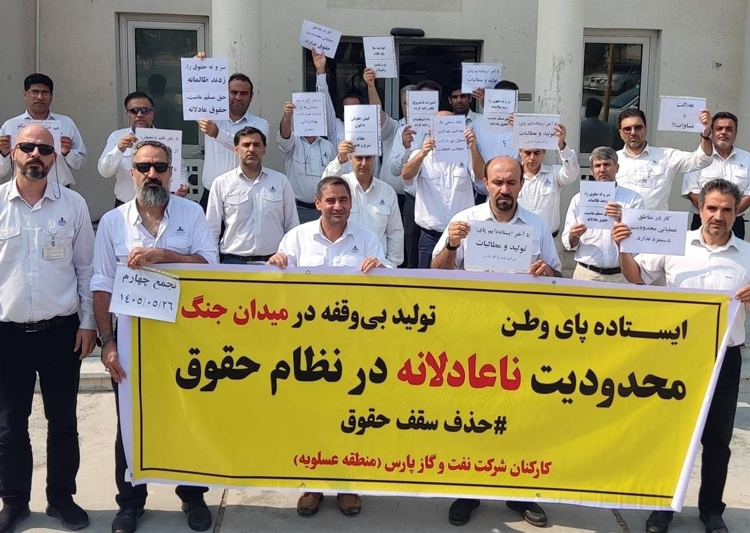
Workers at oil and gas facilities, including offshore platforms, have been holding weekly protests every Monday for six weeks. At Sept. 1 actions they demanded protection for pensions, pay hikes and raising the minimum wage for newly hired workers.
Many protests by hundreds of retirees take up not only demands around pensions and healthcare, but opposition to the imprisonment of trade union activists and the death penalty. The actions are getting larger and bolder, often on busy streets, where they’re seen by tens of thousands.
Nationwide protests by teachers have been announced for Sept. 6 under the slogan “The teacher is not a slave.”
War a lose-lose situation for workers
The regime’s fear of the working class is also reflected in an article published by the government-funded Iranian Labour News Agency Sept. 1. It reports on the worsening conditions confronting workers at the Shahid Rajaee Port outside Bandar Abbas on Iran’s southern coast.
The article notes that because of the U.S. naval blockade, “the enormous cranes that were once symbols of vitality and movement now stood motionless in the distance, like the metallic skeletons of extinct dinosaurs.”
The contractors they worked for “ruthlessly put the blade of layoffs to the throats of thousands of workers,” the article notes. “It is the workers who pay for the cost of this historic shutdown with their empty dinner tables.”
Yaser, who worked for a customs clearance company, told the news agency “the company neither officially dismisses us,” blocking workers from receiving severance pay, “nor gives us an official ‘no longer needed’ letter” that would allow them to apply for unemployment.
“The war is a lose-lose situation for us workers,” Rahim, a longtime port worker, said. Those that are still working, moving more than 135,000 containers that were at the port before the blockade began, are getting only “70% of last year’s wages” despite skyrocketing inflation, Rahim said. “They say it’s wartime and the company has no income.”
The boss “simply calls and says ‘don’t come tomorrow,’” said Saaed, another customs worker. Meanwhile, the boss “drives his Porsche around Tehran.”
For Afghan immigrants as well as workers from the oppressed Baloch nationality, conditions are worse. Thousands of Baloch, born and raised in Iran, are denied ID cards by the government. Nemat, a 24-year-old Afghan worker, told ILNA how they are given the hardest, lowest paid jobs, working 14 hours a day “without masks, without gloves.” Despite the intense heat, “we even have to buy our own ice water.”
With the layoffs and inflation, “we the working families are the ones paying the price of sanctions and the blockade,” Aminah, the wife of a laid-off worker, said.
“Thousands of exhausted men” are “waiting for the day when these great gates will set aside a fairer share for their calloused hands.” The point of the article was to warn the regime that instead of “waiting,” more workers may be preparing to join together to fight for what they need.
Rival wings of the regime
Public disputes among rival wings of the reactionary regime over what to do in the face of U.S. imperialism’s sanctions, blockade and intermittent military attacks have increased. Some officials are calling for negotiations while others call for new military offensives against U.S. allies and bases.
Whatever their differences, the main factions are all committed to the longer-term goal of the destruction of Israel as a refuge for Jews.
“Every kind of false dichotomy — such as war versus negotiation, consensus versus extremism, or compromise versus warmongering,” Khamenei claimed, “weakens” the country. Talking about the economic crisis and other problems only aids the “American-Zionist enemy,” he said.
The regime has suffered significant blows to its military, industrial and economic capacity, despite its bluster about having “defeated” U.S. imperialism in the 40-day war.
But President Donald Trump’s administration has been unable to win what it anticipated would be a quick victory, forcing Tehran to put off its goal of acquiring nuclear weapons and form a working relationship with Washington. The U.S. rulers seek to increase their plunder of the resources of the region and push back their rivals, especially Beijing. Though greatly weakened, Tehran is still able to threaten ships passing through the Strait of Hormuz, a key choke point for world trade.
With no clear end to the on-again, off-again U.S. airstrikes and negotiations, other capitalist regimes in the region are jockeying to advance their own rival interests.
The governments of Turkey, Pakistan and Saudi Arabia recently formed the “Mecca Defense Alliance,” which they say will allow for joint use of their militaries and “efforts to combat terrorism.”