MARTÍN KOPPEL AND
CLAUDIA KAISER-LENOIR
HAVANA — A team of Militant correspondents from the United States, Canada and the United Kingdom was here in early August to report on the brutal impact of Washington’s relentless aggression against Cuba, and how millions of Cubans and their government are responding to it with dignity and through enormous effort.
As one person after another told us, the U.S. imperialist rulers seek to starve working people into submission. They want to overthrow Cuba’s socialist revolution and erase its longstanding example for millions around the world. That’s the goal they have pursued for more than six decades under Democratic and Republican administrations alike.
Here are a few examples of what we learned.
Challenge of U.S. oil blockade
We spoke with Carlos Muñiz, who we had interviewed on a reporting trip six months earlier. At that time, the self-employed welder, along with his wife, Magela Elepán, both strong supporters of the revolution, told us the prolonged blackouts and other economic hardships had worsened since Washington’s Jan. 3 assault on Venezuela and its near-complete blockade of oil shipments to the island.
Reporter’s Notebook from Havana
After Jan. 3, thousands of outraged Cubans mobilized to condemn the U.S. attack on Venezuela’s sovereignty and stepped-up military threats against Cuba itself. Many, Elepán included, volunteered for arms training exercises across the island. Today, weekly “Days of Defense” training exercises continue to be held, rotating through different areas of the country.
But the cumulative impact of the U.S. blockade on oil and other necessities weighs even greater than it did in February, Muñiz said. “Our focus is overwhelmingly the challenges of everyday life. The uncertainty — not knowing what tomorrow holds for us.”
Blackouts of more than 20 hours a day are the norm, Muñiz said. The alumbrones — or “lights-on,” as Cubans call the unpredictable moments when power returns, sometimes in the middle of the night — are when families move into action to charge electrical devices and use appliances for daily chores. Households buy food items that won’t quickly spoil from lack of refrigeration. And the blackouts also lead to irregular running water.
Vegetables, fruits, eggs and other basic food items are available in private stores, but inflation ravages the living standards of the majority. The fuel shortages increase the cost of transporting produce from the countryside, while working people often get hit by price-gouging, especially in the privately owned street stands and stores where most Cubans buy their food.
In addition, most wages and pensions in Cuba are deposited directly in banks. When people attempt to withdraw their funds, a cash shortage “leads to unending lines,” Muñiz said.
“These days it’s not possible for me to live as a welder,” he told us, given the lack of reliable electricity. So Muñiz finds odd jobs from home maintenance to taxi work. Elepán is working two office jobs plus cleaning houses and apartments. Muñiz, a Communist Party member, said he has seldom made local party meetings in recent weeks.
You feel the U.S. blockade personally, Muñiz said. “But we know it’s the country as a whole — the lack of fuel and essential imports. Hospitals face an uphill battle in treating kids with cancer, or people on dialysis. Elderly people are dying unnecessarily. Infant mortality is on the rise.
“So we continue to resist with dignity. We reinvent ourselves every day, determined to defend our sovereignty and independence. The solidarity from friends abroad is a big boost to the Cuban people.”
Protecting the most vulnerable
In face of this crisis, the Cuban government has taken measures to give priority to the most vulnerable in society, and thousands of working people have pitched in to make a difference.
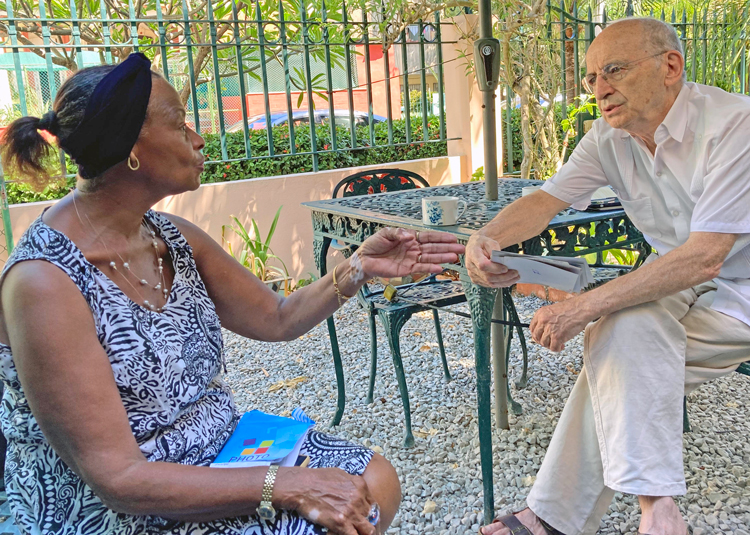
Karina González, president of the National Association of the Blind (ANCI) for Havana province, welcomed us into her living room to talk one afternoon. She explained that ANCI members are proud of their long record of integrating the blind into all areas of society — one of the gains of Cuba’s socialist revolution. But the fuel shortage has sharply limited their mobility, “so we’ve organized more activities in local communities.”
That week Cubans nationwide were celebrating the centennial of revolutionary leader Fidel Castro’s birth. In the neighborhood of San Miguel del Padrón, González said, “ANCI is holding an all-night block party with music and a traditional caldosa,” a communal pot of stew where everyone contributes some ingredient.
“And despite today’s conditions, we’re still producing audiobooks for the visually impaired. It’s what Fidel taught us, ‘Never stop!’” This year, she noted proudly, ANCI once again organized a booth at the Havana International Book Fair, although the festival itself was substantially scaled down.
Keeping Special Education going
Sonia Fernández, a special education teacher, traveled a long distance by electric tricycle from her home in the working-class district of La Lisa to talk to us about some of her experiences.
“Many kids in the special school for blind children where I work in can no longer get there because there is no transportation,” she told us. “We had no choice but to integrate them into general schools near where they live. That upset some parents, concerned that the kids are not getting the attention they need.”
Fernández is one of the specialized teachers who now go to the general schools to work together with staff and pupils to help integrate the visually impaired children. “Yes, it’s more difficult. But we have worked to convince the parents that we have to adapt and it’s possible. And eventually the children are going to have to learn how to function in broader society.
She described the painstaking efforts by teachers, including herself, to convince the sighted students to be more conscious about making their blind classmates feel welcome, and to increase the self-confidence of the visually impaired youth themselves. Everyone, students and staff alike, Fernández noted, was surprised at the progress they have made through these efforts.
Healthcare vs. U.S.-imposed scarcity
We learned of many other examples of social solidarity under such adverse conditions, on a scale possible only in a country where a socialist revolution was made. A surgeon at the Calixto García hospital in Havana told us what healthcare personnel and patients face at medical centers across the island as a result of Washington’s barbaric efforts to deprive Cubans of fuel and other basic necessities. Blackouts wreak havoc on the ability to perform surgeries. Basic medicine and medical supplies are extremely scarce.
The surgeon described health workers’ creative approach to the lack of resources, including the use of cellphones as a source of light while performing surgery during blackouts. “We lack a certain polyester thread for post-surgery sutures, so we now use a finer thread we fold over five times to meet the required strength,” she said.
The government is providing special buses free of charge to maximize the ability of healthcare workers to get to major medical centers. But those efforts are limited by the shortages.
In Havana and cities across Cuba, countless doctors, nurses, and health workers, determined to take care of their patients, walk long distances in hot weather, sometimes combined with taking electric tricycles, to get to and from work.
The surgeon we spoke with has received offers to practice in other countries, she told us. “They tell me, ‘You could be a millionaire in the U.S.’ Well, maybe. But my patients are here, and this is where I stay.”
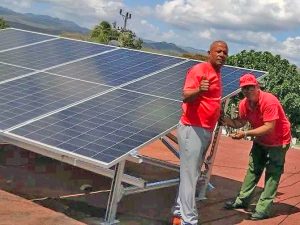
In a future issue, the Reporter’s Notebook from Havana will take up efforts by working people to use solar power to help meet transportation needs, collect garbage in local communities and other initiatives.