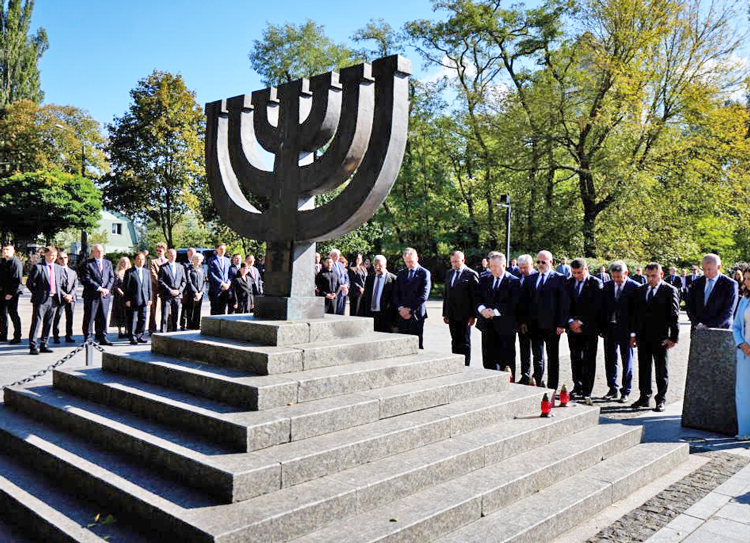
The 85th anniversary of the “Holocaust by bullets,” one of the worst single atrocities by Adolf Hitler’s Nazi regime, was commemorated at Babyn Yar on the outskirts of Kyiv Sept. 29. Less than two weeks after the German imperialist army routed Soviet forces and seized the city in 1941, over 30,000 Jews were systematically slaughtered there. This was one of the killing fields in the Nazis’ genocidal “Final Solution” in which 6 million Jews were murdered in German-occupied nations across Eastern Europe.
Nazi troops rounded up all Jewish men, women and children who hadn’t fled the city. Marched to the ravine, 33,771 were forced to undress and were then machine-gunned Sept. 29-30. The toll was recorded with chilling precision by the Nazi executioners.
Babyn Yar became the largest mass grave in Europe. Over the next two years some 70,000 others — mostly Jews, but also Roma, Soviet prisoners, psychiatric and disabled patients and Ukrainian partisans — were herded along its “road of death,” shot and buried there.
After Russian troops ended the Nazi occupation in 1943, Moscow reestablished its rule over Ukraine. For decades the Stalinist bureaucracy covered up the Nazis’ slaughter of the Jews as it advanced its own antisemitic propaganda.
After 1917, the Bolshevik government, led by V.I. Lenin, had put an end to decades of czarist pogroms against Jews. “The October Revolution abolished the outlawed status of the Jews,” Bolshevik leader Leon Trotsky explained. A revival of Jewish culture was fostered by the young workers republic, as it granted autonomy to nations like Ukraine, long oppressed by Moscow.
Stalin revived antisemitism
Many of the conquests of Russia’s socialist revolution were overturned in the late 1920s as Joseph Stalin consolidated a bloody counterrevolution that ended Ukrainian self-determination and drove workers and peasants out of politics. A reign of terror was unleashed against revolutionaries in Ukraine.
This was accompanied by a revival of Jew-hatred. “The leading cadre of the bureaucracy at the center and in the provinces strives to divert the indignation of the working masses from itself to the Jews,” Trotsky wrote from exile in 1937.
The Stalinist regime resisted pressure to build a memorial at Babyn Yar and hid the fact that Jews had been the target. Moscow built a dam in the ravine in 1957, which then collapsed, leading to an environmental disaster. But Jews and others found ways to mark the anniversary there every year.
After visiting the ravine in 1961, Ukrainian poet Yevgeny Yevtushenko wrote a poem, “Babyn Yar.” He began, “No monument stands over Babyn Yar, a steep cliff only, like the rudest headstone.”
When Soviet Premier Nikita Khrushchev met him in 1962, Yevtushenko read him the last lines of his poem:
“In my blood there is no Jewish blood.
But all anti-Semites hate me with
Encrusted spite as if I were a Jew.
And because of that — I’m a true Russian.”
“Comrade Yevtushenko, this poem has no place here,” Khrushchev warned him.
In 1966, on the 25th anniversary of the massacre, thousands gathered at the ravine for an unauthorized rally. The featured speaker was Ivan Dzyuba, a Ukrainian communist who wrote the book Internationalism or Russification? a defense of Lenin’s course.
“Babyn Yar is a tragedy of the whole of mankind,” he said. “But it happened on Ukrainian soil. And therefore a Ukrainian must not forget it any more than a Jew.
“We, the Ukrainians, should combat in our midst any manifestation of antisemitism, or disrespect to a Jew.”
By 1976 an official monument was erected at Babyn Yar — but only celebrating Soviet “citizens” who suffered in the fight against the Nazis, with no mention of Jews being massacred.
It was only after the disintegration of the Stalinized Soviet Union and Ukraine gaining independence in 1991 that an appropriate monument was built to mark the Nazis’ atrocity at Babyn Yar as part of the Holocaust against the Jews. The anniversary event was held there again this year.