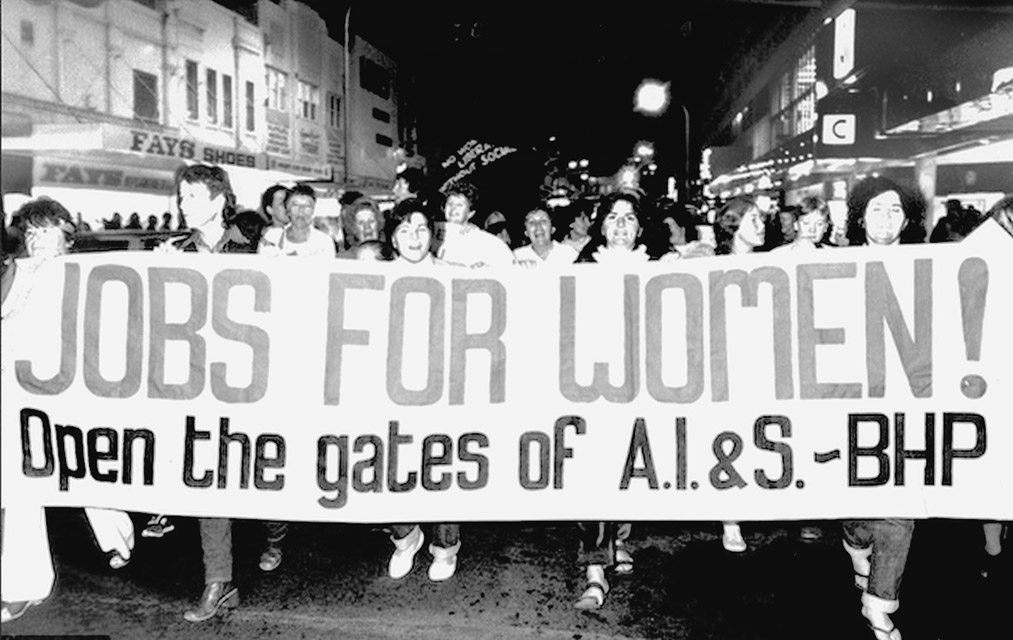
Is Biology Woman’s Destiny? by Evelyn Reed is one of Pathfinder’s Books of the Month for October. Reed was a leader of the Socialist Workers Party, an author and spokeswoman for the party in the 1960s and early ’70s in the fight for women’s emancipation. She used historical materialism to explain how the roots of women’s oppression lie in the evolution of class society. And ending the subjugation of women is tied to the working-class struggle to take political power, opening the door to end capitalist exploitation and the class divisions it rests on. Copyright © 1972 by Pathfinder Press. Reprinted by permission.
What women remain unsure about … is whether or not their biology has played a part in making and keeping them the “second sex.” Such uncertainty is quite understandable in a male-dominated society where not only is history written by those who uphold the status quo but all the sciences are likewise in their hands. Two of these sciences, biology and anthropology, are of prime importance in understanding women and their history. Both are so heavily biased in favor of the male sex that they conceal rather than reveal the true facts about women.
Perhaps the most pernicious pseudoscientific propaganda on female inferiority is that offered in the name of biology. According to the mythmakers in this field, females are biologically handicapped by the organs and functions of motherhood. This handicap is said to go all the way back to the animal world and makes females helpless and dependent upon the superior male sex to provide for them and their young. Nature is held responsible for having condemned females to everlasting inferiority.
It is obvious that females are biologically different from males in that only the female sex possesses the organs and functions of maternity. But it is not true that nature is responsible for the oppression of women; such degradation is exclusively the result of man-made institutions and laws in class-divided patriarchal society. It did not exist in primitive classless society and it does not exist in the animal world. …
Humans are above all social beings who have long since separated themselves from their animal origin and conditions of life. …
This brings us to the final point in the tangle of myths aiming to prove that women have always been the second sex. This one concerns the distinction between the primitive and civilized division of labor between the sexes. According to the prevailing propaganda, the division of labor between the sexes has always been the same. …
But it is not true that procreation, which is a natural function, is identical with the family, which is a man-made institution. While women have always been the procreators of children, they have not always been isolated in self-enclosed units, each woman serving a husband and family. …
Both sexes in primitive society performed social labor. This was possible because their system of communal production was accompanied by communal child care and education. Female children were trained by the adult women into their future occupations while the male children at a certain age were turned over to the adult men who became their tutors and guardians. Both production and child raising were originally social functions, performed by both women and men. It was only with the downfall of the matriarchal commune and its equalitarian relations between the sexes that women were dispossessed from social production and put into family servitude. Men took over in the new divisions of labor.
Historians often point out that with the advent of the new economy founded upon agriculture and stock raising, many new divisions of labor came into existence, replacing the former sexual division of labor. To give a few examples, pastoral activities became separated from farming; metallurgy, house construction, shipbuilding, textiles, pottery, and other crafts became specialized trades. Along with these divisions of labor in the crafts, there grew up specializations in the cultural sphere, from priests and bards to scientists and artists.
The roles of the sexes were radically transformed in the process. As these new divisions and subdivisions of labor grew and proliferated they became more and more — and finally exclusively — in the hands of the men. The women were squeezed out of these fields of social and cultural work — and pushed into home and family life. With the rise of state and church power, women were taught that their whole lives were bounded by the four walls of a home and the best women were those who served their husbands and families without complaint. In this elevation of men and downgrading of women, they were compelled to forfeit not only their former place in social production but also their former system of communal child care.
To be sure, women of the plebeian classes, the “common people,” have always worked. In the long agricultural period they worked on farms as well as in cottage crafts, and they did all this along with bearing children and taking care of households. But working in and through and for an individual husband, home, and family, is by no means the same thing as engaging in socialized labor in a communal society. Participation in social production develops the mind and body; isolation and preoccupation with home chores weakens them and narrows the outlook.
In other words, the division of labor between the sexes has not always been the same. The male-dominated division of labor that came in with class society, private property, and the patriarchal family represented a colossal robbery of the women. …
Woman’s position in society, therefore, has been shaped and reshaped by changing historical conditions. The drastic transformation that overturned matriarchal communism brought about the downfall of the female sex. It was with the rise of patriarchal class society that the biological makeup of women became the ideological pretext for justifying and continuing the dispossession of women from social and cultural life and keeping them in a servile status.
Only by recognizing this can women come to grips with the real causes of our subjugation and degradation which are today bound up with the structure of the capitalist system. Our struggle for liberation will be hindered so long as we are hoodwinked into believing that nature rather than this society is the source of our oppression.