Immigration and Customs Enforcement agents descended on three towns in southwestern Kansas — Dodge City, Garden City and Liberal — at the end of September, stopping cars and making arrests of immigrant workers. Their operations were met by protests by youth and working people, who said their co-workers, neighbors and friends were being slandered by ICE, which claimed it was detaining the “worst of the worst” and threatening to deport them.
ICE agents arrested more than 100 people, demanding proof of their immigration status during traffic stops and from workers entering the area’s beef processing plants.
This part of Kansas is widely known as the “Golden Triangle of Beef,” with Cargill and National Beef plants in Dodge City, Tyson Foods in Garden City and another National Beef operation in Liberal. Together they slaughter some 24,000 cattle a day, over 20% of the nation’s fed-cattle kill. The ICE raids led to sharp drops in production as workers stayed home.
“They were racially profiling people,” Janeth Vazquez, vice mayor of Liberal, told Kansas Reflector news service. “I’m not just talking about undocumented people. I’m talking about U.S. citizens as well.” Some 68% of the 20,000 people living there are Latino.
“I’ve been in contact with several schools, and I’ve been in contact with the families directly,” Vazquez added. “The majority of these families did not have any criminal history. These were hardworking, humble, genuine, good people in our communities.”
Officials from the three cities put out a joint statement saying they were “not notified in advance” about these ICE operations being conducted in their cities. Vasquez described how there was “an ICE vehicle in front of me, and out of nowhere he just busted a U-turn, and there was oncoming traffic going the other way and he didn’t hesitate to even worry that he could create a hazard and dangerous situation.”
Some 200 people rallied in Dodge City Sept. 25 protesting the detention and deportation of local workers. In Liberal a second protest took place Oct. 3.
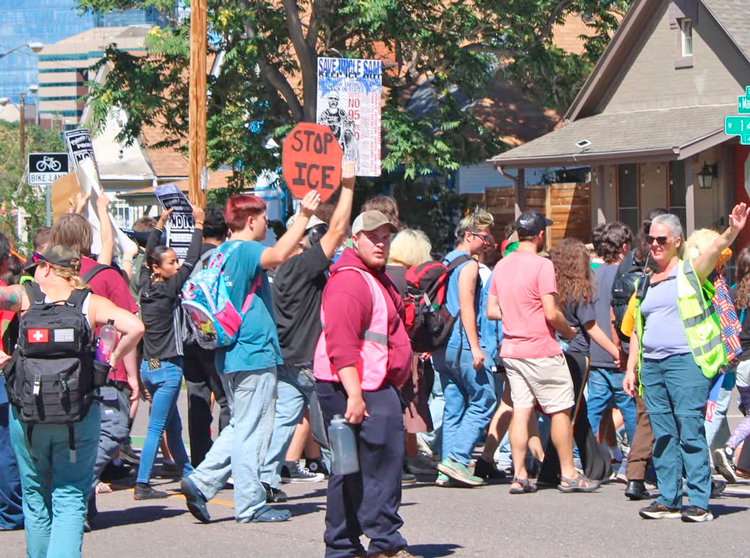
Similar actions occurred in cities large and small in Colorado, where students from more than 200 high schools walked out of class Sept. 4, demanding a halt to ICE targeting classmates, co-workers and others. Hundreds of them gathered for a rally at La Alma-Lincoln Park in Denver, then marched around the neighborhood.
“What ICE is doing is just unconstitutional, unlawful. It’s inhumane, and I just don’t want to sit back and just watch it happen,” Naya Ferguson, a 16-year-old student at Bear Creek High outside Denver told Colorado Newsline.
Demonstrators said they were also protesting the government opening ICE detention centers in the area. They’re run by the GEO Group, the world’s second-largest private prison company, which reaps profits off the decrepit conditions under which immigrant workers are held. One is in Aurora, a suburb of Denver.
Another is being built in Hudson, which is located between the JBS packing plant in Greeley and Cargill’s beef slaughterhouse in Fort Morgan. The workforce at both plants includes workers from many different countries. Through their unions, these workers successfully waged a four-week strike at JBS and fought against a boss lockout at Cargill, demanding increased pay and livable working conditions.
Protests at Nebraska ICE facility
In southwestern Nebraska, protests have been growing against an immigration detention center opened nearly a year ago in the rural town of McCook. Some 300 people rallied there Aug. 15, led by McCook-based Nebraska Voices and the American Civil Liberties Union Nebraska.
Among those taking a bus to the protest was Emma Risinger, a student at the University of Nebraska at Kearney. “I and everyone else here has so much more in common with the people who are in that camp than they ever will with the people who put those people there,” she told the press.
Actions against the ICE prison began modestly, with six protesters showing up when it opened. But their efforts over the next months won widespread support there and throughout the state.
The facility, called by officials the Cornhusker Clink, was originally a minimum-security state jail named the Work Ethic Camp. Its inmates helped out in the community, setting up the town’s annual Santa Claus display and keeping the town’s cemetery clean, McCook resident Diane Lyons told Nebraska Public Media.
“Then all of a sudden it was gone,” she said. “The inmates were sent away. The garden was bulldozed. Rows and rows of barbed wire were put up.”