Years of battles to win the right of Blacks to vote in the Jim Crow South came to a head with the monthslong fight to march from Selma to Montgomery, Alabama, in 1965. During that fight President Lyndon Johnson — a lifelong segregationist — announced he was going to introduce a bill in Congress to guarantee the vote to everyone in the country.
The march went through Lowndes County, one of the most reactionary Ku Klux Klan strongholds in Alabama.
Led by Stokely Carmichael, members of the Student Nonviolent Coordinating Committee stepped away from the march to talk with local Blacks who came out to greet the marchers and discuss plans for a voter registration drive. After the march Carmichael and other SNCC leaders immediately returned to Lowndes.
From bitter experience, these fighters knew that neither the Democratic nor Republican parties offered any protection from deadly assault by white supremacists, let alone any assistance in the struggle to overturn Jim Crow. SNCC’s goal was to organize the broadest layer of working people in Lowndes County to take their destinies into their own hands, including by establishing an independent Black political party.
In 1965 not a single Black was registered to vote in Lowndes County, despite Blacks making up 81% of its population of 15,000. Many were seasonal farm laborers, sharecroppers or maids. As the fight against Jim Crow spread in the early 1960s, no actions to protest Jim Crow had taken place there.
But under the impact of victories against segregation across the South — from the Montgomery bus boycott to the Freedom Rides to the Battle of Birmingham to the Selma-to-Montgomery march — a layer of African Americans in the county were looking for a way to fight. They were led by John Hulett.
He had left Lowndes in 1948 to find work in a foundry in Birmingham, where he joined the foundry workers union and the NAACP. Hulett also joined the armed self-defense team organized to protect Rev. Fred Shuttlesworth, the central leader of the Birmingham desegregation fight. He returned to Lowndes in 1959.
Just weeks before the Selma-to-Montgomery march set out, Hulett led 39 Blacks to try to register at the county courthouse. They were turned back.
Viola Liuzzo, a civil rights fighter from Detroit, had come to join the march. After it concluded in Montgomery, she volunteered to drive participants home. On the way, she was murdered by the Klan in Lowndes. At a meeting to mark her death at Mount Gillard Missionary Baptist Church, 100 Blacks formed the Lowndes County Christian Movement for Human Rights.
SNCC volunteers in Lowndes worked with this newly formed group, going door to door to broaden the reach of the movement. In one rural area, Carmichael rode a mule from house to house. He audaciously backed off cops who tried to prevent him from handing out flyers to high school students, who were clamoring to get involved.
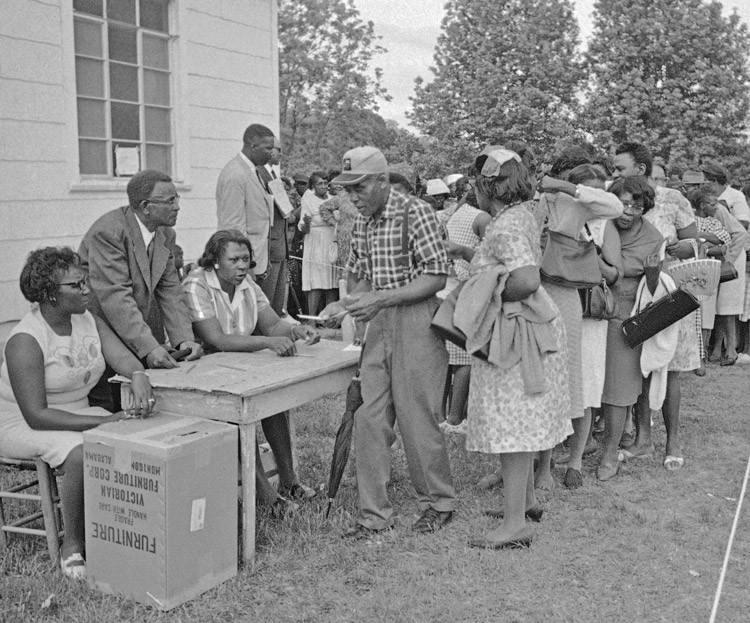
Following the passage of the 1965 Voting Rights Act in August, the federal government sent registrars to Lowndes to sign up Blacks. African Americans lined up day after day to register and it became clear they would soon be a majority of voters in the county.
Racists launch reign of terror
To try to quell the movement’s momentum, a sheriff’s deputy shot and killed Jonathan Daniels, a SNCC volunteer from Massachusetts, and SNCC’s freedom library was bombed. Lowndes activists responded by organizing armed convoys to get people to and from meetings and posting armed sentries outside leaders’ homes.
With the threat of violence pushed back, wealthy white landowners began a wave of evictions of the Black sharecroppers who were backing the desegregation fight. In response, Lowndes activists set up a tent city to house the evictees. In Detroit former Lowndes residents and members of the Friends of SNCC collected food and clothing from the United Auto Workers and other unions to distribute to the evicted sharecroppers.
The supplies were delivered by Rosa Parks, who had helped initiate the Montgomery bus boycott by refusing to sit in the back of a bus and who was now co-chair of the Detroit SNCC support group. She spoke to a mass meeting in Lowndes.
For decades most African American farmers had been kept out of federal government price support and loan programs. In November 1965, SNCC led Black farmers in Lowndes to fight for representation on the government bodies dispensing those funds. The effort was defeated, reinforcing the growing understanding among Blacks that a break with the parties that upheld segregation was needed.
At a mass meeting April 2, 1966, the Lowndes County Freedom Organization was formed as an independent political party. Because illiteracy was so widespread — among Caucasians as well as Blacks — political parties in Alabama had to choose a symbol their supporters would pick when they voted. For Alabama Democrats, it was a white rooster. The LCFO chose a snarling black panther.
“We aren’t asking any longer for protection — we won’t need it — or for anyone to come from the outside to speak for us, because we’re going to speak for ourselves now and from now on,” Hulett said at a 1966 rally in Los Angeles against the Vietnam War. “And I think not only in Lowndes … not only in the South, but in the North. I hope they too will start thinking for themselves.”
Working-class candidates
The party’s slate of candidates, all working people, ran on a program demanding a halt to segregationist violence, aid to Black farmers, a halt to evictions, improved schools for Black children and higher taxes on wealthy landowners.
Willie Ricks, a SNCC field organizer in the county, addressed the party’s nominating convention in May. Alabama governor “George Wallace is a Democrat,” he said. So are “the people who work you for $3 a day” and those who “call themselves the Ku Klux Klan.”
Willie Bolden, 81, cast his first vote in the party’s primary, saying it “made me think I was sort of somebody.”
Socialist Workers Party leaders Betsey Stone and John Benson visited Lowndes on different occasions in 1966, working with Hulett and writing first-hand accounts of the unfolding struggle for the Militant. Members of the Lowndes County Freedom Organization are “continuously canvassing the community, going house to house,” Stone wrote. They hold “frequent meetings” where “the candidates speak and political questions are discussed.”
The liberal New York Times smeared the LCFO, calling it “disruptive” for breaking the two-party control over politics. In contrast, Benson said, “I have never met people so united and enthusiastic about what they were doing. They are proud of their new party and go out of their way to explain what they are doing and why.”
The LCFO candidates won 41% of the vote for county offices in their first outing that year, short of what they needed to get elected. But this example of independent working-class political action was a proud moment in the deepening struggle against Jim Crow.