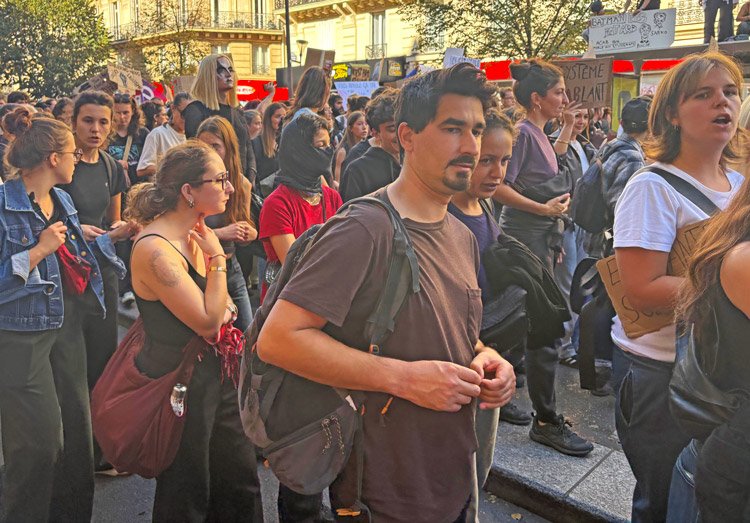
PARIS — Demonstrations by striking high school students demanding a decent education are spreading across France. What began Sept. 18 in Creteil, then three days later in Saint-Denis, both heavily immigrant, working-class suburbs here, rapidly spread to over 40 cities.
Hundreds of thousands of students, joined by their parents, teachers, university students, and the labor unions, took to the streets Oct. 6. They’re battling the effects of a government austerity program that has slashed spending on education, leaving classrooms overcrowded and ill-equipped, schools deteriorating, and with thousands of teaching jobs unfilled. The protesters are demanding these conditions be reversed, including a fairer system for deciding university placement.
Students’ concerns about their future, with youth unemployment at 20%, have converged with wider unrest among working people who face the consequences of today’s deepening capitalist crisis. The French government of President Emmanuel Macron is striving to advance the capitalist rulers’ interests in the face of sharpening competition from their rivals, and deepening political polarization. Wealthy bondholders are demanding government budget cuts to ensure loans they’ve made to cover the country’s enormous debt are repaid.
As the actions escalated, students barricaded hundreds of schools. Anger grew as the government sent baton-wielding riot cops charging — using tear gas and water cannon — against protesters. Media coverage focused on a small minority in the crowd who set trash bins on fire or threw objects at the cops.
Kaspar, a 15-year-old student here, told the BBC the fear he felt when riot police charged as he and his friends protested peacefully. He said they were targeted after some strangers showed up “just to shoot fireworks at police officers” and then run away. “This is not the message we want to send to the world,” he said.
So far, some 7,000 protesters have been arrested and hundreds injured, many seriously. One 15-year-old lost an eye, shot in the face point blank by cops using rubber bullets. Another teenager lost a hand from a stun grenade and a third had their jaw shattered by a tear gas canister.
Under pressure of working-class outrage, the cops have paused the use of the stun grenades for now. “They have armies, they have the police, they have the powers,” Massicella, 18, told the BBC as she marched through Lille. “But we have the mass population.”
Popular chants on the demonstrations include, “Justice nowhere, police everywhere!” and “Macron, resign!”
In Saint-Denis, Zohra, 16, told the Financial Times Oct. 9 that her school is full of rats and cockroaches, and that conditions in classrooms during the summer heat wave with no air conditioning were so punishing that some students fainted. “In winter, we freeze, and in summer we boil.”
Andreane Pierzo, 20, studying to become a doctor, told the Oct. 8 New York Times that government “budgetary cuts affect every public service, except for the police and army.”
Unions back students
The major trade unions joined the students Oct. 6. In Paris, students applauded as members of the CGT, one of the largest union federations in France, formed a defense guard around the student contingents to protect them from further cop attacks. The police said 256,000 demonstrated throughout France that day, while march organizers and union leaders claimed it was almost half a million.
Mickael Sauvage, an aerospace worker, joined the demonstration in response to the call of his union. Following a police attack on the students, a New York Times reporter found him in the space between the police and demonstrators trying to prevent a second attack.
“Young people are worried about their future,” he said. “The trap is that the government is pushing them to violence, so that public opinion will turn against them and their demands won’t be heard.”
A government meeting to try to defuse the student protests refused to extend the education budget, but did take some measures to reduce diesel prices. Officials were worried that more workers, farmers and others would join the student actions.
On Oct. 6 Finance Minister Roland Lescure declared that Macron’s minority government could circumvent parliamentary approval by using executive orders to enact its 43 billion euro ($48 billion) austerity budget cuts.
Signs of deeper capitalist crisis
“This goes beyond having decent toilets in schools,” high school student Alcidor told the BBC in Paris. “It’s strong anger from the youth in France that doesn’t feel represented, that feel abandoned, that feel unheard and are scared of what’s coming in the future.”
As the demonstrations expanded, drawing working-class support, different political forces moved to make gains from relating to them. Jean-Luc Melenchon, leader of the left-wing France Unbowed party, joined the protests. Marine Le Pen, leader of the right-wing National Rally party, criticized Macron for failing to prevent “the noose of interest payments from strangling France.”
The French state debt is at $4 trillion, almost 120% the size of the gross domestic product, which is the second-largest in Europe after Germany. Alongside brewing crises in Greece and Italy, the rulers across Europe fear a fresh financial crisis in the eurozone.