
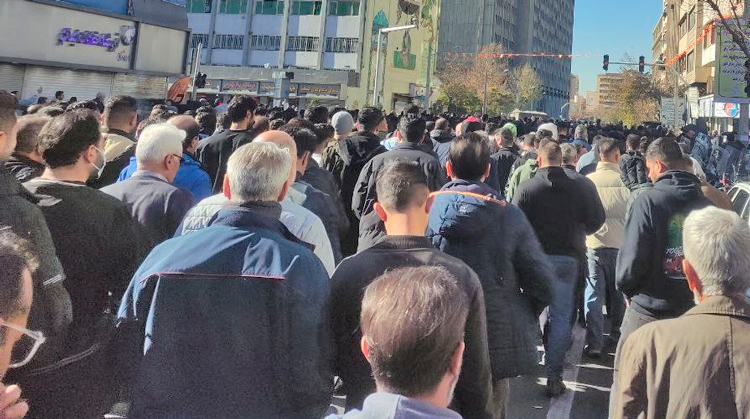
Tens of thousands of small merchants — battered by the plummeting value of the national currency — closed up their shops and took to the streets in rolling protests that began in several bazaars in Tehran Dec. 28. They were joined by other working people. By the fifth day the protests had spread to at least 21 cities as well as to a dozen university campuses.
The protests come amid long-simmering opposition among workers, farmers and middle-class layers to the reactionary capitalist regime that rules Iran and to the consequences of its deadly wars, including attacks on Israel.
Over the last year there have been weekly protests by retirees demanding adequate pensions, by oil workers demanding an end to the exploitative use of contractors and many other actions. Unions issued calls for an end to the deportation of Afghani immigrants. Prisoners carry out weekly hunger strikes against the death penalty. Working farmers have protested government policies that sink them deeper in debt.
“The bazaar, tradespeople, producers and drivers are all victims of wrong decisions, unregulated increases in costs, heavy tolls, high fuel prices, unfair commissions and other pressures,” the nationwide Association of Truckers and Drivers Unions said in a solidarity statement. “The unity of the bazaar and the drivers is the only way out of this situation, and we declare our full support for the bazaar and the people.”
An 11-day strike by truckers at the end of May spread to every one of Iran’s 31 provinces. “We are the voice of a weary nation that demands justice,” their association said.
Inflation and the declining value of the rial — which has lost some 40% of its value since the 12-day war between Tehran and Israel in June — triggered the current actions.
“If we close our shops, our profit is greater than when we sell goods,” one shopkeeper told IranWire, “because tomorrow we won’t be able to buy anything at today’s prices.”
“We have no choice but to keep selling to be able to pay the rent,” another protesting merchant told the government-funded Iranian Labour News Agency, “but the problem is that after the sale, due to the constant price fluctuations, we no longer have the ability to buy and replace the goods we sold.”
U.S. sanctions, Tehran’s war moves
The capitalist economic crisis in Iran has been accelerated by stepped-up U.S. economic and financial sanctions on Tehran and the impact of the regime’s increased war spending. It is trying to rebuild its armory and that of its allied forces, like Hezbollah in Lebanon, and advance its goal of destroying Israel and eliminating the Jews, after being dealt blows by Israel in last summer’s 12-day war.
Just two weeks before the protests began, the government sharply increased the price of gasoline for many people. Drivers can still purchase their quota of gas at a subsidized rate of about 4 cents a liter. The first 100 liters above the quota costs double that price. Any purchase over that will now cost nearly double again.
Many workers in Iran make $150 a month or less, while basic necessities cost $430.
As the protests spread, demonstrators also chanted “Death to the dictator”; “Don’t’ be afraid, don’t be afraid, we are all together”; and “Not for Gaza nor Lebanon, I sacrifice my life for Iran,” a reflection of growing opposition to the regime’s use of military power to try to extend its counterrevolutionary influence in the region.
“People’s livelihoods are my daily concern,” claimed President Masoud Pezeshkian in a Dec. 30 statement, one indication of the regime’s worries the protests could spark wider actions. He instructed the minister of the interior to meet with representatives of the merchants to discuss their “rightful demands.”
Government spokesperson Fatemeh Mohajerani told a press conference that same day that “we emphasize the right to peaceful assembly, which is recognized in the constitution.”
Clashes with police, regime’s thugs
But in fact the police, special units of the Islamic Revolutionary Guard Corps and Basij paramilitary thugs attacked many demonstrators with water cannons, clubs, tear gas and live ammunition. At times protesters fought back and more than once forced the security forces to retreat.
One sign of the deepening hatred for the regime was the decision of some individual cops not to face the protesters. An official of the Islamic Revolutionary Guard Corps issued a call through Iran’s Channel One TV to “officers and personnel who have been negligent in carrying out their duties to confront the disturbances and who have gone absent or fled.”
He warned that “abandoning one’s post or going into hiding during unrest is tantamount to desertion in wartime.”
A product of counterrevolution
The regime in Tehran claims that it is the continuation of the 1979 Iranian Revolution. That was a deepgoing, modern, popular upheaval that overthrew the bloody dictatorship of the hated, U.S.-backed shah of Iran.
In fact, the regime heading the Islamic Republic is the result of a counterrevolution — consolidated by 1983 — that pushed back the workers, farmers, women and oppressed nationalities who carried out the Iranian Revolution.
Over the last decade working people have stepped up their resistance to the regime. In December 2017 and into 2018, working-class protests swept some 90 cities and towns across the country. Those protests were fueled by opposition to working people being used as cannon fodder in the regime’s military adventures in Lebanon, Syria and beyond aimed at the destruction of Israel, as well as against the indignities of capitalist exploitation.
Thousands took to the streets to protest the death in Tehran of Zhina Amini, a young Kurdish woman, after her arrest in September 2022 by the “morality” police for violating the regime’s reactionary dress code. The regime’s thugs killed hundreds of protesters. Since 2023 Baluchis and other oppressed nationalities have joined actions against government repression.
Today, more and more women appear in public without the mandatory hijab. The regime has largely backed off on enforcement, fearful of provoking bigger actions amid its deep crisis.
At the same time, the regime has stepped up use of the death penalty. Some 1,500 executions took place in Iran in 2025 — just up to the start of December — compared to 972 in 2024.
But the regime’s use of its iron fist has not succeeded in stopping resistance. More protests and strikes take place almost every day. Just in the last week there have been strikes at the Zarshouran gold mine in West Azerbaijan province, the Middle East Sugar Agro-Industry Company in Khuzestan and railway lines in Lorestan, Zagros and Andimeshk.