Moscow’s assault on Ukraine is about to enter its fifth year, with Russian President Vladimir Putin unable to stamp out the determination of Ukrainian working people to resist. And opposition among working people at home to his war continues to fester.
President Donald Trump is seeking to end hostilities between Kyiv and Moscow in order to advance the U.S. rulers’ own interests, with scant regard for Ukraine’s right to national sovereignty. He especially hopes to rebuild normal relations with Moscow and to drive a wedge between Putin and the U.S. rulers’ main rival, Beijing.
But Washington’s invasion of Venezuela and its seizure of President Nicolás Maduro has sharpened tensions between Moscow and Washington. Putin’s regime had been advancing close military and political relations with Maduro’s government, a key ally in South America. Putin and Maduro signed a strategic partnership pact last May.
Moscow denounced the U.S. invasion of Venezuela as “an unacceptable violation of the sovereignty of an independent state.” But Moscow’s expressions of concern for “national sovereignty” are a sham. Putin falsely claims Ukraine doesn’t exist as an independent nation and is really part of Russia — a pretext he used to launch his invasion.
While the Kremlin has embraced the White House’s aim of normalizing relations, it has no intention of halting its war and is trying to gain more advantage on the battlefield at huge cost to both the people of Ukraine and to the Russian soldiers it uses as cannon fodder.
Kharkiv, Ukraine’s second-largest city, suffered repeated Russian missile and drone strikes on residential neighborhoods and power infrastructure the first week of 2026. Five people were killed Jan. 2, with more than 30 injured.
Last year Russian war fatalities hit a record high. The ethnic republics in more underdeveloped regions of the Russian Federation have borne a disproportionate share of army recruitment quotas and of front-line casualties since the invasion began. The republics of Tyva, Buryatia and Altai have by far the highest number of deaths per capita.
Despite severe repression, Putin has been unable to eradicate opposition to his regime or its policies.
In the southern city of Krasnodar 1,000 residents rallied Dec. 14 to protest plans to build a new church dedicated to the Ukraine war. It would honor Moscow’s military forces and serve as a center for the “patriotic education” of young people. Protest organizers made clear they “are not against religion.”
Interview with Russian singer
Singer Diana Loginova gave her first interview since fleeing to Armenia. She had been arrested for performing anti-war songs with her band Stoptime to crowds in a main thoroughfare of St. Petersburg last fall. She described her political evolution and treatment by Putin’s henchmen to Russian YouTube host Yury Dud.
Loginova said that after the 2022 invasion of Ukraine she had tried to avoid politics. At school she’d performed pro-war songs at the request of her teacher. “I did what I was told,” she said.
She was only 14 when Putin launched his invasion of Ukraine. Despite a barrage of nationalistic propaganda, she viewed this as an unprovoked attack on a neighboring country. During nationwide protests in support of jailed opposition politician Alexei Navalny in 2024, and especially after Moscow suppressed them, her political outlook began to change, she said.
Last year she founded Stoptime with guitarist Aleksander Orlov and drummer Vladislav Leontyev. “We needed to sing something fresh, something new. Something that people actually listen to but are afraid to admit it in public,” she said. They started performing music by artists the Kremlin labeled “foreign agents.”
“The songs aren’t banned — so I thought, ‘What can they do to me?’” Loginova said.
What drew the authorities’ attention wasn’t simply the songs, but that the performances drew large crowds, both in the streets and online.
The three band members were arrested for “organizing unsanctioned rallies.” Authorities were nervous about setting off wider demonstrations as many fellow musicians and thousands of supporters spoke out against their arrests.
When she was initially detained, authorities threatened to beat other members of the group when they found them if Loginova didn’t reveal their whereabouts. They offered her fame and fortune if she apologized and promoted the Kremlin line — backed by the threat of a seven-year prison sentence if she didn’t. She didn’t back down. After the trio were released, her mother joined her and Orlov as they hastily left for Armenia.
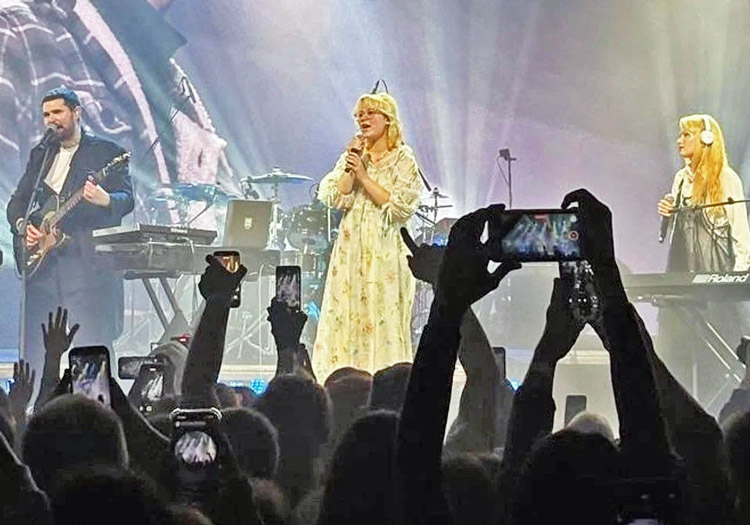
Two weeks after they left, at a concert in Lithuania, Loginova and Orlov sang with Noize MC and the exiled Russian singer Monetochka, so-called foreign agents whose music Stoptime had performed in St. Petersburg.
Russian riot police raided a punk music festival at a Moscow nightclub Jan. 6, forcing concertgoers to lie on the floor while their phones were checked for any opposition or pro-Ukraine material. Those with online anti-war links were pressed to sign contracts with the military. Any who resisted or had subscriptions to Ukrainian channels were beaten.