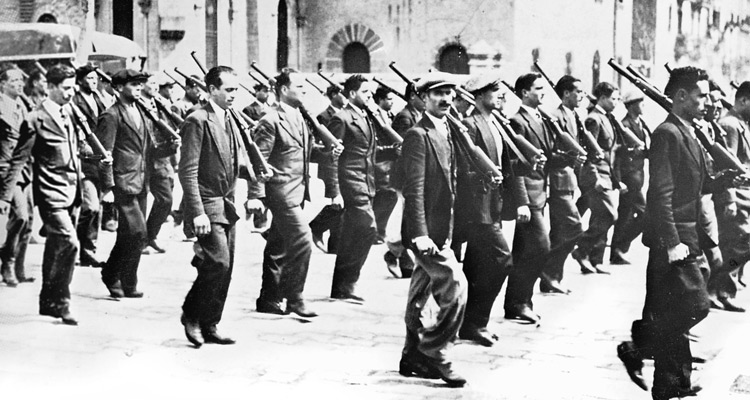
Revolution and Counter-Revolution in Spain by Felix Morrow is one of Pathfinder’s Books of the Month for January. The Spanish Revolution was an uprising by workers and peasants against Gen. Francisco Franco’s 1936 military coup, backed by landlords and capitalists. The reformist Socialist and Communist parties collaborated with bourgeois forces in a Popular Front coalition government. The republican side in the civil war, crippled by the lack of a revolutionary leadership to fight for a workers and farmers government, was defeated by Franco’s fascist forces in 1939. This made the outbreak of World War II inevitable. This excerpt, about events in July 1936, is from Chapter 7, “Counter-revolution and dual power.” Copyright © 1974 by Pathfinder Press. Reprinted by permission.
Rather than arm the workers — their allies in the People’s Front, who had put them into power! — [Manuel] Azaña and the republicans were preparing to make peace with the fascists, at the expense of the workers. Had Azaña carried out his plan, the fascists would have conquered Spain.
But in the very hours that the ministers huddled together in the presidential palace, the proletariat was already mobilizing. In Madrid itself the Socialist Youth militia was distributing its scant store of arms; was throwing up barricades on key streets and around the Montaña barracks; was organizing its patrols for house to house seizures of reactionaries; at midnight had launched the first attack on the barracks. In Barcelona … the C.N.T. [National Confederation of Labor] and P.O.U.M. (“Workers Party”) militants had stormed several government arms depots on the afternoon of the 18th. By the time the garrison revolted, at one the next morning, the armed workers had surrounded the troops in an iron ring, arming eager recruits with equipment seized from the fascists, and with whatever could be confiscated from the department stores; later the militia seized the regular arsenals.
The Asturian miners had outfitted a column of six thousand for a march on Madrid, before the ministerial crisis was well over. In Malaga, the strategic port opposite Morocco, the ingenious workers, unarmed, had surrounded the reactionary garrison with a wall of gasoline-fired houses and barricades. In Valencia, refused arms by the Madrid governor, the workers prepared to face the troops with barricades, cobble-stones and kitchen-knives — until their comrades within the garrison shot the officers and gave arms to the workers. In a word: without so much as a by your leave to the government, the proletariat had begun a war to the death against the fascists. [Catalan President Lluís] Companys and Azaña found themselves confronted by the first regiments of the Red Army of the Spanish proletariat.
The Azaña-Barrio scheme for a deal with the fascist generals collapsed because the workers had prevented it. And for no other reason! Thanks only to their utter distrust of the government, the masses were able to prevent their betrayal. Independent mobilization, under their own leadership, with their own banners — only this prevented the victory of fascism.
Thus it was that, side by side with the formal power still held by the government, there arose the “unofficial” but far more substantial power of the armed proletariat — the “dual power,” Lenin called it. One power, that of Azaña and Companys, was already too weak to challenge the existence of the other; the other, that of the armed proletariat, was not yet strong enough, not yet conscious enough of the necessity, to dispense with the existence of the other. The phenomenon of “dual power” has accompanied all proletarian revolutions; it signifies that the class struggle is about to reach the point where either one or the other must become undisputed master; it is a critical balancing of alternatives on a razor edge; a long period of equilibrium is out of the question, either one or the other must soon prevail!
The crushing of the counter-revolution will make infinitely more likely the establishment of a workers’ and peasants’ government. The interests of the bourgeoisie are not, therefore, served by a victory over the fascist generals: the true interests of Spanish capitalism lie in a victory of the counter-revolution or, what is the same thing, a compromise with it. That is why the People’s Front government behaved so treacherously in the first days of the counter-revolution. That is why the People’s Front government continued to behave treacherously thereafter. Surrounded by armed workers, the republicans dared not openly go over to the enemy; but their policy, at the front and in the rear, permitted the counter-revolution success after success. …
On July 30, only a few days after the struggle began, [Leon] Trotsky dealt … with the meaning of the Spanish events for France. …
“Certainly, the Spanish proletariat, like the French proletariat, does not want to remain disarmed before Mussolini and Hitler. But to defend themselves against these enemies it is first necessary to crush the enemy in one’s own country. … In every victorious counter-revolution, the officers have played the decisive role. Every victorious revolution that had a profound social character destroyed the old officers’ corps. This was the case in the Great French Revolution at the end of the eighteenth century, and this was the case in the October Revolution in 1917.
“To decide on such a measure one must stop crawling on one’s knees before the Radical bourgeoisie. A genuine alliance of workers and peasants must be created against the bourgeoisie, including the Radicals. One must have confidence in the strength, initiative and courage of the proletariat and the proletariat will know how to bring the soldier over to its side. This will be a genuine and not a fake alliance of workers, peasants and soldiers. This very alliance is being created and tempered right now in the fire of civil war in Spain. The victory of the people means the end of the People’s Front and the beginning of Soviet Spain. The victorious social revolution in Spain will inevitably spread out over the rest of Europe. For the Fascist hangmen of Italy and Germany it will be incomparably more terrible than all the diplomatic pacts and all the military alliances.”