Merchants of the Grand Bazaar of Tehran have called for nationwide actions Feb. 17, 18 and 19 to commemorate the thousands massacred across Iran by the reactionary capitalist regime during the recent wave of protests against its rule. Families in Iran traditionally hold commemorations for their loved ones 40 days after their death.
The merchants “invite the honorable people of Iran to simultaneously in their own cities keep the memory of those killed alive and continue the national uprising.” The “40th day is not the end,” the merchants said. “It is the beginning of our collective responsibility.”
In a Jan. 30 statement the Council for Organizing Protests of Contract Oil Workers said, “You will hear our cry of rage and protest at the commemorations for those who were killed while seeking rights and freedom.”
The protests began Dec. 28 when shopkeepers and capitalist traders at the Tehran bazaar shut their doors and took to the streets in the face of rising prices and steep declines in the value of Iran’s national currency.
Sections of the working class took advantage of the actions by the capitalist traders in the bazaar, who in the past had supported the regime, to broaden their own protests.
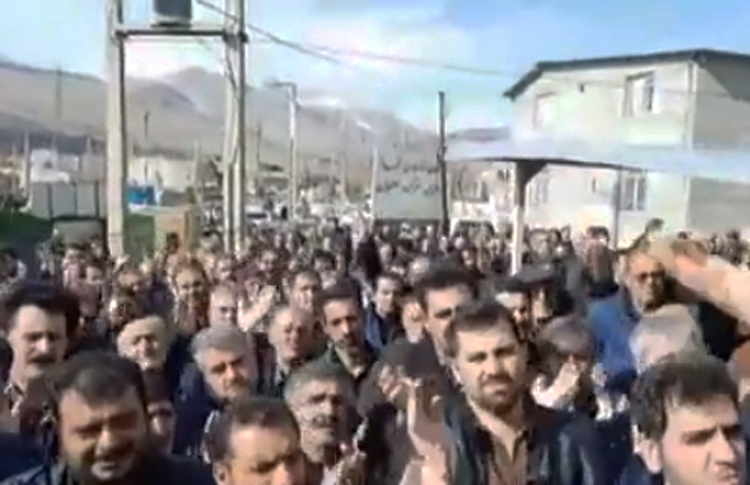
Demonstrations spread around the country to cities and towns large and small. Chants included “Death to the dictator!” “Freedom, freedom, freedom!” and “Not for Gaza, not for Lebanon; I give my life for Iran” — a reflection of the deep-seated opposition among working people to the regime’s deadly attacks on Israel and its other military adventures in the region. Oil workers in the south began to join the actions, as did oppressed nationalities, including Kurds, Baluchis, Arabs and Azerbaijanis.
Dozens were killed during the first week of demonstrations, before the regime unleashed its most murderous assaults Jan. 8 and 9, ending the protest wave for the moment. The Islamic Revolutionary Guard Corps, police, paramilitary thugs, and operatives brought in from Hezbollah in Lebanon and Tehran-organized militias in Iraq joined together in brutal assaults on protesters. Snipers, thugs with knives and clubs, and operatives with machine guns went on an orgy of killing.
Deepening hatred for the regime
Instead of demoralizing working people, the massacre deepened their resolve to fight to overturn the regime.
Funerals and the first 40-day commemorations for those killed in the first few days of the protests have already become anti-government actions, with hundreds chanting and dancing to celebrate the lives of those who were killed fighting for freedom. In some neighborhoods, photos of the dead are posted all over the streets.
The family of 27-year-old Saeed Tavakolian, killed in Shiraz Jan. 7, did not wait for the 40 days. They returned Feb. 8 to the site where he was shot, holding up his photo and tossing flowers into the street. Passing drivers honked in solidarity and some stopped to hug his mother.
Continuing arrests
Trying to quell the protest movement, the regime has been arresting members of the teachers unions, nurses, lawyers and others, often denying them their rights to a lawyer or to talk with their families.
Government spokesperson Fatemeh Mohajerani was challenged by a reporter during a live broadcast on state-run IRINN TV Jan. 27. Mohajerani claimed that it was “terrorists” backed by Iran’s enemies — a reference to Israel and Washington — who “distorted” the protests and caused the deaths.
Parisa Hashemi — a journalist with Ham-Mihan newspaper that was recently shut down by the regime — challenged Mohajerani.
“There is a lack of free and unfiltered access to information,” Hashemi said. “Discrimination runs rampant in every corner of the country, and poverty strikes everywhere.
“Now [the government] says that the enemy has destroyed our protests, massacred us, and caused the bloodshed. There is no doubt that whoever shot our youth, our children, and our men and women is, indeed, an enemy of this country.” No one could miss Hashemi’s meaning.
Cracks in the regime
The regime has been weakened by the blows Israel has dealt to it and its so-called axis of resistance since Hamas’ Oct. 7, 2023, pogrom, and by the growing resistance among working people. It’s also facing deepening divisions within the capitalist class.
Although there is an elected parliament and president in Iran, the real power that rules for the capitalist class is Supreme Leader Ali Khamenei.
A prominent leader of the reformist wing of the regime, Mir Hossein Mousavi, a presidential candidate in 2009 and a former prime minister, has been under house arrest since 2011. While calling for some democratic rights, this wing has always professed loyalty to the Supreme Leader.
In the wake of the latest massacre, Mousavi issued a statement calling on the regime to “lay down your guns and step aside from power.” He called for a constitutional referendum. The regime rapidly arrested three Mousavi advisors as well as Azar Mansouri, the head of the Reformist Front. Some regime supporters called for Mousavi’s execution.
Return of the monarchy?
Sections of the bourgeois press in the U.S. have been trying to pretty up Reza Pahlavi, the exiled son of the Shah of Iran, as a potential pro-Washington replacement for the regime. The brutal rule of the shah was overthrown in a deep-going popular revolution in 1979. The Wall Street Journal ran an article by U.S.-based Babek Seradjeh Feb. 8 headlined “I Was Born in the Shah’s prison. Now I Support His Son.”
The Union Retirees Group of Iran noted that the U.S.-backed shah’s rule in Iran was “always dictatorial, repressive, and predatory.” If Reza Pahlavi came to power, it explains, “the plunder of the people of Iran would be repeated with cruelty and savagery many times over.”
Despite the de facto martial law in parts of the country and the threat of more repression, workers keep looking for ways to fight for their own interests.
Even though a number of oil workers in the region have been arrested in the wake of the protests, contract workers at the 10th Refinery of the South Pars Gas Complex went on strike Feb. 3 over unpaid wages and poor conditions in their housing, including severe overcrowding.
The Council for Organizing Protests of Contract Oil Workers issued a statement Feb. 9 calling for solidarity with the strike. It noted that many co-workers “are being held in prison under very harsh conditions and deprived of any contact or phone calls with their families.” The council demands “their immediate and unconditional release.”