
Four years into its invasion of Ukraine, Russian President Vladimir Putin’s regime has intensified its bombardment of energy generation facilities to deny heat, water and electricity to punish and attempt to demoralize Ukraine’s civilian population. But this has just fortified the resolve of working people there to defend the country’s sovereignty.
Moscow’s relentless assaults have depleted Ukraine’s air defense missile stocks. The country’s defense industry has now developed a low-cost drone interceptor system designed to nimbly and effectively limit the damage. But enough airstrikes get through to do serious harm. Repair crews from around the country work in freezing conditions to restore power.
Kyiv’s electricity supply is now limited to a few hours per day. At one point over 1,600 high-rise buildings, which house as many as 800,000 people, lost power and central heating after Moscow’s missiles destroyed one of Kyiv’s largest combined generating and heat plants.
The Kyiv Post reported Jan. 27 on a visit to a tent camp in the city’s Troieshchyna district. The emergency services set it up to provide people there with shelter, heat and comradeship in subzero temperatures.
Hundreds of people go to warm up and meet neighbors. Children play games. They can also get hot drinks and meals, charge their phones and work on their laptops. Student volunteers help to keep watch.
Ukraine union youth council appeal
“Bombed cities, freezing homes — a call to trade unions to stand with Ukraine” was the headline of a Feb. 2 statement by the Youth Council of the Federation of Trade Unions of Ukraine.
“No electricity. No heating. No water. Children trying to sleep fully dressed under several blankets. Hospitals running on generators — until the fuel runs out,” the Youth Council reported.
“This is not a natural disaster or a technical failure” but a deliberate strategy “executed by one state against another’s people.”
Disruption to power networks extended beyond Ukraine, the council noted. “Blackouts were recorded in parts of Moldova and Romania.”
The statement paid tribute to “soldiers holding the front at the cost of their lives. Energy workers, medics, rescuers, utility workers restoring what is destroyed — again and again, under fire and enormous risk.”
It noted that Moscow is “attacking railways and national logistics, putting workers under fire, killing them and cutting lifelines for millions of people.
“But Ukraine is still standing. Because its people refuse to break.”
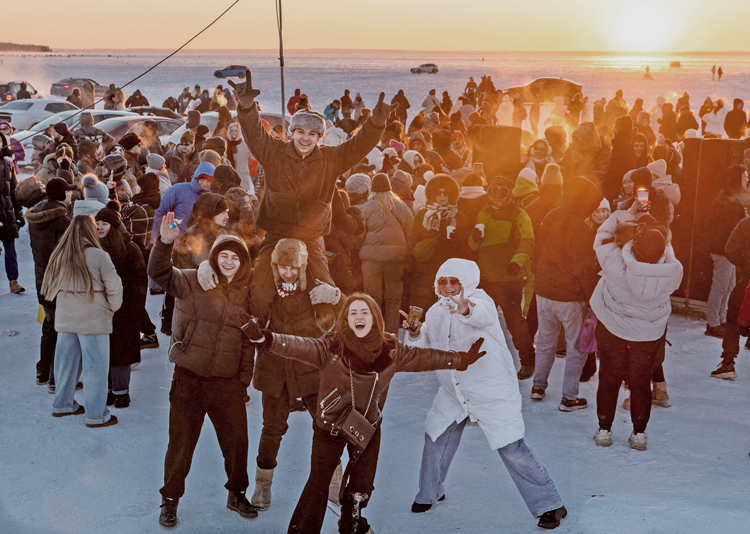
At sunset on the frozen-over Dnipro River in Kyiv, people were dancing, racing cars and having barbecues, National Public Radio reported Feb. 5. One dance party on the iced-over river had a DJ and generator-powered sound system, creating a rave on ice.
Zhenia Chypiha told NPR that it helps “to have fun in such dark moments of our life.” She described Moscow’s efforts to make Ukrainians’ lives so miserable that they will supposedly agree to end the war on Putin’s terms.
“They think they will bomb power plants and we will leave. But no, it doesn’t work like that,” she said.
People don’t have power or water but, “it’s negative 20 degrees and they are out here partying,” Farhad Ostovari told NPR. Ostovari came from Washington, D.C., to work in Kyiv helping wounded Ukrainian veterans.
DJ Vitalii Svitchynskyi said the parties are an act of resistance. He wants to give energy to people who “will never give up.”
Ukrainians seek culture in wartime
As Moscow bombards Ukraine’s power grid, performances at packed concert halls and on underground stages are taking place. Museums, galleries and bookshops are open.
“Culture during wartime is not a luxury. It strengthens, unites, shapes memory and works toward future recovery,” Myroslava Makarevych wrote in the Jan. 21 Kyiv Post.
Makarevych interviewed Oksana Lyniv, an acclaimed Ukrainian conductor. She has been denounced by some for conducting music by Russian composer Peter Tchaikovsky. Makarevych asked Lyniv why she opposes the Ukrainian government’s calls to boycott Russian culture.
Lyniv has explained that performing works by Russians shouldn’t be considered “siding with the enemy.”
“The works of Tchaikovsky, Prokofiev, etc., stand alongside the works of Berlioz, Chopin, Brahms, Beethoven, Ravel,” and other great composers. They’re a “mandatory repertoire that every professional musician should master,” she said.
“It’s akin to our defenders on the front lines seizing the enemy’s weapons and using them to reclaim new territories,” Lyniv said.
For Ukrainian working people, calls to boycott Russian culture only create barriers to forging ties with the most important potential allies in their fight against the Putin regime’s attempt to conquer Ukraine — fellow workers in Russia.