US rulers escalate their attacks against Cuba
Over the last week, the U.S. rulers launched a dangerous escalation of threats against Cuba. CIA Director John Ratcliffe went to the island “to deliver a message” to the Cuban government; U.S. spy planes have reportedly increased flights near Cuba; and the U.S. Department of Justice announced it was considering the indictment of Cuban leader Raúl Castro. All this, as the White House widened sanctions and continues to strangle the Cuban people with an oil blockade.
At Washington’s request, Ratcliffe met with Cuba’s interior minister and other officials in Havana May 14, and, according to “unnamed” CIA officials cited in the U.S. press, told them the Donald Trump administration would only “seriously engage” in talks if Havana “makes fundamental changes.” The U.S. rulers, however, are not looking for “changes,” they are seeking to overthrow Cuba’s socialist revolution.
Washington then ratcheted up its threats of military action further, leaking an “exclusive” story to Axios May 17, claiming Cuba has acquired some 300 military drones from Iran and Russia and is preparing to use them to attack “the U.S. base at Guantánamo Bay, U.S. military vessels and possibly Key West, Fla.”
“Without any legitimate excuse, the U.S. government is building, day after day, a fraudulent case to justify the ruthless economic war against the Cuban people and eventual military aggression,” responded Cuban Foreign Minister Bruno Rodríguez. “Specific media outlets are playing into their hands, promoting slander and leaking insinuations from the U.S. government itself.”
“The U.S. is the aggressor,” added Carlos Fernández de Cossío, Cuba’s deputy minister of foreign affairs.
The Cuban government released a statement after the meeting with Ratcliffe saying Cuba “is not a threat to U.S. national security, and there are no legitimate reasons to include it in the list of states that supposedly sponsor terrorism.”
Once again, the statement said, Cuba “does not host, support, finance, or allow terrorist or extremist organizations; and that there are no foreign military or intelligence bases in its territory.” It has “never supported nor will it permit any hostile action against the United States from Cuba.”
“Nobody in Cuba has ever threatened to place an aircraft carrier, a frigate, or a battleship off of the U.S. coastline,” Fernández de Cossío said May 13. “There is no action or measure taken by the Cuban government aimed at damaging the standard of living, well-being, and income of the people of the United States. This is in contrast to the ruthless economic war that the U.S. government is carrying out as collective punishment against the Cuban nation and people.”
At the same time, the Department of Justice resurrected a decades-old slander accusing the Cuban government of shooting down over international waters two planes flown by the Miami-based counterrevolutionary group Brothers to the Rescue in 1996. In fact, after numerous earlier warnings, the planes were shot down by Cuba after they repeatedly violated the island’s airspace. Washington charges Raúl Castro, who was minister of defense at the time, with giving the order.
No oil reserves left
The same day Ratcliffe was in Cuba, Cuban Minister of Energy Vicente de la O Levy reported there was no fuel oil or diesel reserves left to run the country’s electrical system. Levy said the difficult situation Cuba has faced over the last few months has worsened.
With the exception of one Russian oil tanker that delivered fuel to Cuba in March, Washington’s threat of imposing harsh tariffs on any country that sells or provides oil to Cuba has succeeded in preventing any other deliveries. Despite Cuba’s appeals to “buy oil from any country that would sell it,” no government has stepped forward to challenge Washington’s violation of Cuba’s sovereignty.
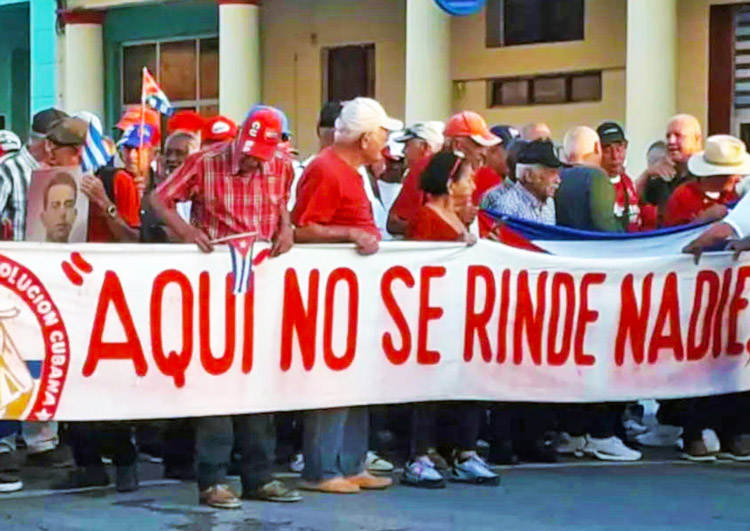
The U.S. rulers’ goal is to create desperate conditions for the Cuban people, hoping to provoke a social explosion against the government, which they have utterly failed to do. While there have been periodic small nightly protests against the prolonged electrical blackouts and their effects on the population, most Cubans see the U.S. oil blockade as the primary source of the crisis.
On May 13 Secretary of State Marco Rubio accused the Cuban government of refusing a U.S. offer to provide $100 million in “direct humanitarian assistance” to the Cuban people, to be distributed in coordination with the Catholic Church.
“Even taking into account the incongruity of this apparent generosity from a party that subjects the Cuban people to collective punishment through an economic war,” Cuba’s embassy in Washington responded the next day, Cuba “does not, as a matter of practice, reject foreign aid offered in good faith and with genuine aims of cooperation.”
The best assistance “the U.S. government could provide to the noble Cuban people at this time — and at any time — is to deescalate the energy, economic, commercial, and financial blockade measures.”