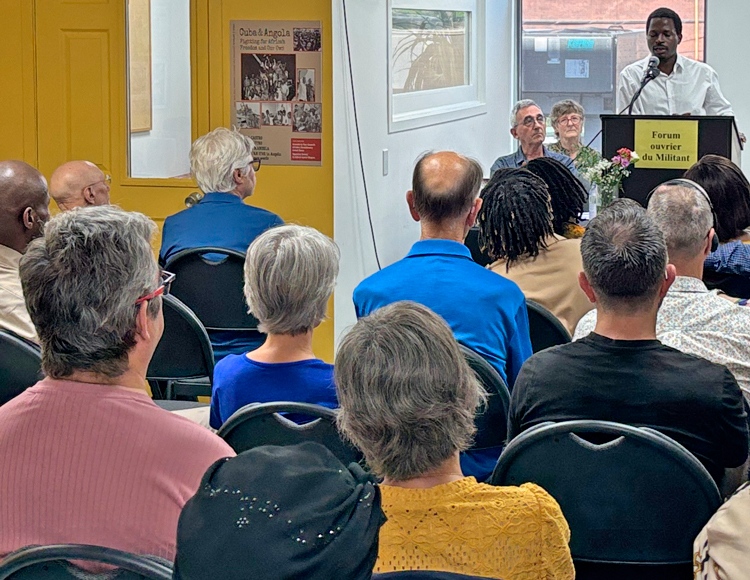
MONTREAL — Thirty-four people attended a special June 28 Militant Labor Forum here to celebrate the publication in French of Cuba and the Independence War in Guinea-Bissau and Cape Verde: The Fall of the Last Colonial Empire in Africa by Cuban revolutionary Víctor Dreke.
The speakers were Idris Diallo, a leader of the National Front for the Defense of the Constitution (of Guinea-Conakry), and Katy LeRougetel, who had participated in the launch of the book in Havana earlier this year and is a member of the Communist League.
Among the forum participants were eight people from Africa, many of whom had already read the book.
Dreke had been the commander of the Cubans who fought alongside the independence fighters in Guinea-Bissau and led the Cuban volunteers who helped train newly formed militias in neighboring Guinea-Conakry.
Diallo described Amílcar Cabral, the central leader of the African Party for the Independence of Guinea and Cape Verde (PAIGC), who was assassinated in 1973 by an operation led by the Portuguese intelligence service just months before the independence forces were victorious.
“Seeing firsthand the suffering of Portuguese working people while he was studying in Portugal,” Diallo said, “Cabral learned that the oppressor was the same in Europe, in America and in Africa.
“In 1964 Cabral met Che Guevara, a leader of the Cuban Revolution,” Diallo said. “The Cubans didn’t come to Africa to impose their domination but to listen and to help.
“Cabral understood the importance of working with all the different ethnic communities. He said we are all Africans, with varied languages and cultures. The Portuguese try to divide us. We have to overcome these divisions,” Diallo said. “The Portuguese prisoners played football together with their Guinean captors. Cabral understood they were peasants forced to make war.”
“Before the fight began, women had practically no social role. The PAIGC combatants abolished forced marriage and the dowry. Women were a full part of the independence struggle.” Like Thomas Sankara, the leader of the 1983-87 revolution in Burkina Faso, Cabral understood there could be no successful revolution without the involvement and mobilization of women.
LeRougetel stressed the importance of ongoing public actions to defend Cuba today, under attack by Washington with the complicity of Ottawa. Michel Prairie, the forum’s chairperson, urged everyone to join a June 30 picket line in Montreal against these attacks.
“In May delegates of the Canadian Labour Congress, the biggest union organization in the country, met and adopted a resolution condemning the U.S.-led blockade and demanding action by the Canadian government to support Cuba,” LeRougetel said.
“When I was in Cuba in February, we saw the effects of Washington’s criminal blockade, and it’s worse now — blackouts at any time, food going bad, people walking everywhere because lack of fuel stopped all public transportation, the devastating effect on health care,” she said. “The Canadian government participates fully in the blockade. All flights from Canada to Cuba are cut off, hotel chains are closed. These are very big and deliberate blows to tourism from Canada, a key source of hard currency for Cuba.
“In 1970 the only colonial empire still standing in Africa was the oldest, that of Portugal, which lasted nearly 500 years. In Dreke’s book we learn how working people there made it fall, and about the decisive support of the Cuban revolutionaries. The struggle not only triggered the fall of Portugal’s empire in Africa but also the end of the fascist dictatorship at home,” LeRougetel said.
“We learn what kind of leadership it takes to win. This is what has allowed the Cuban Revolution to survive and contribute to the victories described in these pages. And this is what we seek to do in building the Communist League, forging the revolutionary party that workers need to take political power in Canada.”
Cuba’s role
“The participation of Cubans in the liberation of Africa was totally voluntary,” Anna Ramirez, coordinator of the Association of Cubans Resident in Montreal, said in the discussion. “They came not to exploit, but because it was their duty.”
Diallo said Cuba sent 425,000 volunteers to Angola to participate in the fight against the invasions by the U.S.-backed South African army. “The Cubans were not looking for plunder and wealth, and left only with their dead and wounded.”
He said Cabral opposed committing atrocities in the name of the struggle. “We don’t want a bloodthirsty people, shedding blood for the sake of it. If blood is to be shed, it is for a political reason, to serve the future of our country,” Cabral had said.
“Today workers around the world are defending ourselves from attacks by the bosses and their governments, as they march humanity toward a third world war,” LeRougetel said. “Cuba’s socialist revolution is an example for working people everywhere fighting for a better world, built on humanity and solidarity, not dog-eat-dog capitalist competition and war. We need to build more meetings like this to discuss the lessons this book provides as a guide for action in today’s world.”