The Spanish edition of Revolution and the Road to Peace in Colombia: The Example of the Cuban Revolution by Fidel Castro is one of Pathfinder’s Books of the Month for July. The selection, “For revolutionaries victory in war depends on a minimum of weapons and a maximum of moral values,” takes up key lessons of Cuba’s fight for power. It comes from an Aug. 19, 1958, Radio Rebelde broadcast by Castro from the Sierra Maestra mountains, the rebel army’s station during the revolutionary war against the U.S.-backed Batista tyranny. Copyright © 2025 by Pathfinder Press. Reprinted by permission.
The wounded and all other prisoners have been released without conditions. It might seem illogical to free enemy prisoners in the midst of a war. That depends on what kind of war it is, and the concept one has of the war.
War requires a policy toward the adversary as well as a policy toward the civilian population. War is not simply a question of rifles, bullets, artillery, and planes. Maybe that belief of ours is one of the reasons for the failure of the tyranny’s forces.
Our apostle José Martí said that what matters is not the number of weapons in hand but the number of stars on one’s forehead. Those words might have seemed merely poetic — but they have proved to be a profound truth for us.
From the moment of the Granma landing, we carried out an unwavering line of conduct regarding treatment of the adversary. Very seldom in history, perhaps, has anyone adhered to that line of conduct as rigorously as we have.
Since the first battle at La Plata on January 17, 1957, to the last battle at Las Mercedes in early August [1958], more than six hundred members of the armed forces have been captured just by the Rebel Army front in the Sierra Maestra.
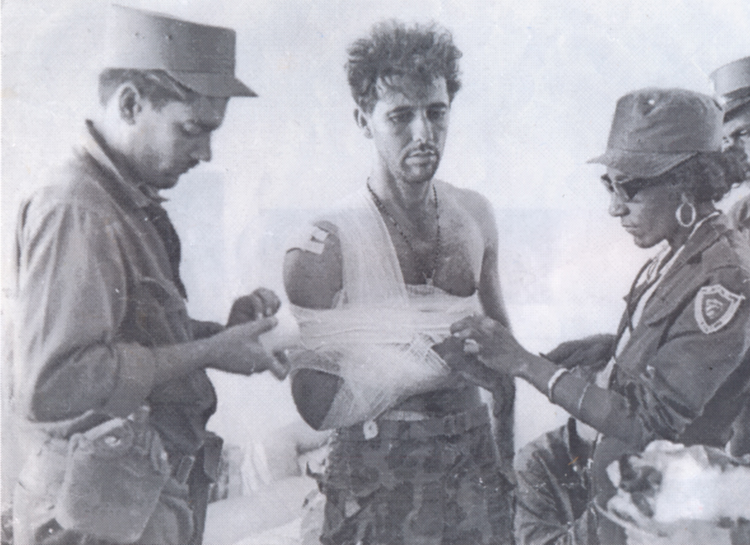
With the legitimate pride of those who follow ethical norms, we can say that, without exception, Rebel Army combatants have followed its laws regarding prisoners. No prisoner’s life has ever been taken. No wounded soldier has ever been left without medical attention.
But we can say more: No prisoner has ever been beaten. And furthermore: No prisoner has ever been insulted or humiliated.
Every officer whom we’ve taken prisoner can testify to the fact that none was subjected to interrogations, because of our respect for them as human beings and as soldiers.
The victories won by our weapons — without murdering, torturing, or even interrogating an adversary — demonstrate that no affront to human dignity can ever be justified. This attitude has been maintained over twenty months of combat and more than a hundred clashes and battles. It speaks for itself about the conduct of the Rebel Army. Today, in the midst of human passions, this record is valued less than it will be when the history of the revolution is written.
In the human sense, the fact that we follow this line right now, when we are stronger, is not as commendable as it was earlier, when we were a handful of men hunted down like animals in the rugged mountains. It was then … that respecting the lives of prisoners had a deep moral significance.
If the forces of the tyranny had respected the lives of adversaries who fell into their hands, even this record would have been nothing more than an elementary duty of reciprocity. But to the contrary, torture and death were the certain fate that awaited any rebel, any sympathizer of our cause, or anyone simply suspected of supporting our cause who fell into enemy hands.
In many cases, unfortunate peasants were murdered in order to pile up corpses that could justify the fake reports of the tyranny’s high command. For our part, we can state truthfully that the six hundred members of the armed forces who at some point were in our hands remain alive and are with their families today. In contrast, the dictatorship would have to say that more than six hundred defenseless compatriots, in many cases individuals not involved in any revolutionary activity, were murdered by its forces during those twenty months of war. Killing does not make anyone stronger.
Killing has made them weaker. Not killing has made us stronger.
Why don’t we murder the soldiers we capture?
First, because only cowards and thugs murder an enemy who has surrendered.
Second, because the Rebel Army cannot fall into the same practices as the tyranny it is fighting against.
Third, because the dictatorship’s policy and propaganda have essentially consisted of portraying revolutionaries as sworn ruthless enemies of every man wearing the uniform of the armed forces.
Through lies and deceit, the dictatorship has made every effort to get soldiers to identify with the regime, to make them believe that by fighting against the revolution they are fighting for their careers and their own lives. It would suit the dictatorship better if we didn’t treat the wounded, if we didn’t respect the lives of prisoners, if instead we murdered them all without exception. Then the tyranny might convince every member of the armed forces that they must fight to the last drop of blood.
Fourth, because acts of cruelty are stupid in any war, and even more so in a civil war, where those engaged in fighting will some day have to live side by side with each other — where perpetrators will have to face the children, wives, and mothers of their victims.
Fifth, because for the generations to come, we must counterpose the inspiring and edifying example our combatants are setting to the shameful and depressing actions taken by the dictatorship’s torturers and assassins.
Sixth, because we need to plant today the seeds of fraternity that must prevail in the future homeland we are building for all and for the good of all. If those who fight squarely prove capable of respecting the life of an adversary who surrenders, then tomorrow, during peacetime, no one will feel entitled to commit acts of vengeance or political crimes.